







Question: Take the data provided below and do the following Data from the Bureau of Standards (J. Phys. Chem. Ref. Data, vol. 11, suppl. 2, 1982)
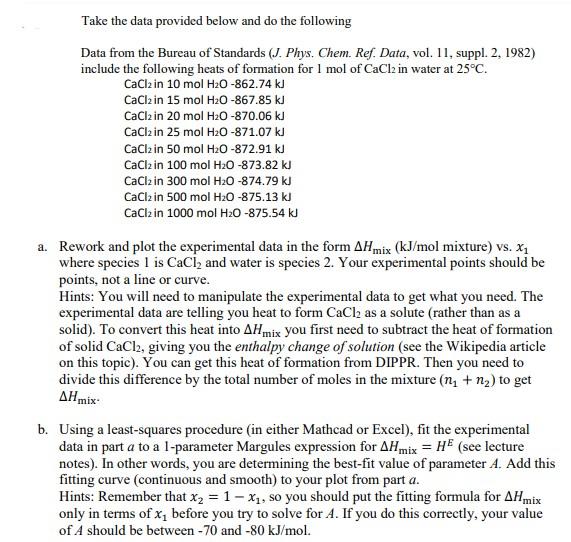
Take the data provided below and do the following Data from the Bureau of Standards (J. Phys. Chem. Ref. Data, vol. 11, suppl. 2, 1982) include the following heats of formation for 1 mol of CaCl2 in water at 25C. CaCl2 in 10 mol H20-862.74 kJ CaCl2 in 15 mol H20-867.85 kJ CaCl2 in 20 mol H20-870.06 kJ CaCl2 in 25 mol H20-871.07 kJ CaCl2 in 50 mol H20-872.91 kJ CaCl2 in 100 mol H20-873.82 kJ CaCl2 in 300 mol H20-874.79 kJ CaCl2 in 500 mol H20-875.13 kJ CaCl2 in 1000 mol H20-875.54 kJ a. Rework and plot the experimental data in the form AH mix (kJ/mol mixture) vs. X where species 1 is CaCl, and water is species 2. Your experimental points should be points, not a line or curve. Hints: You will need to manipulate the experimental data to get what you need. The experimental data are telling you heat to form CaCl2 as a solute (rather than as a solid). To convert this heat into AH mix you first need to subtract the heat of formation of solid CaCl2, giving you the enthalpy change of solution (see the Wikipedia article on this topic). You can get this heat of formation from DIPPR. Then you need to divide this difference by the total number of moles in the mixture (ni +n2) to get AH mix b. Using a least-squares procedure (in either Mathcad or Excel), fit the experimental data in part a to a 1-parameter Margules expression for AH mix = H (see lecture notes). In other words, you are determining the best-fit value of parameter A. Add this fitting curve (continuous and smooth) to your plot from part a. Hints: Remember that X2 = 1 - X, so you should put the fitting formula for AH.nix only in terms of x before you try to solve for A. If you do this correctly, your value of A should be between - 70 and -80 kJ/mol
Step by Step Solution
There are 3 Steps involved in it

Get step-by-step solutions from verified subject matter experts
 Study Help