







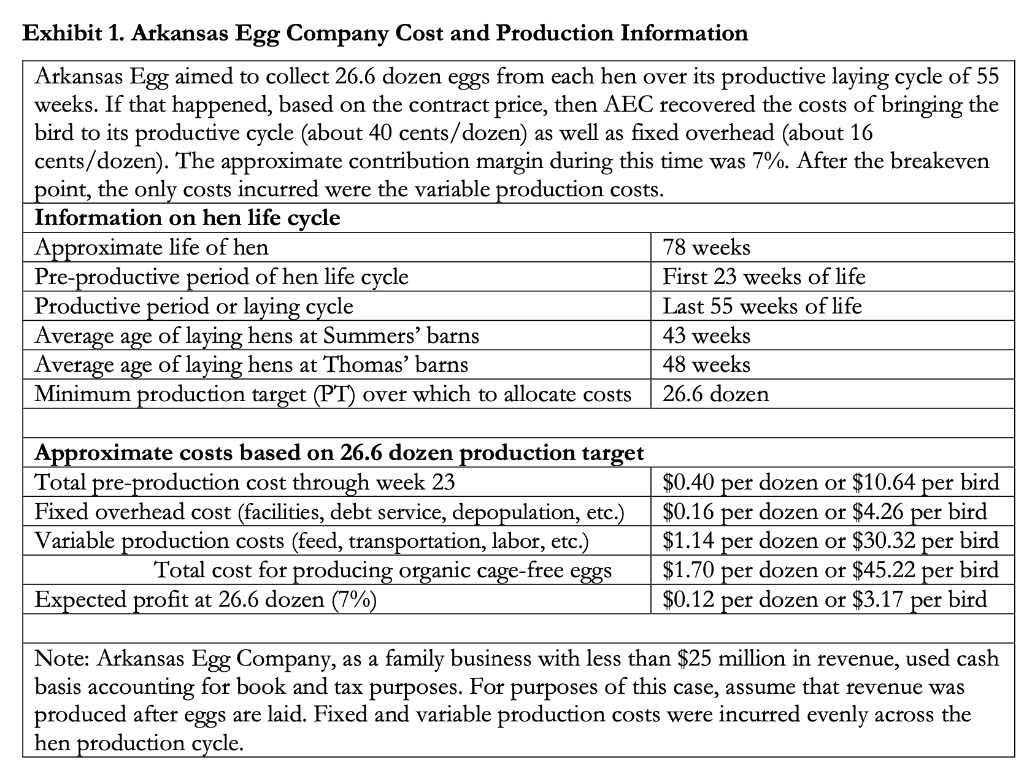
Question: Taking into account the data in Exhibit 1, prepare a table that calculates when a hen is spent under normal conditions such as the CCF
- Taking into account the data in Exhibit 1, prepare a table that calculates when a hen is spent under normal conditions such as the CCF Brands contract, or that could be used to decide when it is no longer profitable to continue egg production. That is, create a model with formulas for which you can easily vary inputs, such as price, profit, or variable costs (such as in question 2 below). Use the output template provided below. (Hint: Distinguish between relevant and non-relevant costs. Determine the estimated revenue per dozen and weekly production costs first.)
|
Week(s) A | # Eggs per Hen/Week |
# Weeks C | Dozen Eggs Laid B | Marginal Costs D ( | Marginal Revenue | Contribution to Profit |
| 1-23 | n/a | 23 | 0 | $(10.64) | $0 | $(10.64) |
| 24 | 3 | 1 | 0.25 |
|
|
|
| 25 | 4 | 1 | 0.33 |
|
|
|
| 26 | 5 | 1 | 0.42 |
|
|
|
| 27-28 | 6 | 2 | 1.00 |
|
|
|
| 29-39 | 7 | 11 | 6.42 |
|
|
|
| 40-64 | 6 | 25 | 12.50 |
|
|
|
| 65-76 | 5 | 12 | 5.00 |
|
|
|
| 77 | 4 | 1 | 0.33 |
|
|
|
| 78 | 3 | 1 | 0.25 |
|
|
|
- Based on the model that you developed in question 1, and assuming that hens are already laying, how sensitive is the model to changes in expected contract profit? In variable costs? What course of action does the model indicate should be taken when contribution margin is negative?
- Using data in Exhibit 1, calculate Coxs break-even point in sales dollars (per hen). Taking into account his cumulative revenue for a hen, during which week (approximately) will the break-even point occur? (Hint, consider the pre-production costs as fixed for this calculation.)
- Calculate Coxs investment in the 130,000 hens. Given the average age of the hens at the Summers barns and the Thomas barns and the break-even analysis, how should Cox use this information in his decision on what to do about losing the CCF Brands contract?
Exhibit 1. Arkansas Egg Company Cost and Production Information Arkansas Egg aimed to collect 26.6 dozen eggs from each hen over its productive laying cycle of 55 weeks. If that happened, based on the contract price, then AEC recovered the costs of bringing the bird to its productive cycle (about 40 cents/dozen) as well as fixed overhead (about 16 cents/dozen). The approximate contribution margin during this time was 7%. After the breakeven point, the only costs incurred were the variable production costs. Note: Arkansas Egg Company, as a family business with less than $25 million in revenue, used cash basis accounting for book and tax purposes. For purposes of this case, assume that revenue was produced after eggs are laid. Fixed and variable production costs were incurred evenly across the hen production cycle
Step by Step Solution
There are 3 Steps involved in it

Get step-by-step solutions from verified subject matter experts
 Study Help