







Question: Task 1 (50 pts). Implement the bellman ford(int s) function as discussed in Lecture 19 in JAVA. Task 2 (50 pts). Implement the dijkstra(int s)
Task 1 (50 pts). Implement the bellman ford(int s) function as discussed in Lecture 19 in JAVA.
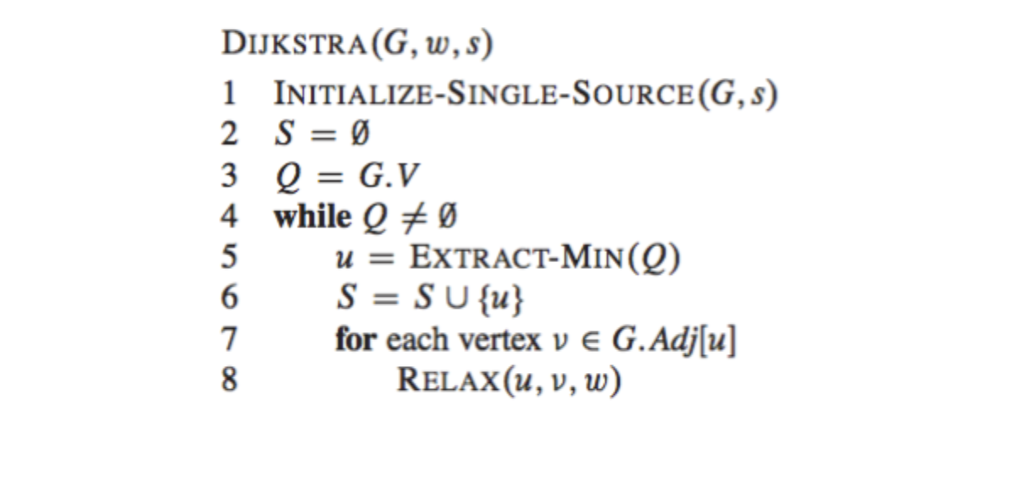
Task 2 (50 pts). Implement the dijkstra(int s) function as discussed in Lecture 20.
Hint 1: We use an adjacent matrix to represent the graph. If A[i][j] = 0, it means there is no edge between the i-th and j-th node. If A[i][j] 6= 0, then it means the weight of the edge between the i-th and j-th node. Hint 2: You do not need to do any operation for the variable in the pseudocode in Task 1 and Task 2.
Task 3 (50 pts (Extra Credit)). Implement a function to organize the shortest path for each node as a string.
Below is the psescode, and skeleton code to modify for the above question/solution.
public class Graph3 {
int n;
int[][] A;
int[] d; //shortest distance
/**
* @param args
*/
public Graph3 () {
}
public Graph3 (int _n, int[][] _A) {
n = _n;
A = _A;
d = new int[n];
}
public void initialize_single_source(int s) {
for (int i = 0; i
d[i] = Integer.MAX_VALUE;
d[s] = 0;
}
public void relax (int u, int v) {
if (d[v] > (d[u] + A[u][v]))
d[v] = d[u] + A[u][v];
}
public boolean bellman_ford (int s) {
//fill in your program
}
public void dijkstra (int s) {
//fill in your program
}
public void display_distance () {
for (int i = 0; i
System.out.println(i + ": " + d[i]);
}
public static void main(String[] args) {
// TODO Auto-generated method stub
int n = 5;
int[][] A = {
{0, 6, 0, 7, 0},
{0, 0, 5, 8, -4},
{0, -2, 0, 0, 0},
{0, 0, -3, 0, 9},
{2, 0, 7, 0, 0}
};
Graph3 g1 = new Graph3(n, A);
g1.bellman_ford(0);
g1.display_distance();
System.out.println("-----------------------");
int[][] B = {
{0, 10, 0, 5, 0},
{0, 0, 1, 2, 0},
{0, 0, 0, 0, 4},
{0, 3, 9, 0, 2},
{7, 0, 6, 0, 0}
};
Graph3 g2 = new Graph3(n, B);
g2.dijkstra(0);
g2.display_distance();
}
}
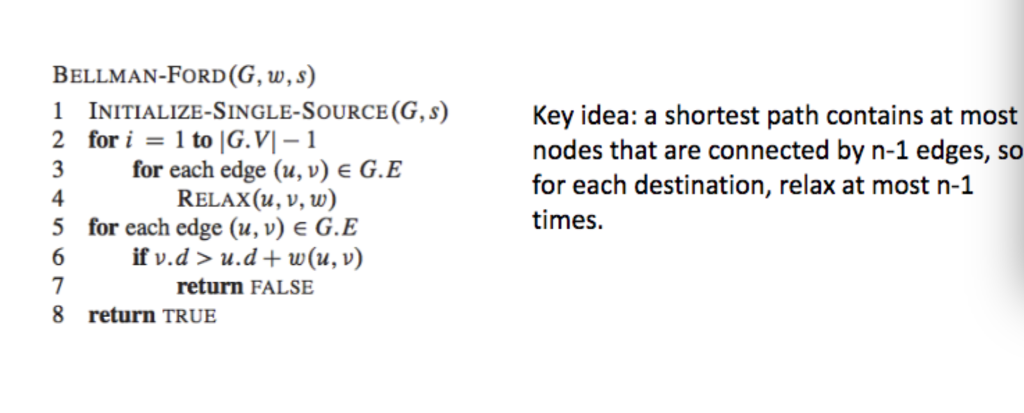
BELLMAN-FORD(G, w,s) INITIALzE-SINGLE-SoURCE(G,s)Key idea: a shortest path contains at most for i= l tolG.VI-1 1 2 3 4 5 nodes that are connected by n-1 edges, so for each destination, relax at most n-1 times. for each edge (u, v) e G.E RELAX(u, v, w) for each edge (u, v) E G.E return FALSE 8 return TRUE
Step by Step Solution
There are 3 Steps involved in it

Get step-by-step solutions from verified subject matter experts
 Study Help