







Question: Task 1: e can represent any number in scientific notation. In decimal 3598286723 3.598286723 x 03.598 x 10 Here, 3.598 is the mantissa and 9
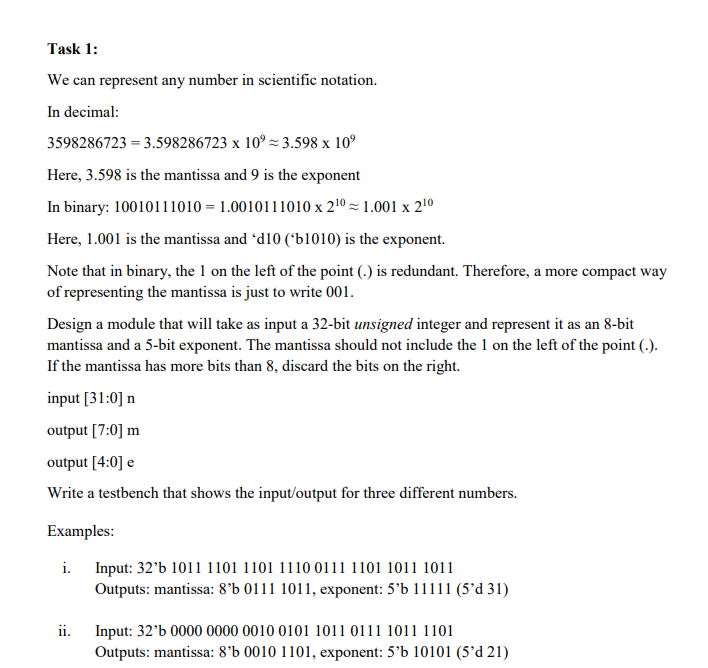
Task 1: e can represent any number in scientific notation. In decimal 3598286723 3.598286723 x 03.598 x 10 Here, 3.598 is the mantissa and 9 is the exponent In binary: 10010111010 1.0010111010 x 210~ 1.001 x 210 Here, 1.001 is the mantissa and 'd10 ('b1010) is the exponent. Note that in binary, the 1 on the left of the point (.) is redundant. Therefore, a more compact way of representing the mantissa is just to write 001 Design a module that will take as input a 32-bit unsigned integer and represent it as an 8-bit mantissa and a 5-bit exponent. The mantissa should not include the 1 on the left of the point (.) If the mantissa has more bits than 8, discard the bits on the right. input [31:0] n output [7:0] m output [4:0] e Write a testbench that shows the input/output for three different numbers. Examples i. Input: 32'b 1011 1101 1101 1110011 1101 1011 1011 ii. Input: 32'b 0000 0000 0010 0101 1011 0111 1011 1101 Outputs: mantissa: 8'b 0010 1101, exponent: 5'b 10101 (5'd 21)
Step by Step Solution
There are 3 Steps involved in it

Get step-by-step solutions from verified subject matter experts
 Study Help