







Question: TASK 10: Security application key-codes. Four logic bits can produce 16 distinct combinations, which correspond to the 4-bit codes 0000 to 1111. Devise a means
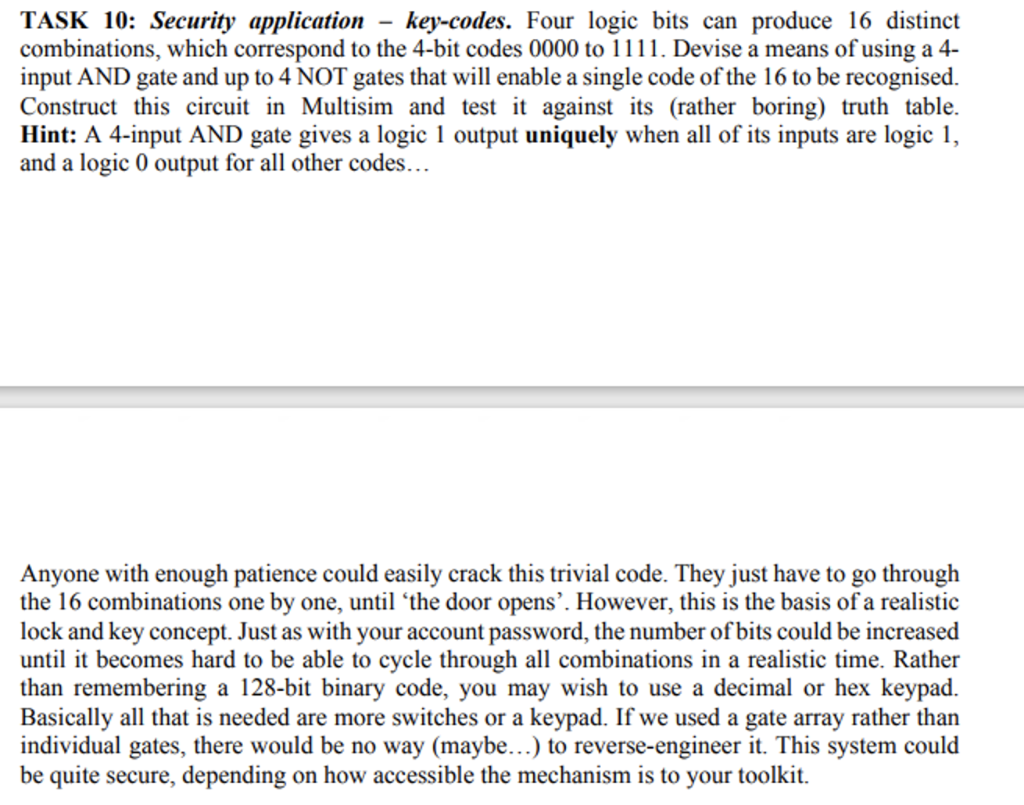
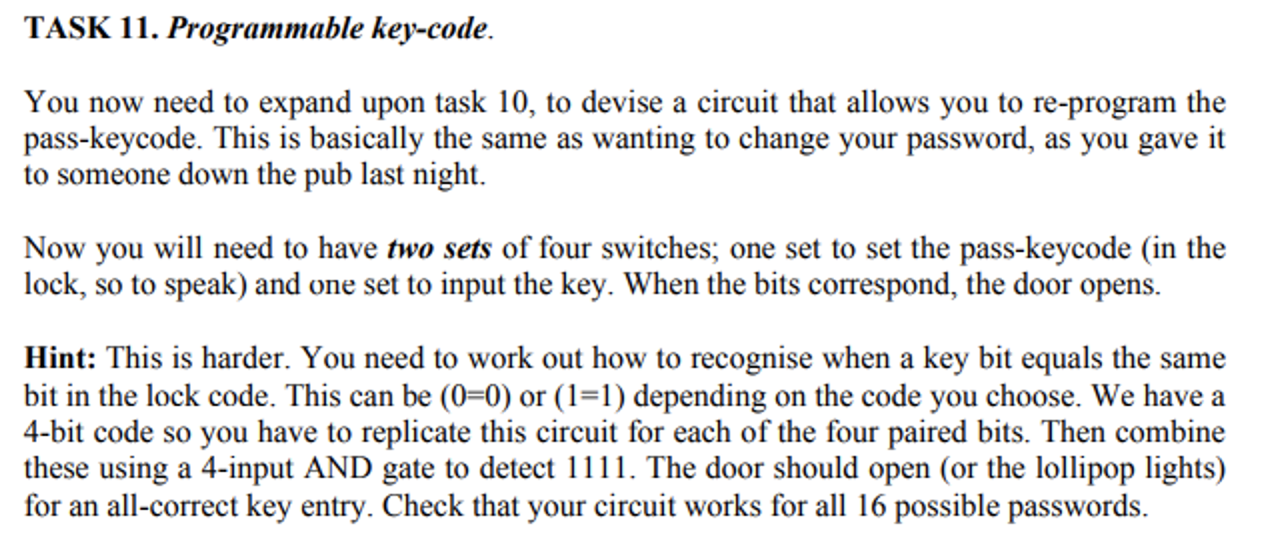
TASK 10: Security application key-codes. Four logic bits can produce 16 distinct combinations, which correspond to the 4-bit codes 0000 to 1111. Devise a means of using a 4- input AND gate and up to 4 NOT gates that will enable a single code of the 16 to be recognised. Construct this circuit in Multisim and test it against its (rather boring) truth table. Hint: A 4-input AND gate gives a logic 1 output uniquely when all of its inputs are logic 1, and a logic 0 output for all other codes... Anyone with enough patience could easily crack this trivial code. They just have to go through the 16 combinations one by one, until the door opens'. However, this is the basis of a realistic lock and key concept. Just as with your account password, the number of bits could be increased until it becomes hard to be able to cycle through all combinations in a realistic time. Rather than remembering a 128-bit binary code, you may wish to use a decimal or hex keypad. Basically all that is needed are more switches or a keypad. If we used a gate array rather than individual gates, there would be no way (maybe...) to reverse-engineer it. This system could be quite secure, depending on how accessible the mechanism is to your toolkit. TASK 11. Programmable key-code. You now need to expand upon task 10, to devise a circuit that allows you to re-program the pass-keycode. This is basically the same as wanting to change your password, as you gave it to someone down the pub last night. Now you will need to have two sets of four switches; one set to set the pass-keycode (in the lock, so to speak) and one set to input the key. When the bits correspond, the door opens. Hint: This is harder. You need to work out how to recognise when a key bit equals the same bit in the lock code. This can be (0=0) or (1=1) depending on the code you choose. We have a 4-bit code so you have to replicate this circuit for each of the four paired bits. Then combine these using a 4-input AND gate to detect 1111. The door should open (or the lollipop lights) for an all-correct key entry. Check that your circuit works for all 16 possible passwords. TASK 10: Security application key-codes. Four logic bits can produce 16 distinct combinations, which correspond to the 4-bit codes 0000 to 1111. Devise a means of using a 4- input AND gate and up to 4 NOT gates that will enable a single code of the 16 to be recognised. Construct this circuit in Multisim and test it against its (rather boring) truth table. Hint: A 4-input AND gate gives a logic 1 output uniquely when all of its inputs are logic 1, and a logic 0 output for all other codes... Anyone with enough patience could easily crack this trivial code. They just have to go through the 16 combinations one by one, until the door opens'. However, this is the basis of a realistic lock and key concept. Just as with your account password, the number of bits could be increased until it becomes hard to be able to cycle through all combinations in a realistic time. Rather than remembering a 128-bit binary code, you may wish to use a decimal or hex keypad. Basically all that is needed are more switches or a keypad. If we used a gate array rather than individual gates, there would be no way (maybe...) to reverse-engineer it. This system could be quite secure, depending on how accessible the mechanism is to your toolkit. TASK 11. Programmable key-code. You now need to expand upon task 10, to devise a circuit that allows you to re-program the pass-keycode. This is basically the same as wanting to change your password, as you gave it to someone down the pub last night. Now you will need to have two sets of four switches; one set to set the pass-keycode (in the lock, so to speak) and one set to input the key. When the bits correspond, the door opens. Hint: This is harder. You need to work out how to recognise when a key bit equals the same bit in the lock code. This can be (0=0) or (1=1) depending on the code you choose. We have a 4-bit code so you have to replicate this circuit for each of the four paired bits. Then combine these using a 4-input AND gate to detect 1111. The door should open (or the lollipop lights) for an all-correct key entry. Check that your circuit works for all 16 possible passwords
Step by Step Solution
There are 3 Steps involved in it

Get step-by-step solutions from verified subject matter experts
 Study Help