







Question: Task 11 In this task, you will prove Dedekind's claim that +1 and i are the only units in Z[i]. (a) Begin by explaining why
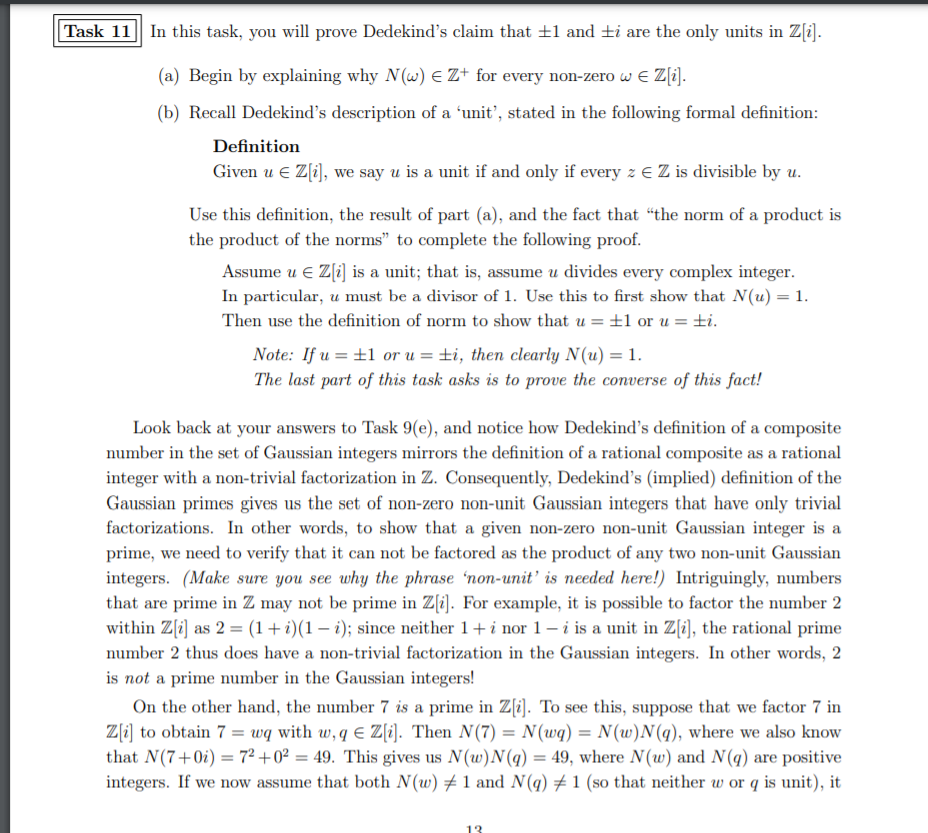
Task 11 In this task, you will prove Dedekind's claim that +1 and i are the only units in Z[i]. (a) Begin by explaining why N(w) E Z+ for every non-zero w E Z[i]. (b) Recall Dedekind's description of a 'unit', stated in the following formal definition: Definition Given u ( Z[i], we say u is a unit if and only if every z E Z is divisible by u. Use this definition, the result of part (a), and the fact that "the norm of a product is the product of the norms" to complete the following proof. Assume u ( Z[i] is a unit; that is, assume u divides every complex integer. In particular, u must be a divisor of 1. Use this to first show that N(u) = 1. Then use the definition of norm to show that u = +1 or u = ti. Note: If u = +1 or u = ti, then clearly N(u) = 1. The last part of this task asks is to prove the converse of this fact! Look back at your answers to Task 9(e), and notice how Dedekind's definition of a composite number in the set of Gaussian integers mirrors the definition of a rational composite as a rational integer with a non-trivial factorization in Z. Consequently, Dedekind's (implied) definition of the Gaussian primes gives us the set of non-zero non-unit Gaussian integers that have only trivial factorizations. In other words, to show that a given non-zero non-unit Gaussian integer is a prime, we need to verify that it can not be factored as the product of any two non-unit Gaussian integers. (Make sure you see why the phrase 'non-unit' is needed here!) Intriguingly, numbers that are prime in Z may not be prime in Z[i]. For example, it is possible to factor the number 2 within Z[i] as 2 = (1 + i)(1 - i); since neither 1 + i nor 1 - i is a unit in Z[i], the rational prime number 2 thus does have a non-trivial factorization in the Gaussian integers. In other words, 2 is not a prime number in the Gaussian integers! On the other hand, the number 7 is a prime in Z[i]. To see this, suppose that we factor 7 in Z[i] to obtain 7 = wq with w, q e Z[i]. Then N(7) = N(wq) = N(w)N(q), where we also know that N(7 +0i) = 72 +02 = 49. This gives us N(w) N(q) = 49, where N(w) and N(q) are positive integers. If we now assume that both N(w) # 1 and N(q) # 1 (so that neither w or q is unit), it
Step by Step Solution
There are 3 Steps involved in it

Get step-by-step solutions from verified subject matter experts
 Study Help