







Question: Task 2 - Performance evaluation of the SI engine Unzip the provided 'Labdata.zip' file, open folder Labdata Petrol'. You will find 5 'txxx_yyyy.mat' files,
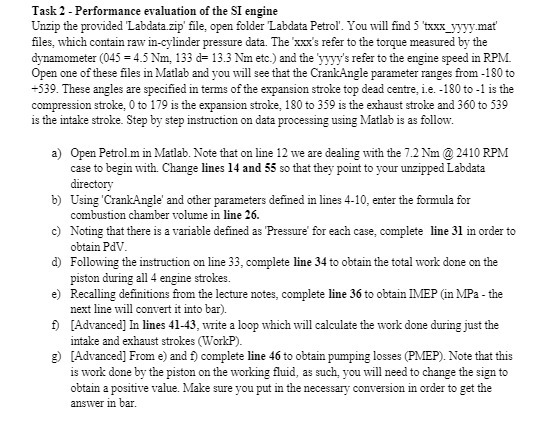
Task 2 - Performance evaluation of the SI engine Unzip the provided 'Labdata.zip' file, open folder "Labdata Petrol'. You will find 5 'txxx_yyyy.mat' files, which contain raw in-cylinder pressure data. The 'xxx's refer to the torque measured by the dynamometer (045 = 4.5 Nm, 133 d= 13.3 Nm etc.) and the 'yyyy's refer to the engine speed in RPM. Open one of these files in Matlab and you will see that the CrankAngle parameter ranges from -180 to +539. These angles are specified in terms of the expansion stroke top dead centre, i.e. -180 to -1 is the compression stroke, 0 to 179 is the expansion stroke, 180 to 359 is the exhaust stroke and 360 to 539 is the intake stroke. Step by step instruction on data processing using Matlab is as follow. a) Open Petrol.m in Matlab. Note that on line 12 we are dealing with the 7.2 Nm @ 2410 RPM case to begin with. Change lines 14 and 55 so that they point to your unzipped Labdata directory b) Using 'CrankAngle' and other parameters defined in lines 4-10, enter the formula for combustion chamber volume in line 26. c) Noting that there is a variable defined as 'Pressure for each case, complete line 31 in order to obtain PdV. d) Following the instruction on line 33, complete line 34 to obtain the total work done on the piston during all 4 engine strokes. e) Recalling definitions from the lecture notes, complete line 36 to obtain IMEP (in MPa - the next line will convert it into bar). f) [Advanced] In lines 41-43, write a loop which will calculate the work done during just the intake and exhaust strokes (WorkP). g) [Advanced] From e) and f) complete line 46 to obtain pumping losses (PMEP). Note that this is work done by the piston on the working fluid, as such, you will need to change the sign to obtain a positive value. Make sure you put in the necessary conversion in order to get the answer in bar.
Step by Step Solution
There are 3 Steps involved in it

Get step-by-step solutions from verified subject matter experts
 Study Help