



Question: Task 2.3 Assuming that the data set represents the population of schooling-age children in the country, a} what is the probability that a randomly selected
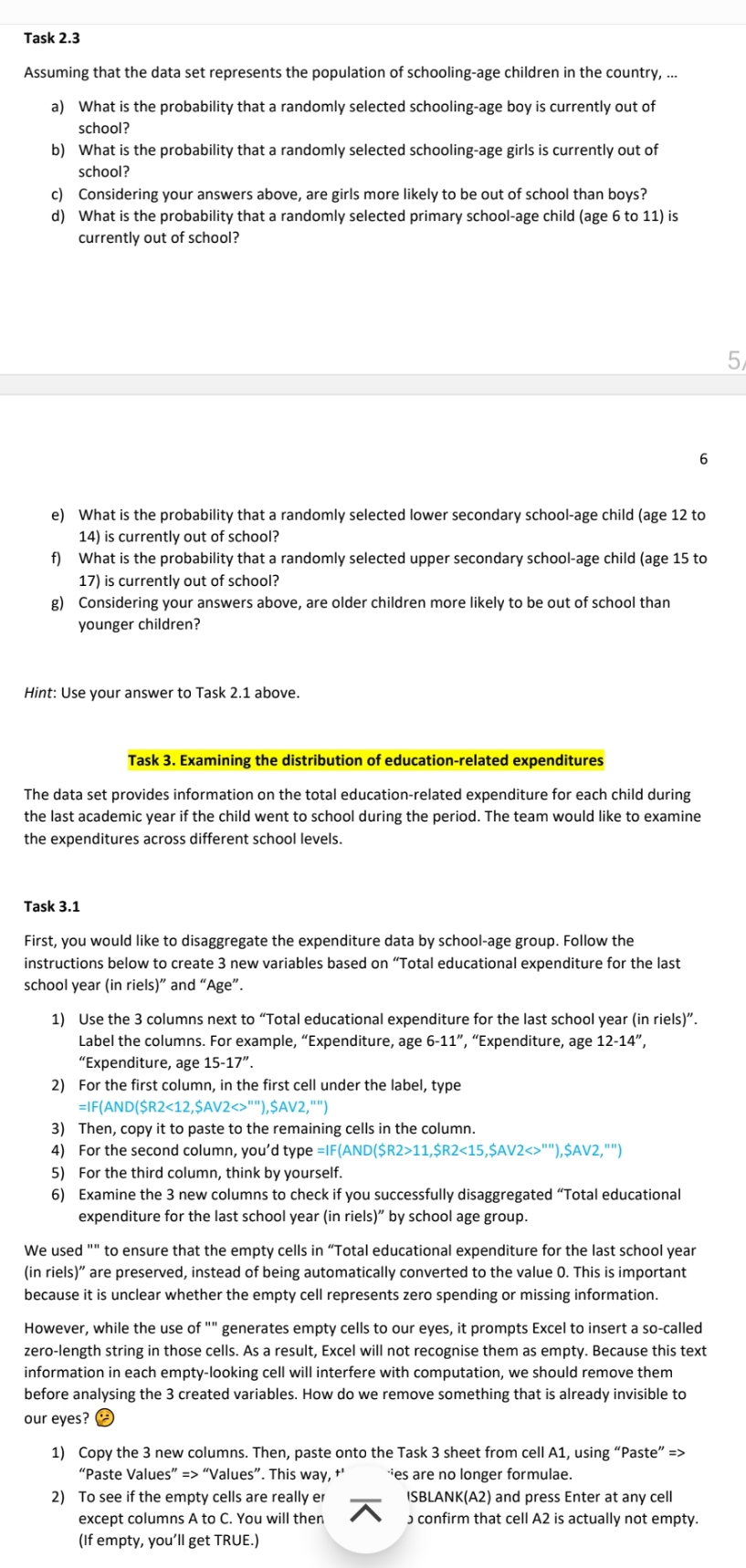
Task 2.3 Assuming that the data set represents the population of schooling-age children in the country, a} what is the probability that a randomly selected school ing-age boy is currently out of school? b] What is the probability that a randomly selected school ing-age girls is currently out of school? cl Considering your answers above, are girls more likely to be out of school than boys? 11] what is the probability that a randomly selected primary school-age child (age 6 to 11] is currently out of school? e) What is the probability that a randomly selected lower secondary school-age child (age 12 to 14) is Currently out of school? f] what is the probability that a randomly selected upper secondary school-age child {age 15 to 17) is currently out of school? 3] Considering your answers above, are older children more likely to be out of school than younger children? Hint: Use your answer to Task 2.1 above. Task 3. Examining the distribution at education-related expenditures The data set provides information on the total education-related expenditure for each child during the last academic year if the child went to school during the period. The team would like to examine the expenditures across different school levels. Task 3.1 First, you would like to disaggregate the expenditure data by school-age groupc Follow the instructions below to create 3 new variables based on \"Total educational expenditure for the last school year [in riels)" and "Age\". 1] Use the 3 columns next to "Total educational expenditure for the last school year (in rielsl\". Label the columns. For example, \"Expenditure, age 6711\
Step by Step Solution
There are 3 Steps involved in it

Get step-by-step solutions from verified subject matter experts