







Question: Task 6: Complete the following function: function CHECKGRIDS(puzzle) end function This function will take the vector puzzle (as produced by MAKEVECTOR) as an input parameter
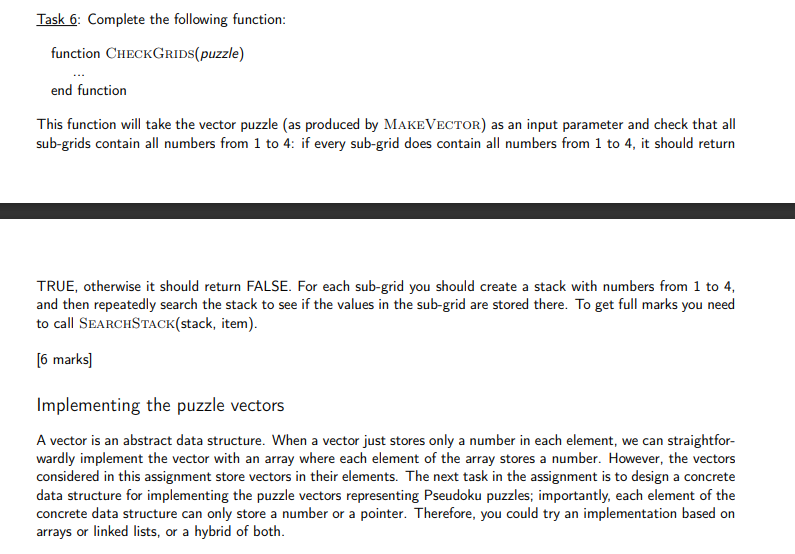
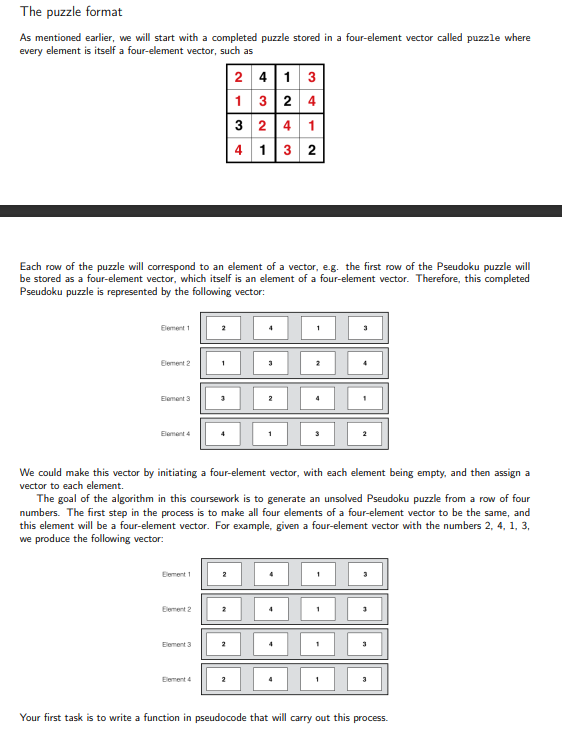
Task 6: Complete the following function: function CHECKGRIDS(puzzle) end function This function will take the vector puzzle (as produced by MAKEVECTOR) as an input parameter and check that all sub-grids contain all numbers from 1 to 4: if every sub-grid does contain all numbers from 1 to 4, it should return TRUE, otherwise it should return FALSE. For each sub-grid you should create a stack with numbers from 1 to 4, and then repeatedly search the stack to see if the values in the sub-grid are stored there. To get full marks you need to call SEARCHSTACK(stack, item). [6 marks) Implementing the puzzle vectors A vector is an abstract data structure. When a vector just stores only a number in each element, we can straightfor- wardly implement the vector with an array where each element of the array stores a number. However, the vectors considered in this assignment store vectors in their elements. The next task in the assignment is to design a concrete data structure for implementing the puzzle vectors representing Pseudoku puzzles; importantly, each element of the concrete data structure can only store a number or a pointer. Therefore, you could try an implementation based on arrays or linked lists, or a hybrid of both. The puzzle format As mentioned earlier, we will start with a completed puzzle stored in a four-element vector called puzzle where every element is itself a four-element vector, such as 2 41 3 1 3 2 4 3 2 4 1 4 1 3 2 Each row of the puzzle will correspond to an element of a vector, e.g. the first row of the Pseudoku puzzle will be stored as a four-element vector, which itself is an element of a four-element vector. Therefore, this completed Pseudoku puzzle is represented by the following vector: Element1 Element 2 Elements Element 4 We could make this vector by initiating a four-element vector, with each element being empty, and then assign a vector to each element. The goal of the algorithm in this coursework is to generate an unsolved Pseudoku puzzle from a row of four numbers. The first step in the process is to make all four elements of a four-element vector to be the same, and this element will be a four-element vector. For example, given a four-element vector with the numbers 2, 4, 1, 3, we produce the following vector: Element1 Element 2 Element 3 Element 3 Your first task is to write a function in pseudocode that will carry out this process
Step by Step Solution
There are 3 Steps involved in it

Get step-by-step solutions from verified subject matter experts
 Study Help