Question: TASK A. (10p) 1. What is the difference between the introduction and the literature review in a research paper? TASK B. Below you have been
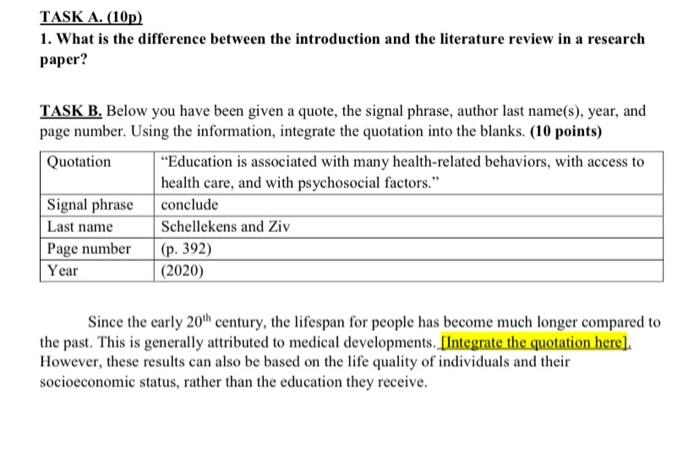
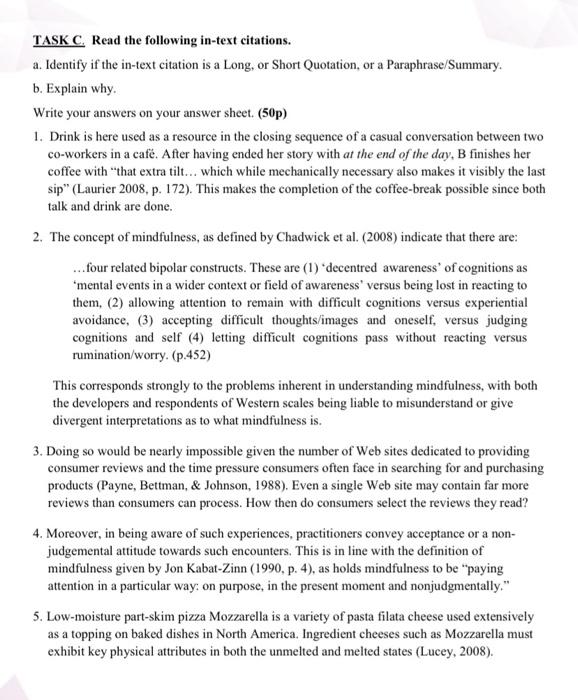
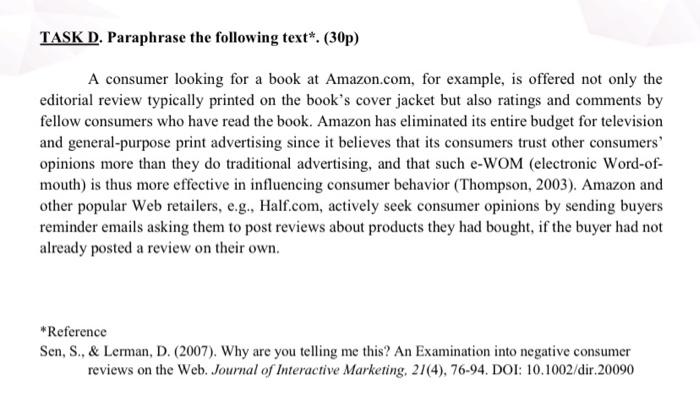
TASK A. (10p) 1. What is the difference between the introduction and the literature review in a research paper? TASK B. Below you have been given a quote, the signal phrase, author last name(s), year, and page number. Using the information, integrate the quotation into the blanks. (10 points) Quotation Education is associated with many health-related behaviors, with access to health care, and with psychosocial factors." Signal phrase conclude Last name Schellekens and Ziv Page number (p. 392) Year (2020) Since the early 20th century, the lifespan for people has become much longer compared to the past. This is generally attributed to medical developments. [Integrate the quotation here) However, these results can also be based on the life quality of individuals and their socioeconomic status, rather than the education they receive. TASK C. Read the following in-text citations. a. Identify if the in-text citation is a Long, or Short Quotation, or a Paraphrase/Summary. b. Explain why. Write your answers on your answer sheet. (50p) 1. Drink is here used as a resource in the closing sequence of a casual conversation between two co-workers in a caf. After having ended her story with at the end of the day. B finishes her coffee with that extra tilt... which while mechanically necessary also makes it visibly the last sip" (Laurier 2008, p. 172). This makes the completion of the coffee-break possible since both talk and drink are done. 2. The concept of mindfulness, as defined by Chadwick et al. (2008) indicate that there are: ...four related bipolar constructs. These are (1) decentred awareness of cognitions as *mental events in a wider context or field of awareness' versus being lost in reacting to them, (2) allowing attention to remain with difficult cognitions versus experiential avoidance, (3) accepting difficult thoughts/images and oneself, versus judging cognitions and self (4) letting difficult cognitions pass without reacting versus rumination/worry. (p.452) This corresponds strongly to the problems inherent in understanding mindfulness, with both the developers and respondents of Western scales being liable to misunderstand or give divergent interpretations as to what mindfulness is. 3. Doing so would be nearly impossible given the number of Web sites dedicated to providing consumer reviews and the time pressure consumers often face in searching for and purchasing products (Payne, Bettman, & Johnson, 1988). Even a single Web site may contain far more reviews than consumers can process. How then do consumers select the reviews they read? 4. Moreover, in being aware of such experiences, practitioners convey acceptance or a non- judgemental attitude towards such encounters. This is in line with the definition of mindfulness given by Jon Kabat-Zinn (1990, p. 4), as holds mindfulness to be "paying attention in a particular way, on purpose, in the present moment and nonjudgmentally." 5. Low-moisture part-skim pizza Mozzarella is a variety of pasta filata cheese used extensively as a topping on baked dishes in North America. Ingredient cheeses such as Mozzarella must exhibit key physical attributes in both the unmelted and melted states (Lucey, 2008). TASK D. Paraphrase the following text*. (30p) A consumer looking for a book at Amazon.com, for example, is offered not only the editorial review typically printed on the book's cover jacket but also ratings and comments by fellow consumers who have read the book. Amazon has eliminated its entire budget for television and general-purpose print advertising since it believes that its consumers trust other consumers' opinions more than they do traditional advertising, and that such e-WOM (electronic Word-of- mouth) is thus more effective in influencing consumer behavior (Thompson, 2003). Amazon and other popular Web retailers, e.g., Half.com, actively seek consumer opinions by sending buyers reminder emails asking them to post reviews about products they had bought, if the buyer had not already posted a review on their own. *Reference Sen, S., & Lerman, D. (2007). Why are you telling me this? An Examination into negative consumer reviews on the Web. Journal of Interactive Marketing, 21(4), 76-94. DOI: 10.1002/dir.20090









 Study Help