







Question: Task: A 20-storey building has a steel frame structure with composite floors, steel-concrete T-beams (steel beam-concrete slab). Assume that each floor includes 100 T-beams,
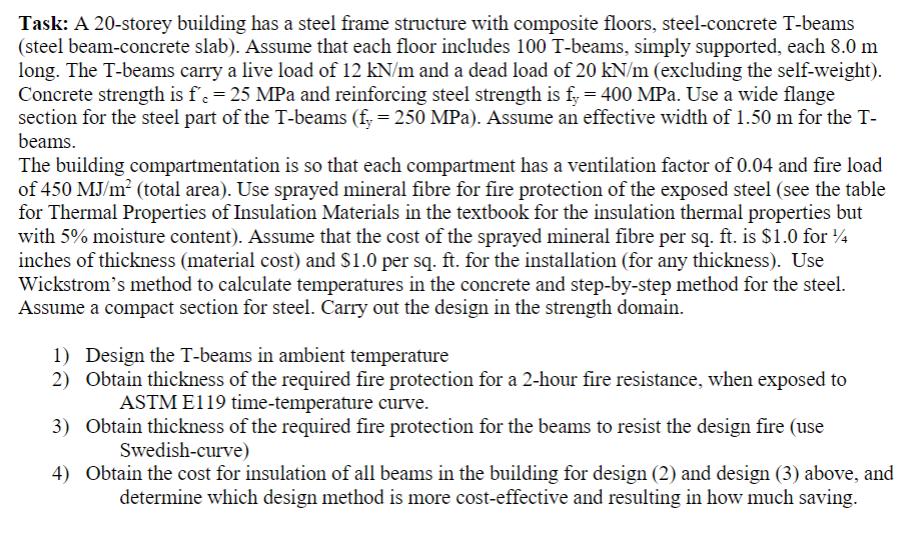
Task: A 20-storey building has a steel frame structure with composite floors, steel-concrete T-beams (steel beam-concrete slab). Assume that each floor includes 100 T-beams, simply supported, each 8.0 m long. The T-beams carry a live load of 12 kN/m and a dead load of 20 kN/m (excluding the self-weight). Concrete strength is fc25 MPa and reinforcing steel strength is fy = 400 MPa. Use a wide flange section for the steel part of the T-beams (fy = 250 MPa). Assume an effective width of 1.50 m for the T- beams. The building compartmentation is so that each compartment has a ventilation factor of 0.04 and fire load of 450 MJ/m (total area). Use sprayed mineral fibre for fire protection of the exposed steel (see the table for Thermal Properties of Insulation Materials in the textbook for the insulation thermal properties but with 5% moisture content). Assume that the cost of the sprayed mineral fibre per sq. ft. is $1.0 for inches of thickness (material cost) and $1.0 per sq. ft. for the installation (for any thickness). Use Wickstrom's method to calculate temperatures in the concrete and step-by-step method for the steel. Assume a compact section for steel. Carry out the design in the strength domain. 1) Design the T-beams in ambient temperature 2) Obtain thickness of the required fire protection for a 2-hour fire resistance, when exposed to ASTM E119 time-temperature curve. 3) Obtain thickness of the required fire protection for the beams to resist the design fire (use Swedish-curve) 4) Obtain the cost for insulation of all beams in the building for design (2) and design (3) above, and determine which design method is more cost-effective and resulting in how much saving.
Step by Step Solution
There are 3 Steps involved in it

Get step-by-step solutions from verified subject matter experts
 Study Help