







Question: Task: Executive Summary Case study: Just about everyone who has a smartphone wants to be able to bring it to work and use it on
Task:
Executive Summary
Case study:
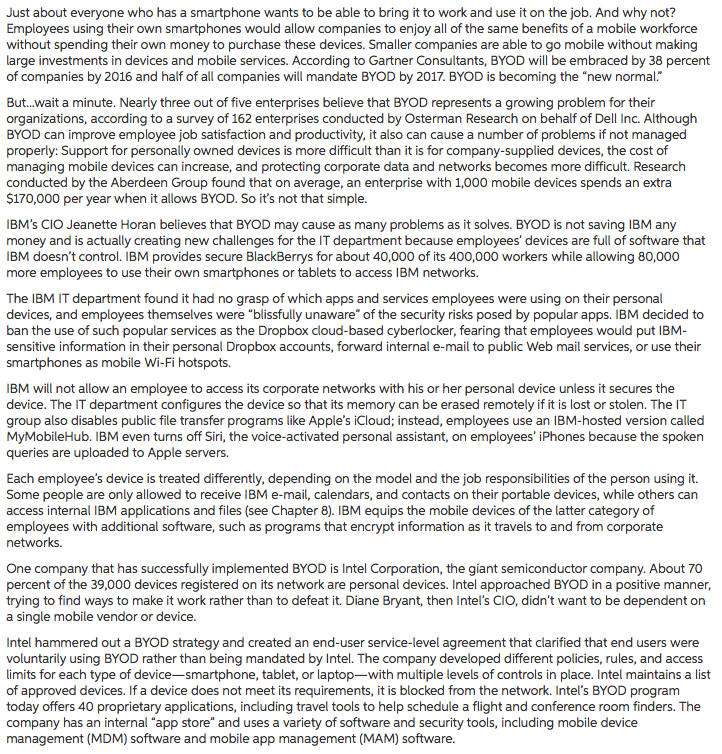
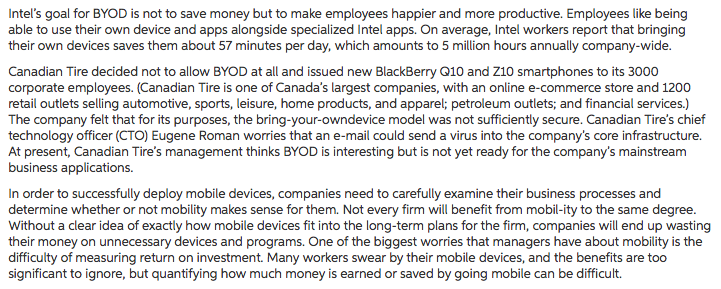
Just about everyone who has a smartphone wants to be able to bring it to work and use it on the job. And why not? Employees using their own smartphones would allow oompanies to enjoy all of the same benets of a mobile workforce without spending their own money to purchase these devices. Smaller companies are able to go mobile without making large investments in devices and mobile services. According to Gartner Consultants, BYOB will be em braced by 30 percent of companies by 2016 and half of all companies will mandate BYOB by 201?. BYOB is becoming the \"new normal.' But...wait a minute. Nearly three out of ve enterprises believe that BYOB represents a growing problem fortheir organizations, according to a survey of 15?. enterprises conducted by Osterman Research on behalf of Dell Inc. Although BYOB can improve employee job satisfaction and productivity, it also can cause a number of problems if not managed properly: Support for personally owned devices is more difficult than it is for companysupplied devices, the cost of managing mobile devices can increase, and protecting corporate data and networks becomes more difficult. Research conducted by the Aberdeen Group found that on average, an enterprise with 1,000 mobile devices spends an extra 530,000 per year when it allows BYOB. So it's not that simple. IBM's CIO Jeanette Horan believes that BYOB may cause as many problems as it solves. BYOB is not saving IBM any money and is actually creating new challenges for the IT department because employees' devices are full of software that IBM doesn't control. IBM provides secure BlackBerrys for about 40,000 of its 400,000 workers while allowing 50,000 more employees to use their own smartphones or tablets to aocess IBM networks. The IBM IT department found it had no grasp of which apps and senrices employees were using on their personal devices, and employees themselves were 'blissfully unaware' of the security risks posed by popular apps. IBM decided to ban the use of such popular services as the Bropbox cloud-based cyberlo-cker, fearing that employees would put IBM- sensitive information in their personal Bropbox accounts, forward internal email to public IIv'll'eb mail seniices, or use their smartphones as mobile 'w'iFi hotspots. IBM will not allow an employee to acoess its corporate networks with his or her personal device unless it secures the device. The IT department configures the device so that its memory can be erased remotely if it is lost or stolen. The IT group also disables public le transfer programs like Apple's iCloud; instead, employees use an IBMhosted version called MyMobileHub. IBM even tums off Siri, the voiceactivated personal assistant, on employees' iF'hones because the spoken queries are uploaded to Apple servers. Each employee's device is treated differently, depending on the model and the job responsibilities of the person using it. Some people are only allowed to receive IBM email, calendars, and contacts on their portable devices, while others can access internal IBM applications and files {see Chapter 5}. IBM equips the mobile devices of the latter category of employees with additional software, such as programs that encrypt information as it travels to and from corporate networks. One company that has successfully implemented BYOB is Intel Corporation, the giant semioonductor company. About ?0 percent of the 39,000 devices registered on its network are personal devices. Intel approached BYOB in a positive manner, trying to nd ways to make it work rather than to defeat it. Biane Bryant, then Intel's CIO, didn't want to be dependent on a single mobile vendor or device. Intel hammered out a BYOB strategy and created an enduser senrice~level agreement that claried that end users were voluntarily using BYOB rather than being mandated by Intel. The company developed different policies, rules, and access limits for each type of devicesmartphone, tablet, or laptopwith multiple levels of controls in place. Intel maintains a list of approved devioes. If a device does not meet its requirements, it is blocked from the network. Intel's BYOB program to-day offers 40 proprietary applications, including travel tools to help schedule a flight and conference room finders. The company has an internal 'app store' and uses a variety of software and security tools, including mobile device management {MBM} software and mobile app management {MAM} software. Intel's goal for BYOD is not to save money but to make employees happier and more productive. Employees like being able to use their own device and apps alongside specialized Intel apps. On average, Intel workers report that bringing their own devices saves them about 57 minutes per day, which amounts to 5 million hours annually company-wide. Canadian Tire decided not to allow BYOD at all and issued new BlackBerry Q10 and Z10 smartphones to its 3000 corporate employees. (Canadian Tire is one of Canada's largest companies, with an online e-commerce store and 1200 retail outlets selling automotive, sports, leisure, home products, and apparel; petroleum outlets; and financial services.) The company felt that for its purposes, the bring-your-owndevice model was not sufficiently secure. Canadian Tire's chief technology officer (CTO) Eugene Roman worries that an e-mail could send a virus into the company's core infrastructure. At present, Canadian Tire's management thinks BYOD is interesting but is not yet ready for the company's mainstream business applications. In order to successfully deploy mobile devices, companies need to carefully examine their business processes and determine whether or not mobility makes sense for them. Not every firm will benefit from mobil-ity to the same degree. Without a clear idea of exactly how mobile devices fit into the long-term plans for the firm, companies will end up wasting their money on unnecessary devices and programs. One of the biggest worries that managers have about mobility is the difficulty of measuring return on investment. Many workers swear by their mobile devices, and the benefits are too significant to ignore, but quantifying how much money is earned or saved by going mobile can be difficult
Step by Step Solution
There are 3 Steps involved in it

Get step-by-step solutions from verified subject matter experts
 Study Help