







Question: Task Three: Financial Management Exercise (50 marks) - Individual Students are required to monitor a budget that you set for yourself and track your spending
Task Three: Financial Management Exercise (50 marks) - Individual Students are required to monitor a budget that you set for yourself and track your spending over a period of four (4) weeks. The exercise aims at getting to know your spending habits, your ability to manage a budget, and your decisions on how to distribute/use your resources (in this case your money). Please concentrate and be organized. Exercise Instructions: 1. Decide on a budget for a month (starting from this weekend January 28th and until February 25th) and keep monitoring what you do in it from a financial perspective (this means monitor your spending and the decisions you are doing for the next 4 weeks (college weeks 4, 5, 6 and 7) 2. Start this weekend by going to your Google store or Apple store and download a Budget tracker free application. This App might have different names (like money spending tracker, etc.). 3. Every day, starting this weekend, start recording all your daily expenses. 4. Analyze your daily expenses at the end of the exercise period (the one month) in the following way: a. What have you learnt from this exercise? Any new ideas about budgets, expenditures, monitoring your own financial decisions? Am I a spender? Am I someone who can save? Be honest with these reflections as it will help you to have better financial habits in your future life. b. Tell me how can you be a more responsible member of your family, your community, and the UAE in general as pertaining to your spending as a consumer? Do you buy things that you don't need, just for the sake of buying, do you spend money on products such as food or clothes or accessories in excess to what you need (thus wasting your money)? c. Think about your spending pattern, what could you do better? What is your biggest challenge in terms of expenses? d. Finally, what is your saving pattern? How can you save more money in the future? What is your motivation for saving? 5. So, at the end of week 4 (end of week 7), one or two pages reflection paper giving your teacher a summary of what happened to you during those 4 weeks and what main financial management lessons did you learn from it (you can use any information from a, b, c or d above to help you and provide examples).
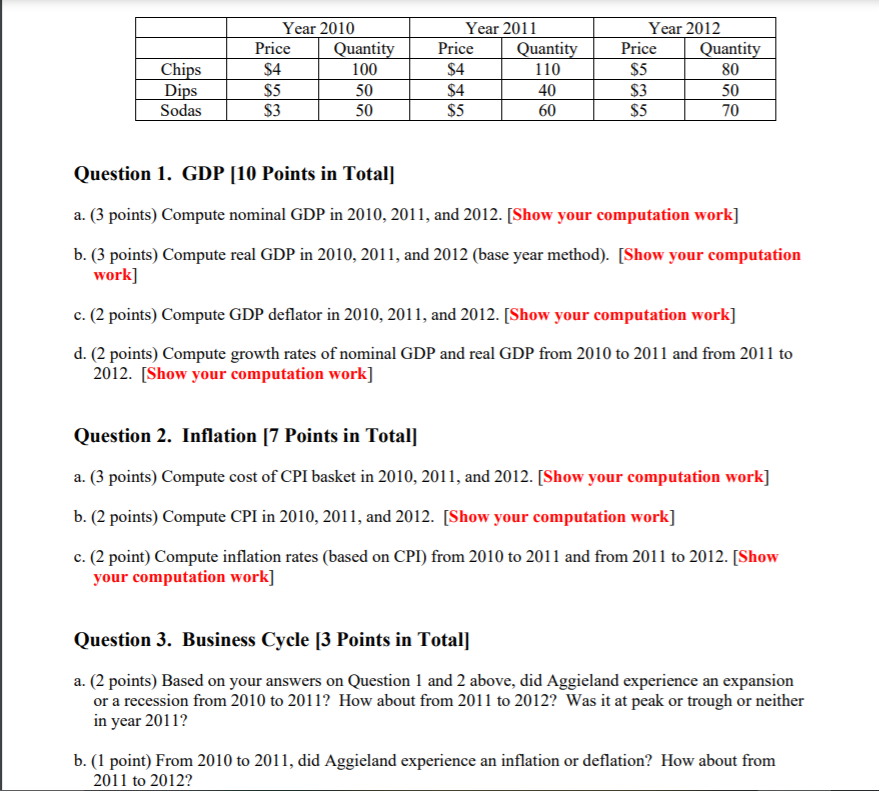
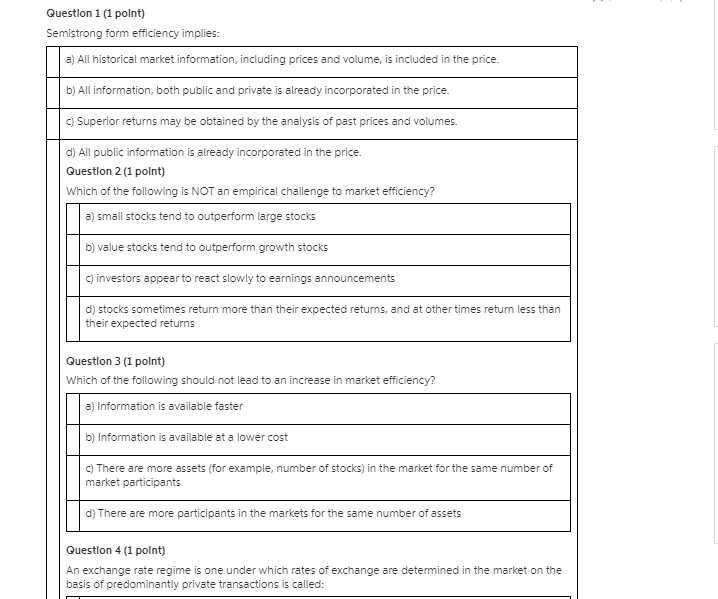
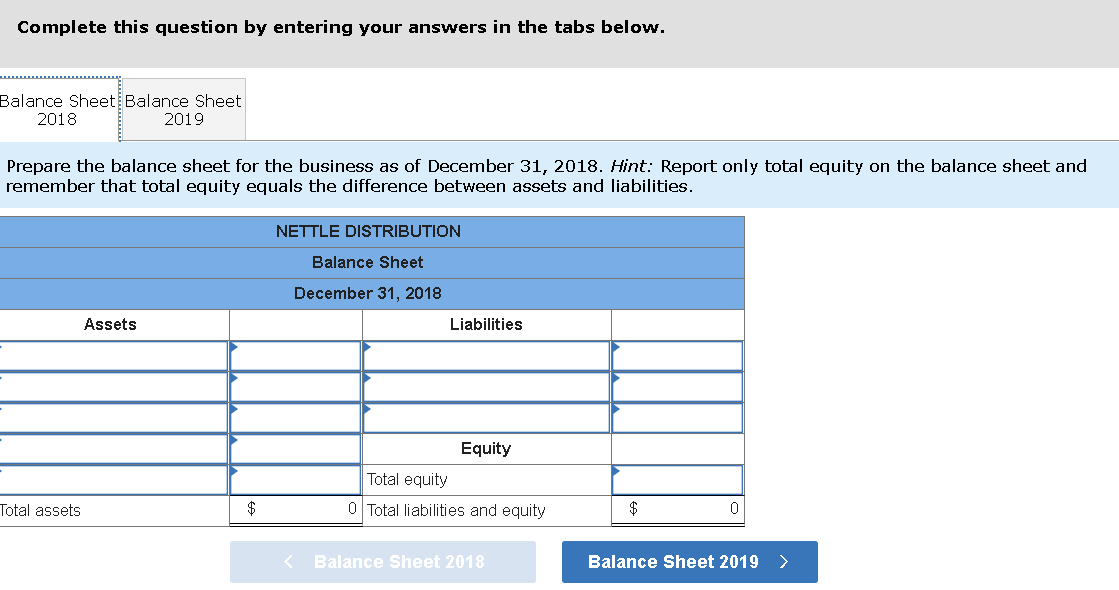
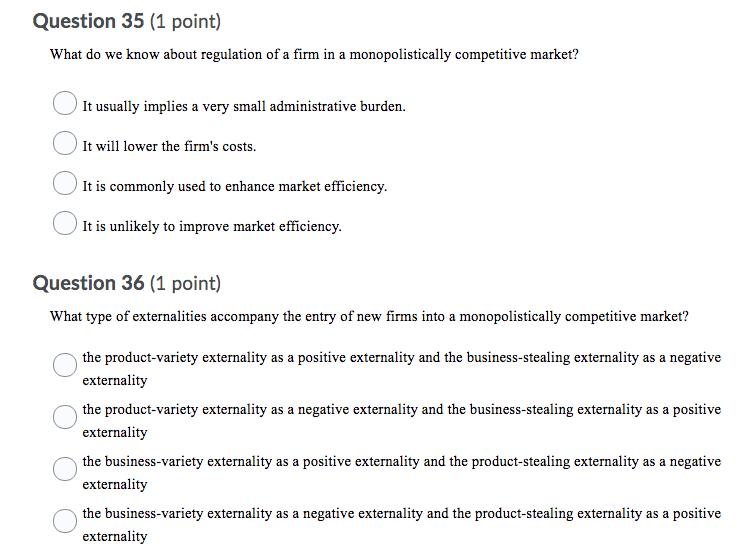
Year 2010 Year 2011 Year 2012 Price Quantity Price Quantity Price Quantity Chips $4 100 $4 110 $5 80 Dips $5 50 $4 40 $3 50 Sodas $3 50 $5 60 $5 70 Question 1. GDP [10 Points in Total] a. (3 points) Compute nominal GDP in 2010, 2011, and 2012. [Show your computation work] b. (3 points) Compute real GDP in 2010, 2011, and 2012 (base year method). [Show your computation work] c. (2 points) Compute GDP deflator in 2010, 2011, and 2012. [Show your computation work] d. (2 points) Compute growth rates of nominal GDP and real GDP from 2010 to 2011 and from 2011 to 2012. [Show your computation work] Question 2. Inflation [7 Points in Total] a. (3 points) Compute cost of CPI basket in 2010, 2011, and 2012. [Show your computation work] b. (2 points) Compute CPI in 2010, 2011, and 2012. [Show your computation work] c. (2 point) Compute inflation rates (based on CPI) from 2010 to 2011 and from 2011 to 2012. [Show your computation work] Question 3. Business Cycle [3 Points in Total] a. (2 points) Based on your answers on Question 1 and 2 above, did Aggieland experience an expansion or a recession from 2010 to 2011? How about from 2011 to 2012? Was it at peak or trough or neither in year 2011? b. (1 point) From 2010 to 2011, did Aggieland experience an inflation or deflation? How about from 2011 to 2012?Question 1 :1 point: Semistrong form efficiency implies: I a] All historical market information, including prices and volume. is included in the price. I b] All information, both public and private is already incorporated in the price. I c} Superior returns may be obtained by the analysis of past prices and volumes. d] All public information is already incorporated in the price. Question 211 point]- Which ofthe following is NOT an empirical challenge to market efficiency? I a] small stocks tend to outperform large stocks I b] value stocks tend to outperform growth stocks I c] investors appear to react slowly to earnings announcements di stocks sometimes return more than their expected return s, and at othertimes return less than their expected returns Question 3 [1 point]- Which ofthe following should not lead to an increase in market efciency? I a] Information is available faster I b] Infon'nation is available at a lower cost cjl There are more assets {for example, number of stocks) in the market for the same number of market participants I d] There are more participants in the markets for the same number ofassets Question 411 polnt] An exchange rate regime is one under which rates of exchange are determined in the market on the basis of predominantly private transactions is called: Complete this question by entering your answers in the tabs below. Balance Sheet Balance Sheet 2018 2019 Prepare the balance sheet for the business as of December 31, 2018. Hint: Report only total equity 0n the balance sheet and remember that total equity equals the difference between assets and liabilities. "otal equity Total assets $ 0 "otal liabilities and equity $ 0 Balance Sheet 2019 > Question 35 (1 point) What do we know about regulation of a firm in a monopolistically competitive market? It usually implies a very small administrative burden. It will lower the firm's costs. It is commonly used to enhance market efficiency. It is unlikely to improve market efficiency. Question 36 (1 point) What type of externalities accompany the entry of new firms into a monopolistically competitive market? the product-variety externality as a positive externality and the business-stealing externality as a negative externality the product-variety externality as a negative externality and the business-stealing externality as a positive externality the business-variety externality as a positive externality and the product-stealing externality as a negative externality O the business-variety externality as a negative externality and the product-stealing externality as a positive externality
Step by Step Solution
There are 3 Steps involved in it

Get step-by-step solutions from verified subject matter experts
 Study Help