







Question: Task two: Estimate solution errors at a particular time value and the estimated big-O constant associated with the forward Euler method. This task may be
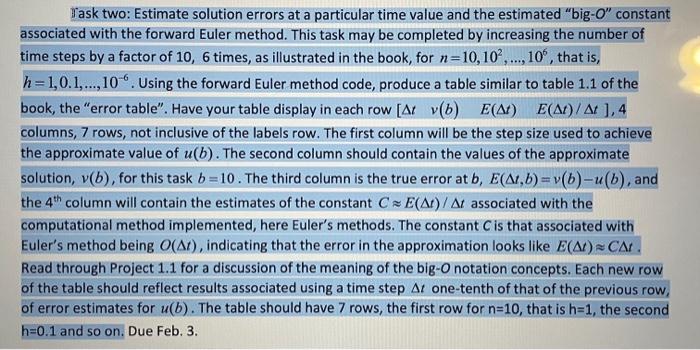
Task two: Estimate solution errors at a particular time value and the estimated "big-O" constant associated with the forward Euler method. This task may be completed by increasing the number of time steps by a factor of 10, 6 times, as illustrated in the book, for n=10,10,...,10, that is, h=1,0.1,...,10. Using the forward Euler method code, produce a table similar to table 1.1 of the book, the "error table". Have your table display in each row [Ar v(b) E(A) E(A)/A4),4 columns, 7 rows, not inclusive of the labels row. The first column will be the step size used to achieve the approximate value of u(b). The second column should contain the values of the approximate solution, v(b), for this task b =10. The third column is the true error at b, E(A1,b)=v(b)-u(b), and the 4th column will contain the estimates of the constant CE(A) / At associated with the computational method implemented, here Euler's methods. The constant Cis that associated with Euler's method being O(At), indicating that the error in the approximation looks like E(A1) CA. Read through Project 1.1 for a discussion of the meaning of the big-o notation concepts. Each new row of the table should reflect results associated using a time step At one-tenth of that of the previous row, of error estimates for u(b). The table should have 7 rows, the first row for n=10, that is h=1, the second h=0.1 and so on. Due Feb. 3. Task two: Estimate solution errors at a particular time value and the estimated "big-O" constant associated with the forward Euler method. This task may be completed by increasing the number of time steps by a factor of 10, 6 times, as illustrated in the book, for n=10,10,...,10, that is, h=1,0.1,...,10. Using the forward Euler method code, produce a table similar to table 1.1 of the book, the "error table". Have your table display in each row [Ar v(b) E(A) E(A)/A4),4 columns, 7 rows, not inclusive of the labels row. The first column will be the step size used to achieve the approximate value of u(b). The second column should contain the values of the approximate solution, v(b), for this task b =10. The third column is the true error at b, E(A1,b)=v(b)-u(b), and the 4th column will contain the estimates of the constant CE(A) / At associated with the computational method implemented, here Euler's methods. The constant Cis that associated with Euler's method being O(At), indicating that the error in the approximation looks like E(A1) CA. Read through Project 1.1 for a discussion of the meaning of the big-o notation concepts. Each new row of the table should reflect results associated using a time step At one-tenth of that of the previous row, of error estimates for u(b). The table should have 7 rows, the first row for n=10, that is h=1, the second h=0.1 and so on. Due Feb. 3
Step by Step Solution
There are 3 Steps involved in it

Get step-by-step solutions from verified subject matter experts
 Study Help