Question: Task Two: Many early integration problems that you'll encounter boil down to a standard format such as the following: The differential formula for the accumulation
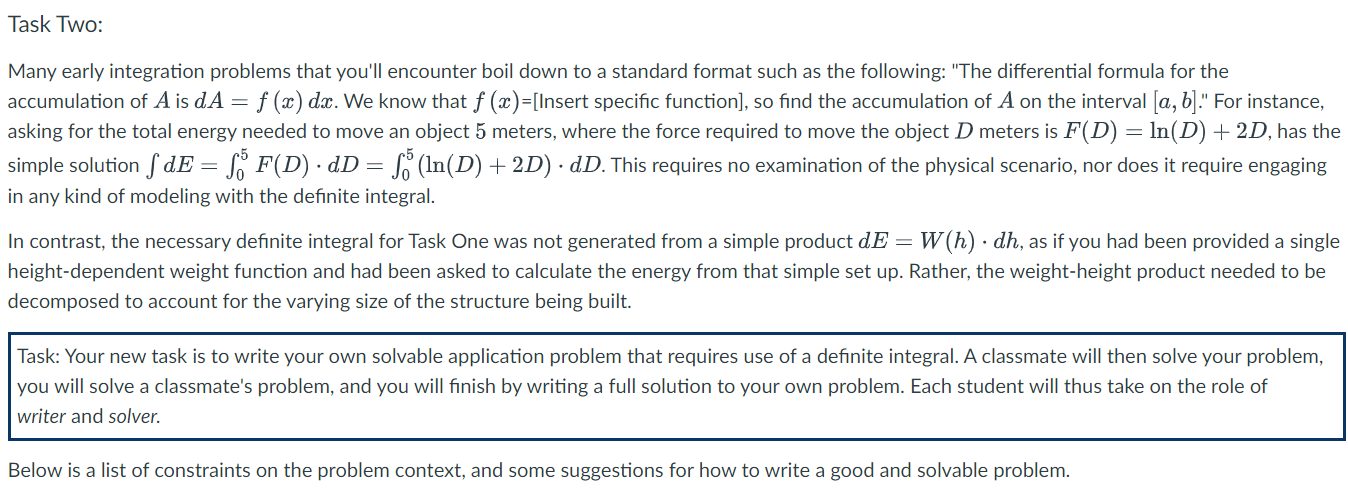
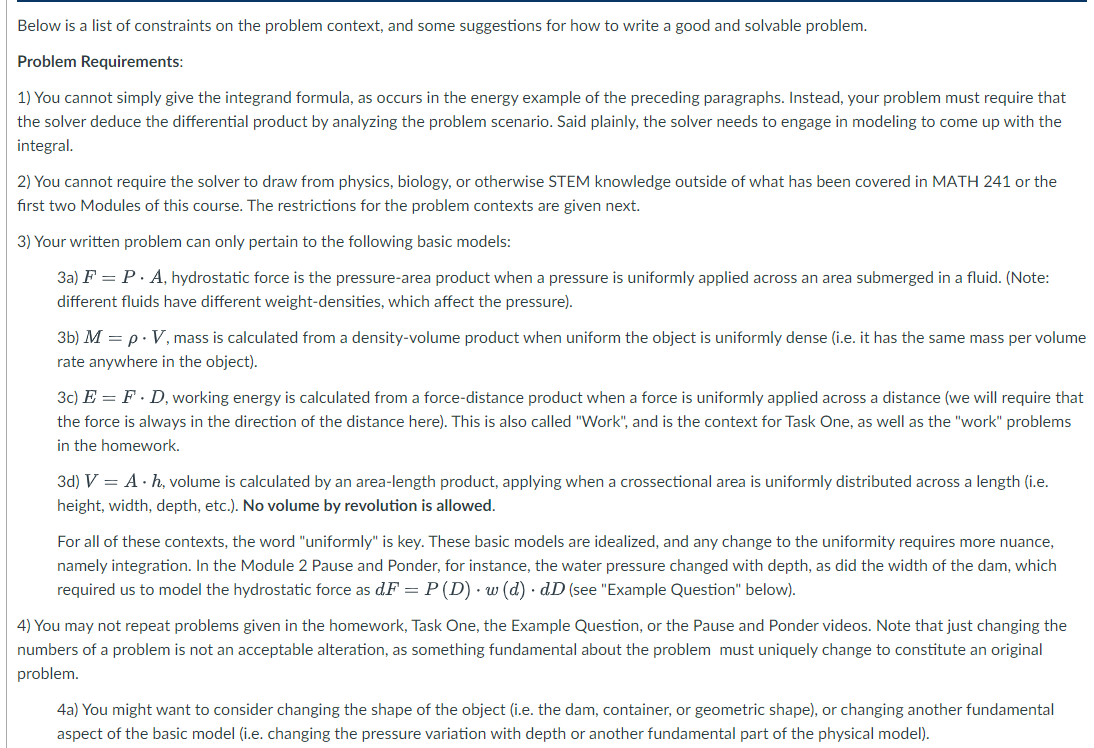
Task Two: Many early integration problems that you'll encounter boil down to a standard format such as the following: "The differential formula for the accumulation of A is dA = f (x) da. We know that f ( )=[Insert specific function], so find the accumulation of A on the interval [a, b]." For instance, asking for the total energy needed to move an object 5 meters, where the force required to move the object D meters is F(D) = In(D) + 2D, has the simple solution f dE = So F(D) . dD = So (In(D) + 2D) . dD. This requires no examination of the physical scenario, nor does it require engaging in any kind of modeling with the definite integral. In contrast, the necessary definite integral for Task One was not generated from a simple product dE = W(h) . dh, as if you had been provided a single height-dependent weight function and had been asked to calculate the energy from that simple set up. Rather, the weight-height product needed to be decomposed to account for the varying size of the structure being built. Task: Your new task is to write your own solvable application problem that requires use of a definite integral. A classmate will then solve your problem, you will solve a classmate's problem, and you will finish by writing a full solution to your own problem. Each student will thus take on the role of writer and solver. Below is a list of constraints on the problem context, and some suggestions for how to write a good and solvable problem.Below is a list of constraints on the problem context, and some suggestions for how to write a good and solvable problem. Problem Requirements: 1) You cannot simply give the integrand formula, as occurs in the energy example of the preceding paragraphs. Instead, your problem must require that the solver deduce the differential product by analyzing the problem scenario. Said plainly. the solver needs to engage in modeling to come up with the integral. 2}! You cannot require the solver to draw from physics. biology, or otherwise STEM knowledge outside of what has been covered in MATH 241 or the first two Modules of this course. The restrictions for the problem contexts are given next. 3} Your written problem can only pertain to the following basic models: 3a} F = P - A. hydrostatic force is the pressurearea product when a pressure is uniformly applied across an area submerged in a fluid. (Note: different uids have different weightdensities. which affect the pressure]. 3b] M = p - V, mass is calculated from a densityvolume product when uniform the object is uniformly dense {i.e. it has the same mass pervolume rate anywhere in the object). 3c] E = F . D. working energy is calculated from a forcedistance product when a force is uniformly applied across a distance [we will require that the force is always in the direction of the distance here). This is also called "Work". and is the context forTask One. as well as the "work" problems in the homework. 3d) V = A ' h. volume is calculated by an arealength product. applying when a crossectional area is uniformly distributed across a length {i.e. height, width. depth. etc.). No volume by revolution is allowed. For all of these contexts. the word "uniformly" is key. These basic models are idealized. and any change to the uniformity requires more nuance. namely integration. In the Module 2 Pause and Ponder, for instance, the water pressure changed with depth. as did the width of the dam. which required us to model the hydrostatic force as (LP 2 P (D) . w {d} - all? (see "Example Question" below]. 4} You may not repeat problems given in the homework, Task One, the Example Question. or the Pause and Ponder videos. Note that just changing the numbers of a problem is not an acceptable alteration. as something fundamental about the problem must uniquely change to consb'tute an original problem. 4a} You might want to consider changing the shape of the object [i.e. the darn, container. or geometric shape}. or changing another fundamental aspect of the basic model (ie. changing the pressure variation with depth or another fundamental part of the physical model)
Step by Step Solution
There are 3 Steps involved in it
1 Expert Approved Answer
Step: 1 Unlock
Question Has Been Solved by an Expert!
Get step-by-step solutions from verified subject matter experts
Step: 2 Unlock
Step: 3 Unlock
Students Have Also Explored These Related Mathematics Questions!









 Study Help