







Question: Tasks: 1. Consider a binary search tree (BST). Assume that the keys are integers and no values (objects) other than the keys are stored in
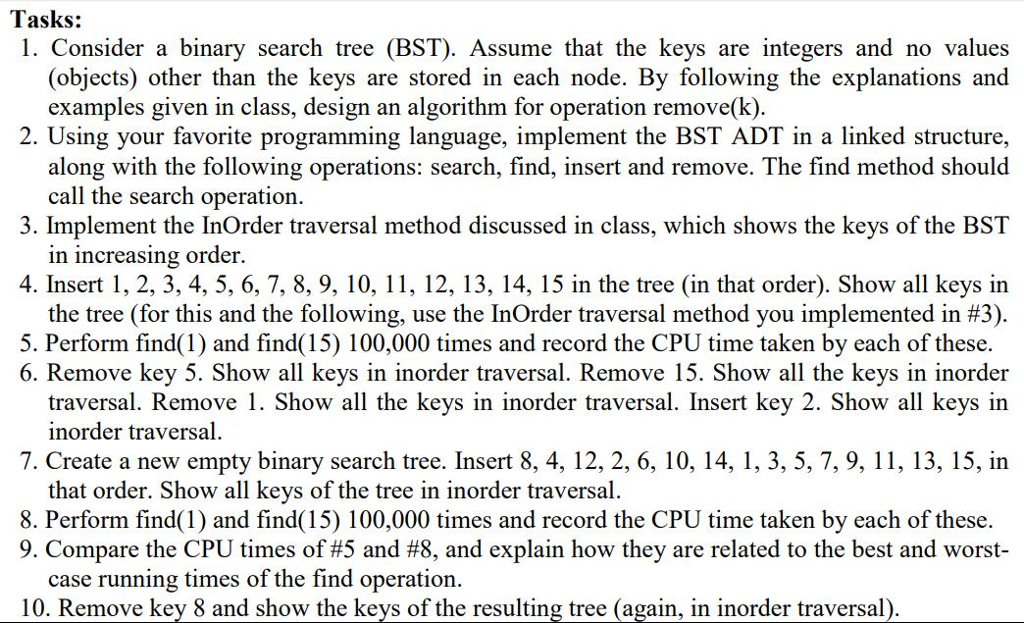
Tasks: 1. Consider a binary search tree (BST). Assume that the keys are integers and no values (objects) other than the keys are stored in each node. By following the explanations and examples given in class, design an algorithm for operation remove(k) 2. Using your favorite programming language, implement the BST ADT in a linked structure, along with the following operations: search, find, insert and remove. The find method should 3. Implement the InOrder traversal method discussed in class, which shows the keys of the BST 4. Insert 1, 2, 3, 4, 5, 6, 7, 8, 9, 10, 11, 12, 13, 14, 15 in the tree (in that order). Show all keys in call the search operation. n increasing order. the tree (for this and the following, use the Inorder traversal method you implemented in #3) 5. Perform find(1) and find(15) 100,000 times and record the CPU time taken by each of these. 6. Remove key 5. Show all keys in inorder traversal. Remove 15. Show all the keys in inorder traversal. Remove 1. Show all the keys in inorder traversal. Insert key 2. Show all keys in inorder traversal. 7. Create a new empty binary search tree. Insert 8, 4, 12, 2, 6, 10, 14, 1, 3, 5, 7, 9, 11, 13, 15, in that order. Show all keys of the tree in inorder traversal. 8. Perform find(1) and find(15) 100,000 times and record the CPU time taken by each of these. 9. Compare the CPU times of #5 and #8, and explain how they are related to the best and worst- case running times of the find operation. 10. Remove key 8 and show the keys of the resulting tree (again, in inorder traversal)
Step by Step Solution
There are 3 Steps involved in it

Get step-by-step solutions from verified subject matter experts
 Study Help