



Question: TCP computes an average round-trip time (RTT) for a connection using an exponential weighted moving average (EWMA) estimator: srttn = a RTTn + (1 -
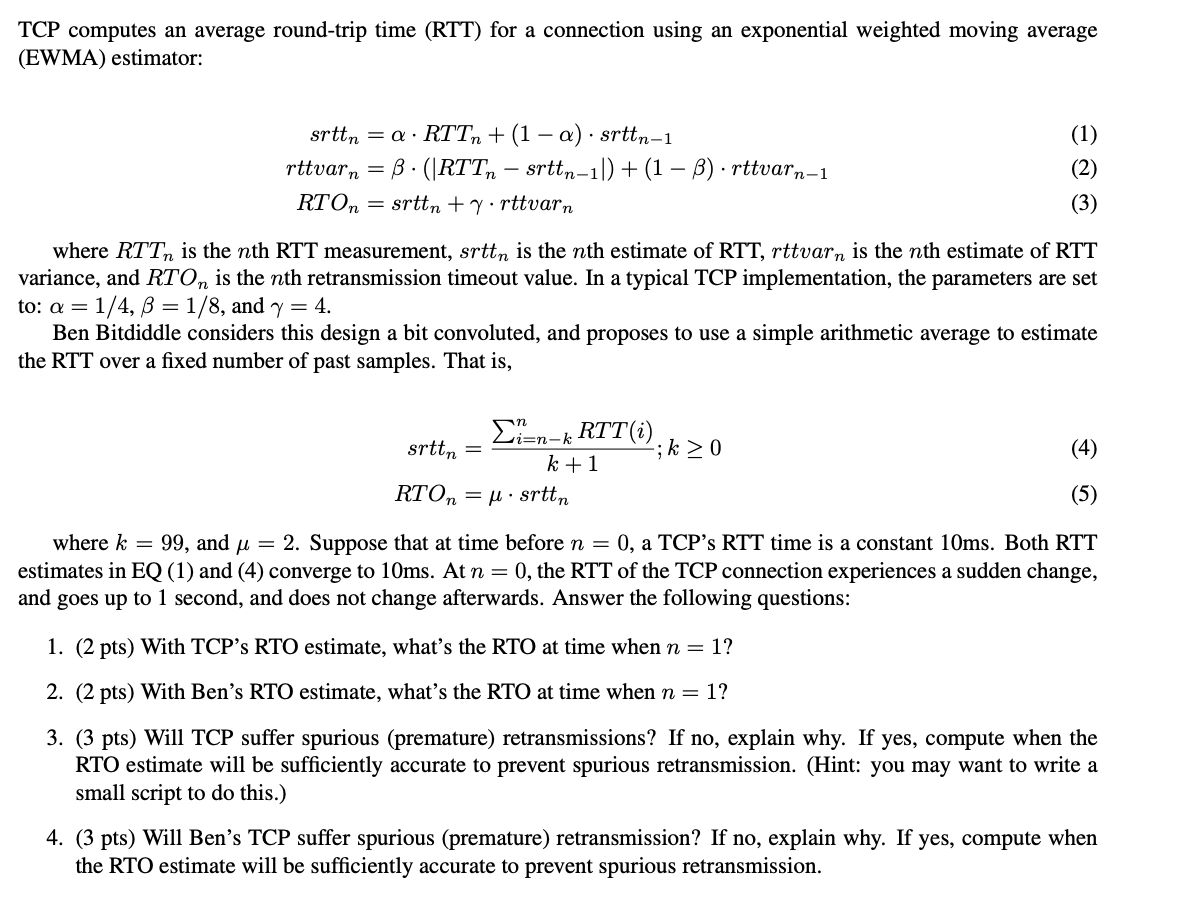
TCP computes an average round-trip time (RTT) for a connection using an exponential weighted moving average (EWMA) estimator: srttn = a RTTn + (1 - a).srttn-1 rttvarn = B. (|RTT, srttn-11) + (1 B). rttvarn-1 RTOn = srttn +7.rttvarn (2) (3) where RTT, is the nth RTT measurement, srttn is the nth estimate of RTT, rttvarn is the nth estimate of RTT variance, and RTOn is the nth retransmission timeout value. In a typical TCP implementation, the parameters are set to: a = 1/4, B = 1/8, and y = 4. Ben Bitdiddle considers this design a bit convoluted, and proposes to use a simple arithmetic average to estimate the RTT over a fixed number of past samples. That is, (4) 2=n-k RTT(i) srttn ?;k > 0 k +1 RTOn = u: srttn (5) where k = 99, and u = 2. Suppose that at time before n = 0, a TCP's RTT time is a constant 10ms. Both RTT estimates in EQ (1) and (4) converge to 10ms. At n = 0, the RTT of the TCP connection experiences a sudden change, and goes up to 1 second, and does not change afterwards. Answer the following questions: 1. (2 pts) With TCP's RTO estimate, what's the RTO at time when n = 1? 2. (2 pts) With Ben's RTO estimate, what's the RTO at time when n = 1? 3. (3 pts) Will TCP suffer spurious (premature) retransmissions? If no, explain why. If yes, compute when the RTO estimate will be sufficiently accurate to prevent spurious retransmission. (Hint: you may want to write a small script to do this.) 4. (3 pts) Will Ben's TCP suffer spurious (premature) retransmission? If no, explain why. If yes, compute when the RTO estimate will be sufficiently accurate to prevent spurious retransmission. TCP computes an average round-trip time (RTT) for a connection using an exponential weighted moving average (EWMA) estimator: srttn = a RTTn + (1 - a).srttn-1 rttvarn = B. (|RTT, srttn-11) + (1 B). rttvarn-1 RTOn = srttn +7.rttvarn (2) (3) where RTT, is the nth RTT measurement, srttn is the nth estimate of RTT, rttvarn is the nth estimate of RTT variance, and RTOn is the nth retransmission timeout value. In a typical TCP implementation, the parameters are set to: a = 1/4, B = 1/8, and y = 4. Ben Bitdiddle considers this design a bit convoluted, and proposes to use a simple arithmetic average to estimate the RTT over a fixed number of past samples. That is, (4) 2=n-k RTT(i) srttn ?;k > 0 k +1 RTOn = u: srttn (5) where k = 99, and u = 2. Suppose that at time before n = 0, a TCP's RTT time is a constant 10ms. Both RTT estimates in EQ (1) and (4) converge to 10ms. At n = 0, the RTT of the TCP connection experiences a sudden change, and goes up to 1 second, and does not change afterwards. Answer the following questions: 1. (2 pts) With TCP's RTO estimate, what's the RTO at time when n = 1? 2. (2 pts) With Ben's RTO estimate, what's the RTO at time when n = 1? 3. (3 pts) Will TCP suffer spurious (premature) retransmissions? If no, explain why. If yes, compute when the RTO estimate will be sufficiently accurate to prevent spurious retransmission. (Hint: you may want to write a small script to do this.) 4. (3 pts) Will Ben's TCP suffer spurious (premature) retransmission? If no, explain why. If yes, compute when the RTO estimate will be sufficiently accurate to prevent spurious retransmission
Step by Step Solution
There are 3 Steps involved in it

Get step-by-step solutions from verified subject matter experts