Question: Teams whose members come from different nations and backgrounds place special demands on managers- especially when a feuding team looks to the boss for help
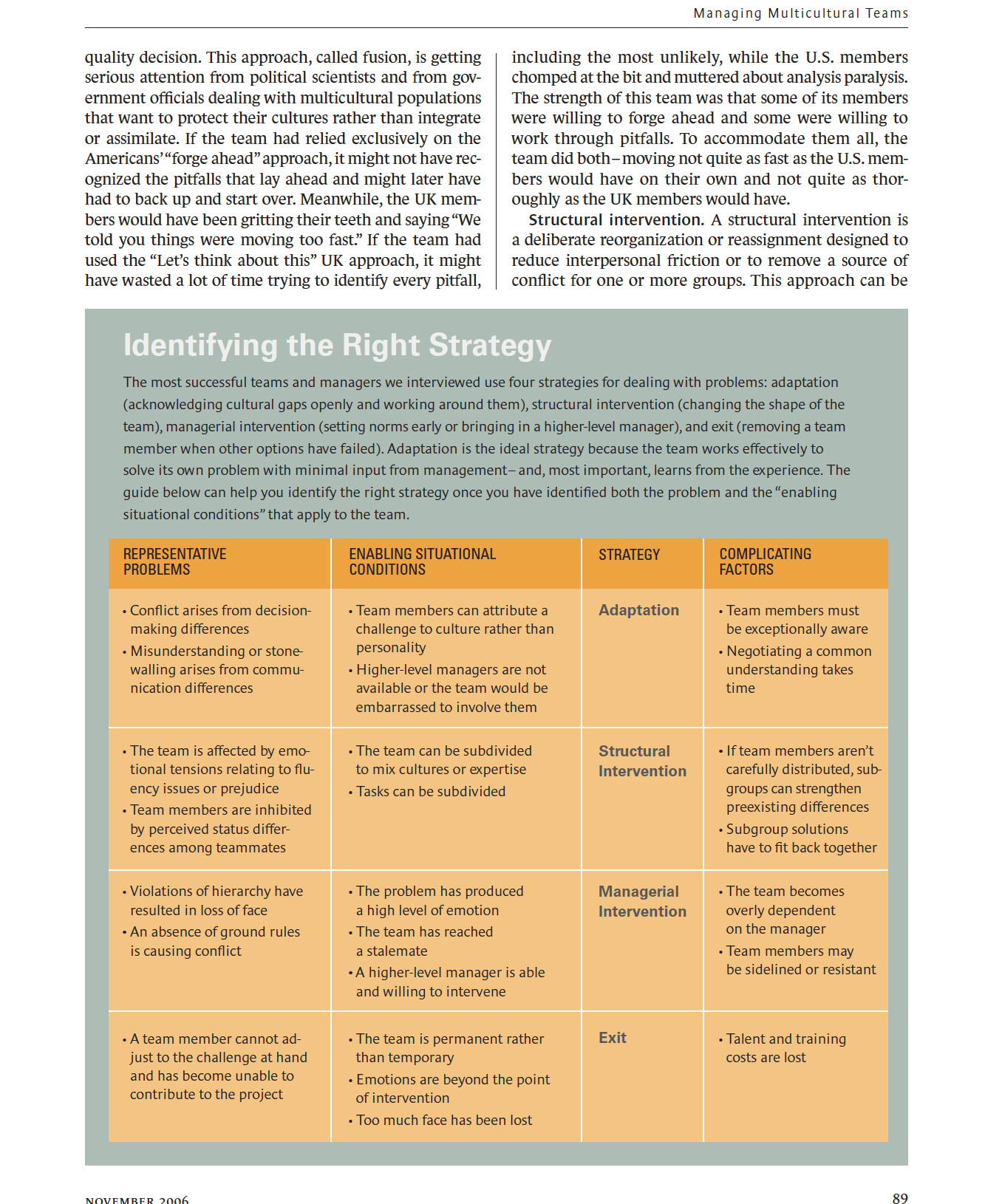
Teams whose members come from different nations and backgrounds place special demands on managers- especially when a feuding team looks to the boss for help with a conflict. Managing Multicultural Teams by Jeanne Brett, Kristin Behfar, and Mary C. Kern When a major international software developer needed to produce a new product quickly, the project manager assembled a team of employees from India and the United States. From the start the team members could not agree on a delivery date for the product. The Americans thought the work could be done in two to three weeks; the Indians predicted it would take two to three months. As time went on, the Indian team mem- bers proved reluctant to report setbacks in the production process, which the American team members would find out about only when work was due to be passed to them. Such conflicts, of course, may affect any team, but in this case they arose from cultural differences. As tensions mounted, conflict over delivery dates and feedback be- came personal, disrupting team members' communica- tion about even mundane issues. The project manager decided he had to intervene-with the result that both the L CALDER American and the Indian team members came to rely onthat the team should have been able to handle itself. The manager became so bogged down by quotidian issues that the project careened hopelessly off even the most pessimistic scheduleand the team never learned to work together effectively. Multicultural teams often generate frustrating manage- ment dilemmas. Cultural differences can create substantial obstacles to effective teamwork but these may be subtle and difficult to recognize until significant damage has al- ready been done. As in the case above, which the manager involved told us about, managers may create more prob- lems than they resolve by intervening. The challenge in managing multicultural teams effectively is to recognize underlying cultural causes of conflict, and to intervene in ways that both get the team back on track and empower its members to deal with future challenges themselves. We interviewed managers and members of multicul- tural teams from all over the world. These interviews, combined with our deep research on dispute resolution and teamwork, led us to conclude that the wrong kind of managerial intervention may sideline valuable members who should be participating or, worse, create resistance, resulting in poor team performance. We're not talking here about respecting differing national standards for doing business, such as accounting practices. We're refer- ring to day-to-day working problems among team mem- bers that can keep multicultural teams from realizing the very gains they were set up to harvest, such as knowl- edge of different product markets, culturally sensitive customer service, and 24-hour work rotations. The good news is that cultural challenges are manage- able if managers and team members choose the right strategy and avoid imposing single-culture-based ap- proaches on multicultural situations. The Challenges People tend to assume that challenges on multicultural teams arise from differing styles of communication. But this is only one of the four categories that, according to our research, can create barriers to a team's ultimate suc- cess. These categories are direct versus indirect communi- cation; trouble with accents and fluency; differing atti- tudes toward hierarchy and authority; and conflicting norms for decision making. Direct versus indirect communication. Communica- tion in Western cultures is typically direct and explicit. The meaning is on the surface, and a listener doesn''t have to know much about the context or the speaker to inter- pret it. This is not true in many other cultures, where meaning is embedded in the way the message is pre- sented. For example, Western negotiators get crucial in- formation about the other party's preferences and pri- orities by asking direct questions, such as \"Do you prefer option A or option B?\" In cultures that use indirect com- munication, negotiators may have to infer preferences and priorities from changes-or the lack of them-in the other party's settlement proposal. In cross-cultural nego- tiations, the non-Westerner can understand the direct communications of the Westerner, but the Westerner has difficulty understanding the indirect communications of the non-Westerner. An American manager who was leading a project to build an interface for a U.S. and Japanese customer-data system explained the problems her team was having this way: \"In Japan, they want to talk and discuss. Then we take a break and they talk within the organization. They want to make sure that there's harmony in the rest of the organization. One of the hardest lessons for me was when I thought they were saying yes but they just meant 'I'm listening to you.\" The differences between direct and indirect communi- cation can cause serious damage to relationships when team projects run into problems. When the American manager quoted above discovered that several flaws in the system would significantly disrupt company opera- tions, she pointed this out in an e-mail to her American boss and the Japanese team members. Her boss appreci- ated the direct warnings; her Japanese colleagues were embarrassed, because she had violated their norms for uncovering and discussing problems. Their reaction was to provide her with less access to the people and informa- tion she needed to monitor progress. They would proba- bly have responded better if she had pointed out the problems indirectly - for example, by asking them what would happen if a certain part of the system was not func- tioning properly, even though she knew full well that it was malfunctioning and also what the implications were. As our research indicates is so often true, communi- cation challenges create barriers to effective teamwork by reducing information sharing, creating interpersonal conflict, or both. In Japan, a typical response to direct con- frontation is to isolate the norm violator. This American manager was isolated not just socially but also physically. She told us, \"They literally put my office in a storage room, where I had desks stacked from floor to ceiling and I was the only person there. So they totally isolated me, which was a pretty loud signal to me that I was not a part of the inside circle and that they would communicate with me only as needed.\" Managing Multicultural Teams Her direct approach had been intended to solve a prob- lem, and in one sense, it did, because her project was launched problem-free. But her norm violations exacer- bated the challenges of working with her Japanese col- leagues and limited her ability to uncover any other prob- lems that might have derailed the project later on. Trouble with accents and fluency. Although the lan- guage of international business is English, misunderstand- ings or deep frustration may occur because of nonnative speakers' accents, lack of fluency, or problems with trans- lation or usage. These may also influence perceptions of status or competence. For example, a Latin American member of a multicul- tural consulting team lamented, \"Many times I felt that the Koreans would caucus at the table by speaking Ko- rean. The buyers, frustrated, would respond by appearing to caucus in Spanishthough they discussed only incon- sequential current events and sports, in case any of the Koreans spoke Spanish. Members of the team who didn't speak Spanish pretended to participate, to the great amusement of their teammates. This approach proved ef- fective: It conveyed to the Koreans in an appropriately indirect way that their caucuses in Korean were frustrat- ing and annoying to the other side. As a result, both teams cut back on sidebar conversations. Differing attitudes toward hierarchy and authority. A challenge inherent in multicultural teamwork is that by design, teams have a rather flat structure. But team In many other cultures, meaning is embedded in the way the message is presented. The differences can cause serious damage to team relationships. because of the language difference, I didn't have the words to say some things that I was thinking. I noticed that when I went to these interviews with the U.S. guy, he would tend to lead the interviews, which was under- standable but also disappointing, because we are at the same level. I had very good questions, but he would take the lead\" When we interviewed an American member of a U.S-- Japanese team that was assessing the potential expan- sion of a U.S. retail chain into Japan, she described one American teammate this way: \"He was not interested in the Japanese consultants' feedback and felt that because they weren't as fluent as he was, they weren't intelligent enough and, therefore, could add no value.\" The team member described was responsible for assessing one as- pect of the feasibility of expansion into Japan. Without input from the Japanese experts, he risked overestimating opportunities and underestimating challenges. Nonfluent team members may well be the most expert on the team, but their difficulty communicating knowl- edge makes it hard for the team to recognize and utilize their expertise. If teammates become frustrated or impa- tient with a lack of fluency, interpersonal conflicts can arise. Nonnative speakers may become less motivated to contribute, or anxious about their performance evalua- tions and future career prospects. The organization as a whole pays a greater price: Its investment in a multicul- tural team fails to pay off. Some teams, we learned, use language differences to resolve (rather than create) tensions. A team of U.S. and Latin American buyers was negotiating with a team from a Korean supplier. The negotiations took place in Korea, but the discussions were conducted in English. Frequently members from some cultures, in which people are treated differently according to their status in an organization, are uncomfortable on flat teams. If they defer to higher- status team members, their behavior will be seen as ap- propriate when most of the team comes from a hierar- chical culture; but they may damage their stature and credibility and even face humiliation if most of the team comes from an egalitarian culture. One manager of Mexican heritage, who was working on a credit and underwriting team for a bank, told us,\"In Mexican culture, you're always supposed to be humble. So whether you understand something or not, you're sup- posed to put it in the form of a question. You have to keep it open-ended, out of respect. I think that actually worked against me, because the Americans thought I really didn't know what I was talking about. So it made me feel like they thought I was wavering on my answer.\" When, as a result of differing cultural norms, team members believe they've been treated disrespectfully, the whole project can blow up. In another Korean-U.S. negotiation, the American members of a due diligence team were having difficulty getting information from their Korean counterparts, so they complained directly to higher-level Korean management, nearly wrecking the deal. The higher-level managers were offended because hierarchy is strictly adhered to in Korean organizations and culture. It should have been their own lower-level people, not the U.S. team members, who came to them with a problem. And the Korean team members were mortified that their bosses had been involved before they themselves could brief them. The crisis was resolved only when high-level U.S. managers made a trip to Korea, con- veying appropriate respect for their Korean counterparts. Managing Multicultural Teams Conflicting norms for decision making. Cultures dif- fer enormously when it comes to decision making partic- ularly, how quickly decisions should be made and how much analysis is required beforehand. Not surprisingly, U.S. managers like to make decisions very quickly and with relatively little analysis by comparison with manag- ers from other countries. A Brazilian manager at an American company who was negotiating to buy Korean products destined for Latin America told us, \"On the first day, we agreed on three points, and on the second day, the U.S.-Spanish side wanted to start with point four. But the Korean side wanted to go back and rediscuss points one through three. My boss almost had an attack\" What U.S. team members learn from an experience like this is that the American way simply cannot be imposed on other cultures. Managers from other cultures may, for example, decline to share information until they under- stand the full scope of a project. But they have learned that they can't simply ignore the desire of their American counterparts to make decisions quickly. What to do? The manent or temporary? Does the team's manager have the autonomy to make a decision about changing the team in some way? Once the situational conditions have been an- alyzed, the team's leader can identify an appropriate re- sponse (see the exhibit \"Identifying the Right Strategy\"). Adaptation. Some teams find ways to work with or around the challenges they face, adapting practices or at- titudes without making changes to the group's mem- bership or assignments. Adaptation works when team members are willing to acknowledge and name their cul- tural differences and to assume responsibility for figur- ing out how to live with them. It's often the best possible approach to a problem, because it typically involves less managerial time than other strategies; and because team members participate in solving the problem themselves, they learn from the process. When team members have this mind-set, they can be creative about protecting their own substantive differences while acceding to the pro- cesses of others. An American software engineer located in Ireland who was working with an Israeli account management team by deferring to higher-status teammates, damage their stature and credibility and even face humiliationif most of the team is from an egalitarian culture. best solution seems to be to make minor concessions on processto learn to adjust to and even respect another ap- proach to decision making. For example, American manag- ers have learned to keep their impatient bosses away from team meetings and give them frequent if brief updates. A comparable lesson for managers from other cultures is to be explicit about what they need - saying, for example, \"We have to see the big picture before we talk details.\" Four Strategies The most successful teams and managers we interviewed used four strategies for dealing with these challenges: adaptation (acknowledging cultural gaps openly and working around them), structural intervention (changing the shape of the team), managerial intervention (setting norms early or bringing in a higher-level manager), and exit (removing a team member when other options have failed). There is no one right way to deal with a particular kind of multicultural problem; identifying the type of challenge is only the first step. The more crucial step is assessing the circumstances or \"enabling situational conditions\"-under which the team is working. For exam- ple,does the project allow any flexibility for change, or do deadlines make that impossible? Are there additional re- sources available that might be tapped? Is the team per- QQ from his own company told us how shocked he was by the Israelis' in-your-face style: \"There were definitely different ways of approaching issues and discussing them. There is something pretty common to the Israeli culture: They like to argue. I tend to try to collaborate more, and it got very stressful for me until I figured out how to kind of merge the cultures\" The software engineer adapted. He imposed some structure on the Israelis that helped him maintain his own style of being thoroughly prepared; that accommo- dation enabled him to accept the Israeli style. He also no- ticed that team members weren't just confronting him; they confronted one another but were able to work to- gether effectively nevertheless. He realized that the con- frontation was not personal but cultural. In another example, an American member of a post- merger consulting team was frustrated by the hierarchy of the French company his team was working with. He felt that a meeting with certain French managers who were not directly involved in the merger \"wouldn't deliver any value to me or for purposes of the project,\" but said that he had come to understand that \"it was very impor- tant to really involve all the people there\" if the integra- tion was ultimately to work. A U.S. and UK multicultural team tried to use their dif- fering approaches to decision making to reach a higher- Managing Multicultural Teams quality decision. This approach, called fusion, is getting including the most unlikely, while the U.S. members serious attention from political scientists and from gov- chomped at the bit and muttered about analysis paralysis. ernment officials dealing with multicultural populations The strength of this team was that some of its members that want to protect their cultures rather than integrate were willing to forge ahead and some were willing to or assimilate. If the team had relied exclusively on the work through pitfalls. To accommodate them all, the Americans' "forge ahead" approach, it might not have rec- team did both-moving not quite as fast as the U.S. mem- ognized the pitfalls that lay ahead and might later have bers would have on their own and not quite as thor- had to back up and start over. Meanwhile, the UK mem- oughly as the UK members would have. bers would have been gritting their teeth and saying "We Structural intervention. A structural intervention is told you things were moving too fast." If the team had a deliberate reorganization or reassignment designed to used the "Let's think about this" UK approach, it might reduce interpersonal friction or to remove a source of have wasted a lot of time trying to identify every pitfall, conflict for one or more groups. This approach can be Identifying the Right Strategy The most successful teams and managers we interviewed use four strategies for dealing with problems: adaptation (acknowledging cultural gaps openly and working around them), structural intervention (changing the shape of the team), managerial intervention (setting norms early or bringing in a higher-level manager), and exit (removing a team member when other options have failed). Adaptation is the ideal strategy because the team works effectively to solve its own problem with minimal input from management- and, most important, learns from the experience. The guide below can help you identify the right strategy once you have identified both the problem and the "enabling situational conditions" that apply to the team. REPRESENTATIVE ENABLING SITUATIONAL STRATEGY COMPLICATING PROBLEMS CONDITIONS FACTORS . Conflict arises from decision- . Team members can attribute a Adaptation . Team members must making differences challenge to culture rather than be exceptionally aware . Misunderstanding or stone- personality Negotiating a common walling arises from commu- Higher-level managers are not understanding takes nication differences available or the team would be time embarrassed to involve them The team is affected by emo- The team can be subdivided Structural If team members aren't tional tensions relating to flu- to mix cultures or expertise Intervention carefully distributed, sub- ency issues or prejudice Tasks can be subdivided groups can strengthen Team members are inhibited preexisting differences by perceived status differ . Subgroup solutions ences among teammates have to fit back together . Violations of hierarchy have The problem has produced Managerial The team becomes resulted in loss of face a high level of emotion Intervention overly dependent . An absence of ground rules The team has reached on the manager is causing conflict a stalemate Team members may A higher-level manager is able be sidelined or resistant and willing to intervene A team member cannot ad- The team is permanent rather Exit Talent and training just to the challenge at hand than temporary costs are lost and has become unable to Emotions are beyond the point contribute to the project of intervention Too much face has been lostManaging Multicultural Teams extremely effective when obvious subgroups demarcate the team (for example, headquarters versus national subsidiaries) or if team members are proud, defensive, threatened, or clinging to negative stereotypes of one another. A member of an investment research team scattered across continental Europe, the UK, and the U.S. described for us how his manager resolved conflicts stemming from status differences and language tensions among the team's three \"tribes\" The manager started by having the team meet face-to-face twice a year, not to discuss mundane day-to-day problems (of which there were many) but to identify a set of values that the team would use to direct and evaluate its progress. At the first meet- ing, he realized that when he started to speak, everyone else \"shut down,\" waiting to hear what he had to say. So he hired a consultant to run future meetings. The consultant didn't represent a hierarchical threat and was therefore able to get lots of participation from team members. Another structural intervention might be to create smaller working groups of mixed cultures or mixed corpo- rate identities in order to get at information that is not forthcoming from the team as a whole. The manager of an the team that was evaluating retail opportunities in Japan used this approach. When she realized that the female Japanese consultants would not participate if the group got large, or if their male superior was present, she broke the team up into smaller groups to try to solve problems. She used this technique repeatedly and made a point of changing the subgroups' membership each time so that team members got to know and respect everyone else on the team. The subgrouping technique involves risks, however. It buffers people who are not working well together or not participating in the larger group for one reason or an- other. Sooner or later the team will have to assemble the pieces that the subgroups have come up with, so this ap- proach relies on another structural intervention: Some- one must become a mediator in order to see that the var- ious pieces fit together. Managerial intervention. When a manager behaves like an arbitrator or a judge, making a final decision with- out team involvement, neither the manager nor the team gains much insight into why the team has stalemated. But it is possible for team members to use managerial intervention effectively to sort out problems. When an American refinery-safety expert with significant experience throughout East Asia got stymied during a project in China, she called in her company's higher-level managers in Beijing to talk to the higher-level managers to whom the Chinese refinery's managers reported. Unlike the Western team members who breached eti- quette by approaching the superiors of their Ko- rean counterparts, the safety expert made sure to respect hierarchies in both organizations. \"Trying to resolve the issues,\" she told us, \"the local management at the Chinese refinery would end up having conferences with our Beijing of- fice and also with the upper management within the refinery. Eventually they understood that we weren't trying to insult them or their culture or to tell them they were bad in any way. We were trying to help. They eventually understood that there were significant fire and safety issues. But we actually had to go up some levels of manage- ment to get those resolved\" Managerial intervention to set norms early in a team's life can really help the team start out with effective processes. In one instance reported to us, a multicultural software development team's lingua franca was English, but some mem- bers, though they spoke grammatically correct English, had a very pronounced accent. In setting the ground rules for the team, the manager ad- dressed the challenge directly, telling the mem- bers that they had been chosen for their task ex- pertise, not their fluency in English, and that the TrAamIrATT nrtoTaros nmarar | rimn Ane Managing Multicultural Teams team was going to have to work around language prob- lems. As the project moved to the customer-services train- ing stage, the manager advised the team members to ac- knowledge their accents up front. She said they should tell customers, \"I realize I have an accent. If you don't un- derstand what I''m saying, just stop me and ask questions.\" Exit. Possibly because many of the teams we studied were project based, we found that leaving the team was an infrequent strategy for managing challenges. In short-term situations, unhappy team members often just waited out the project. When teams were permanent, producing products or services, the exit of one or more members was a strategy of last resort, but it was used - either voluntar- ily or after a formal request from management. Exit was to get the team moving again, but they seldom empower it to help itself the next time a stalemate occurs. When frustrated team members take some time to think through challenges and possible solutions themselves, it can make a huge difference. Take, for example, this story about a financial-services call center. The members of the call-center team were all fluent Spanish-speakers, but some were North Americans and some were Latin Americans. Team performance, measured by calls answered per hour, was lagging. One Latin American was taking twice as long with her calls as the rest of the team. She was han- dling callers' questions appropriately, but she was also engaging in chitchat. When her teammates confronted her for being a free rider (they resented having to make telling the members that they had been chosen for their task expertise, not their fluency in English, and that the team would have to work around problems. likely when emotions were running high and too much face had been lost on both sides to salvage the situation. An American member of a multicultural consulting team described the conflict between two senior consul- tants, one a Greek woman and the other a Polish man, over how to approach problems: \"The woman from Greece would say, 'Here's the way I think we should do it' It would be something that she was in control of. The guy from Poland would say, 'I think we should actually do it this way instead' The woman would kind of turn red in the face, upset, and say, 'I just don't think that's the right way of doing it It would definitely switch from just professional differences to personal differences. \"The woman from Greece ended up leaving the firm. That was a direct result of probably all the different issues going on between these people. It really just wasn't a good fit. I've found that oftentimes when you're in con- sulting, you have to adapt to the culture, obviously, but you have to adapt just as much to the style of whoever is leading the project.\" Though multicultural teams face challenges that are not directly attributable to cultural differences, such differ- ences underlay whatever problem needed to be addressed in many of the teams we studied. Furthermore, while se- rious in their own right when they have a negative effect on team functioning, cultural challenges may also unmask fundamental managerial problems. Managers who inter- vene early and set norms; teams and managers who struc- ture social interaction and work to engage everyone on the team; and teams that can see problems as stemming from culture, not personality, approach challenges with good humor and creativity. Managers who have to inter- vene when the team has reached a stalemate may be able up for her low call rate), she immediately acknowledged the problem, admitting that she did not know how to end the call politely - chitchat being normal in her cul- ture. They rallied to help her: Using their technology, they would break into any of her calls that went overtime, ex- cusing themselves to the customer, offering to take over the call, and saying that this employee was urgently needed to help out on a different call. The team's solution worked in the short run, and the employee got better at ending her calls in the long run. In another case, the Indian manager of a multicultural team coordinating a companywide IT project found him- self frustrated when he and a teammate from Singapore met with two Japanese members of the coordinating team to try to get the Japan section to deliver its part of the project. The Japanese members seemed to be saying yes, but in the Indian manager's view, their follow- through was insufficient. He considered and rejected the idea of going up the hierarchy to the Japanese team mem- bers' boss, and decided instead to try to build consensus with the whole Japanese IT team, not just the two mem- bers on the coordinating team. He and his Singapore teammate put together an eBusiness road show, took it to Japan, invited the whole IT team to view it at a lunch meeting, and walked through success stories about other parts of the organization that had aligned with the com- pany's larger business priorities. It was rather subtle, he told us, but it worked. The Japanese IT team wanted to be spotlighted in future eBusiness road shows. In the end, the whole team worked well together and no higher- level manager had to get involved. Reprint R0611D To order, see page 159
Step by Step Solution
There are 3 Steps involved in it
1 Expert Approved Answer
Step: 1 Unlock
Question Has Been Solved by an Expert!
Get step-by-step solutions from verified subject matter experts
Step: 2 Unlock
Step: 3 Unlock
Students Have Also Explored These Related General Management Questions!









 Study Help