





Question: template class List { // List ADT private: void operator = (const List&) { } // Protect assignment List (const List&) {} // Protect copy
 template class List { // List ADT private: void operator =(const List&) { } // Protect assignment List (const List&) {} //

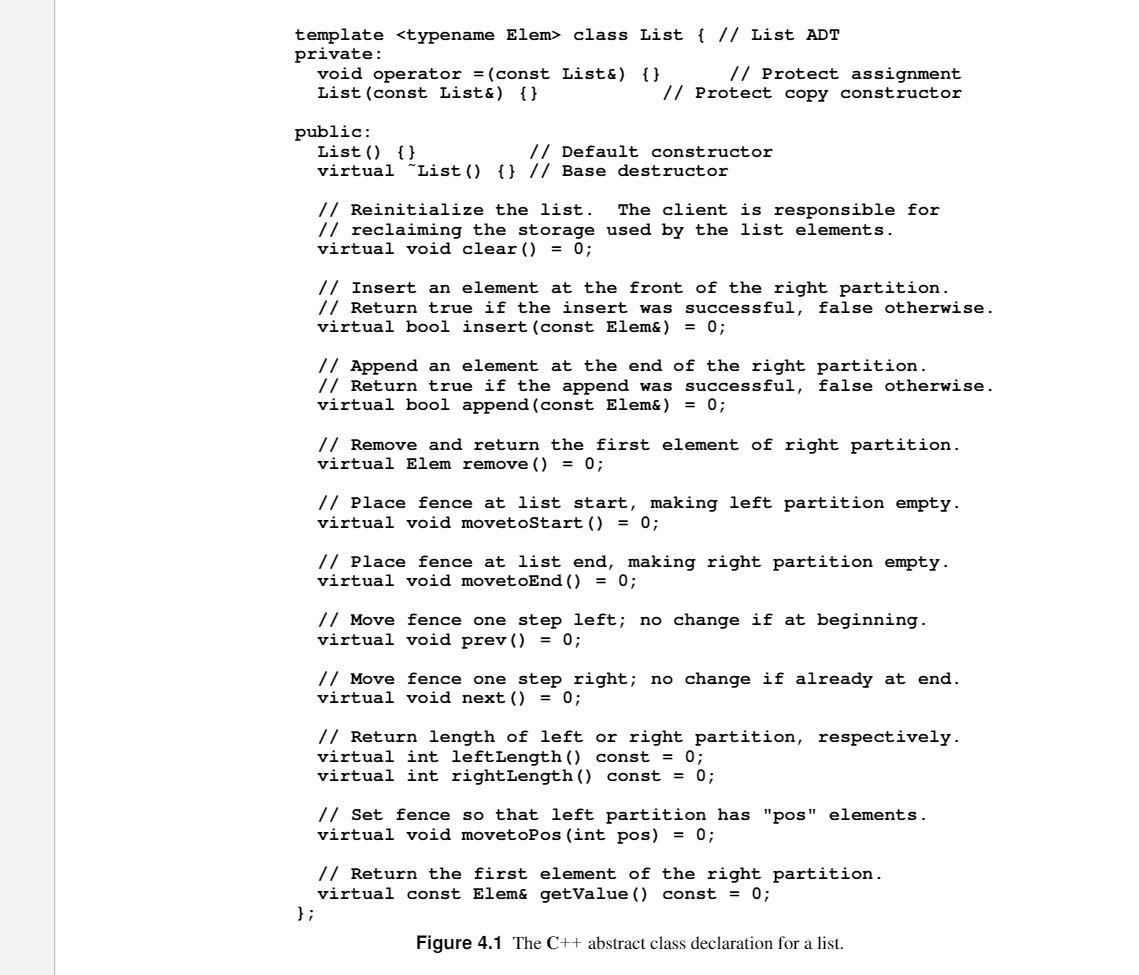
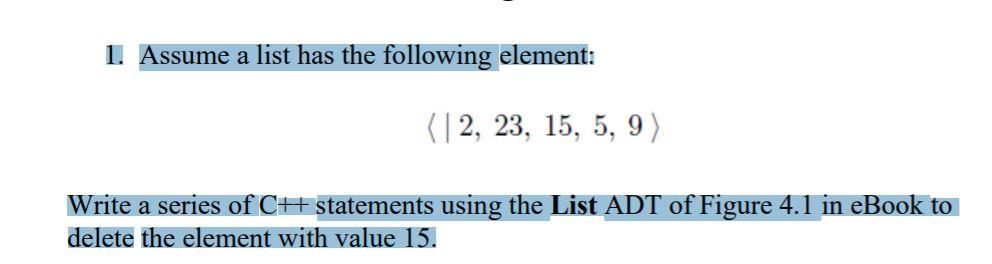
template class List { // List ADT private: void operator = (const List&) { } // Protect assignment List (const List&) {} // Protect copy constructor public: List() {} // Default constructor virtual "List() {} // Base destructor // Reinitialize the list. The client is responsible for // reclaiming the storage used by the list elements. virtual void clear() = 0; // Insert an element at the front of the right partition. // Return true if the insert was successful, false otherwise. virtual bool insert (const Elem&) = 0; // Append an element at the end of the right partition. // Return true if the append was successful, false otherwise. virtual bool append (const Elem&) = 0; // Remove and return the first element of right partition. virtual Elem remove () = 0; // Place fence at list start, making left partition empty. virtual void movetoStart() = 0; // Place fence at list end, making right partition empty. virtual void movetoEnd () // Move fence one step left; no change if at beginning. virtual void prev () = 0; // Move fence one step right; no change if already at end. virtual void next() = 0; // Return length of left or right partition, respectively. virtual int left Length() const = 0; virtual int rightLength() const = 0; // Set fence so that left partition has "pos" elements. virtual void movetoPos (int pos) = 0; // Return the first element of the right partition. virtual const Elem& getValue() const = 0; }; Figure 4.1 The C++ abstract class declaration for a list. 1. Assume a list has the following element: (12, 23, 15, 5, 9) Write a series of CH statements using the List ADT of Figure 4.1 in eBook to delete the element with value 15. template class List { // List ADT private: void operator = (const List&) { } // Protect assignment List (const List&) {} // Protect copy constructor public: List() {} // Default constructor virtual "List() {} // Base destructor // Reinitialize the list. The client is responsible for // reclaiming the storage used by the list elements. virtual void clear() = 0; // Insert an element at the front of the right partition. // Return true if the insert was successful, false otherwise. virtual bool insert (const Elem&) = 0; // Append an element at the end of the right partition. // Return true if the append was successful, false otherwise. virtual bool append (const Elem&) = 0; // Remove and return the first element of right partition. virtual Elem remove () = 0; // Place fence at list start, making left partition empty. virtual void movetoStart() = 0; // Place fence at list end, making right partition empty. virtual void movetoEnd () // Move fence one step left; no change if at beginning. virtual void prev () = 0; // Move fence one step right; no change if already at end. virtual void next() = 0; // Return length of left or right partition, respectively. virtual int left Length() const = 0; virtual int rightLength() const = 0; // Set fence so that left partition has "pos" elements. virtual void movetoPos (int pos) = 0; // Return the first element of the right partition. virtual const Elem& getValue() const = 0; }; Figure 4.1 The C++ abstract class declaration for a list. 1. Assume a list has the following element: (12, 23, 15, 5, 9) Write a series of CH statements using the List ADT of Figure 4.1 in eBook to delete the element with value 15

Step by Step Solution

There are 3 Steps involved in it

1 Expert Approved Answer
Step: 1 Unlock blur-text-image
Question Has Been Solved by an Expert!

Get step-by-step solutions from verified subject matter experts

Step: 2 Unlock
Step: 3 Unlock

Students Have Also Explored These Related Databases Questions!