







Question: Temporary Dams The need for temporary dams is increasing with the increasing frequency of flooding in the U.S. You are to construct temporary concrete dams
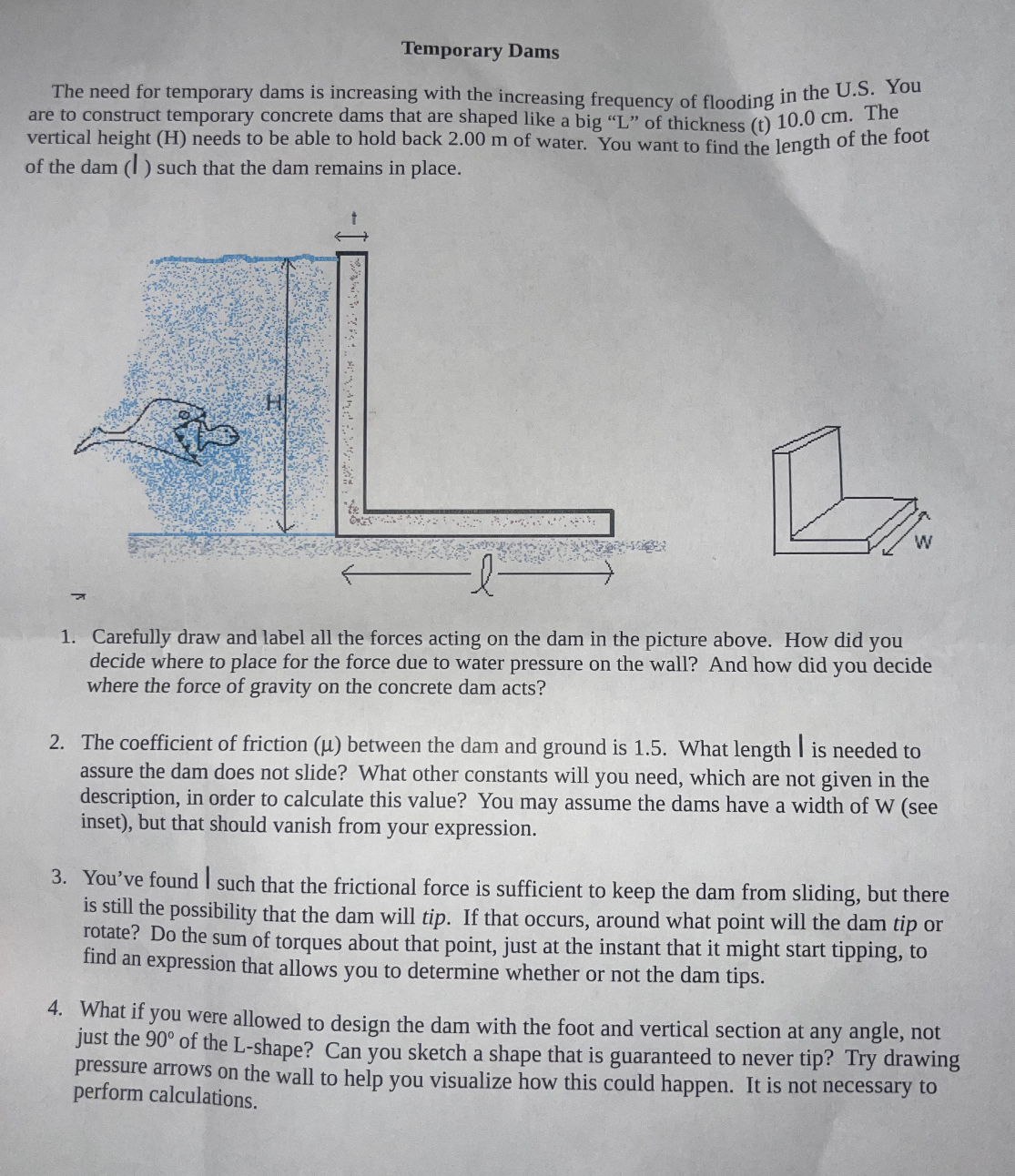
Temporary Dams The need for temporary dams is increasing with the increasing frequency of flooding in the U.S. You are to construct temporary concrete dams that are shaped like a big "L" of thickness (t) 10.0 cm. The vertical height (H) needs to be able to hold back 2.00 m of water. You want to find the length of the foot of the dam ( ) such that the dam remains in place. 1. Carefully draw and label all the forces acting on the dam in the picture above. How did you decide where to place for the force due to water pressure on the wall? And how did you decide where the force of gravity on the concrete dam acts? 2. The coefficient of friction (u) between the dam and ground is 1.5. What length | is needed to assure the dam does not slide? What other constants will you need, which are not given in the description, in order to calculate this value? You may assume the dams have a width of W (see inset), but that should vanish from your expression. 3. You've found | such that the frictional force is sufficient to keep the dam from sliding, but there is still the possibility that the dam will tip. If that occurs, around what point will the dam tip or rotate? Do the sum of torques about that point, just at the instant that it might start tipping, to find an expression that allows you to determine whether or not the dam tips. 4. What if you were allowed to design the dam with the foot and vertical section at any angle, not just the 90 of the L-shape? Can you sketch a shape that is guaranteed to never tip? Try drawing pressure arrows on the wall to help you visualize how this could happen. It is not necessary to perform calculations
Step by Step Solution
There are 3 Steps involved in it

Get step-by-step solutions from verified subject matter experts
 Study Help