







Question: Test Is positive (P) Test is Negative (N)Disease Present (D) .07 .03Disease Absent (D^c) .04 .86 P(NID) = .3 (b) Use Bayes' Rule and the
Test Is positive (P) Test is Negative (N)Disease Present (D) .07 .03Disease Absent (D^c) .04 .86
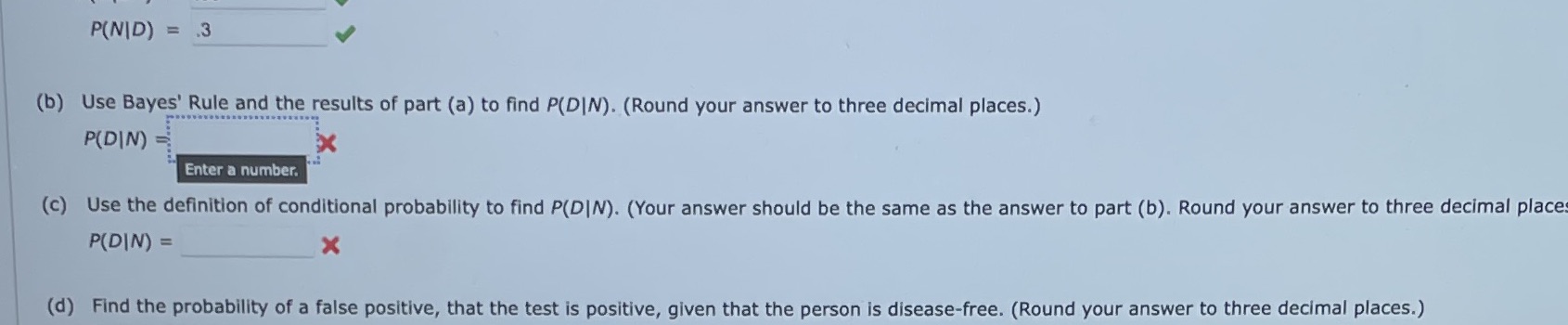
P(NID) = .3 (b) Use Bayes' Rule and the results of part (a) to find P(DIN). (Round your answer to three decimal places.) P(DIN) X Enter a number. (c) Use the definition of conditional probability to find P(DIN). (Your answer should be the same as the answer to part (b). Round your answer to three decimal place P(DIN) = X (d) Find the probability of a false positive, that the test is positive, given that the person is disease-free. (Round your answer to three decimal places.)
Step by Step Solution
There are 3 Steps involved in it
1 Expert Approved Answer
Step: 1 Unlock

Question Has Been Solved by an Expert!
Get step-by-step solutions from verified subject matter experts
Step: 2 Unlock
Step: 3 Unlock
 Study Help