







Question: Weber's law, a concept taught in most Introduction to Psychology courses, states that the ratio of the intensity of a stimulus to the just
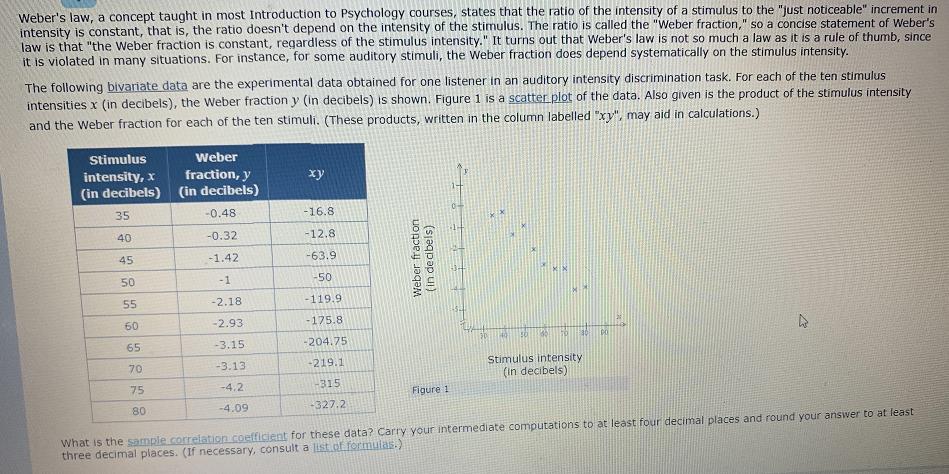
Weber's law, a concept taught in most Introduction to Psychology courses, states that the ratio of the intensity of a stimulus to the "just noticeable" increment in intensity is constant, that is, the ratio doesn't depend on the intensity of the stimulus. The ratio is called the "Weber fraction," so a concise statement of Weber's law is that "the Weber fraction is constant, regardless of the stimulus intensity." It turns out that Weber's law is not so much a law as it is a rule of thumb, since it is violated in many situations. For instance, for some auditory stimuli, the Weber fraction does depend systematically on the stimulus intensity. The following bivariate data are the experimental data obtained for one listener in an auditory intensity discrimination task. For each of the ten stimulus intensities x (in decibels), the Weber fraction y (in decibels) is shown. Figure 1 is a scatter plot of the data. Also given is the product of the stimulus intensity and the Weber fraction for each of the ten stimuli. (These products, written in the column labelled "xy", may aid in calculations.) Stimulus Weber fraction, y intensity, x (in decibels) (in decibels) xy 35 -0.48 -16.8 40 -0.32 -12.8 45 -1.42 -63.9 50 -1 -50 55 -2.18 -119.9 60 -2.93 -175.8 65 -3.15 -204.75 Stimulus intensity (in decibels) 70 -3.13 -219.1 75 -4.2 -315 Figure 1 80 -4.09 -327.2 What is the sample correlation.coefficient for these data? Carry your intermediate computations to at least four decimal places and round your answer to at least three decimal places. (If necessary, consult a list of formuias.) Weber fraction (in decibels)
Step by Step Solution
3.50 Rating (163 Votes )
There are 3 Steps involved in it

Get step-by-step solutions from verified subject matter experts
 Study Help