







Question: Testing Assumptions Before performing a t-test on the variables, we will test for assumptions. It will be assumed that homogeneity of variance can be
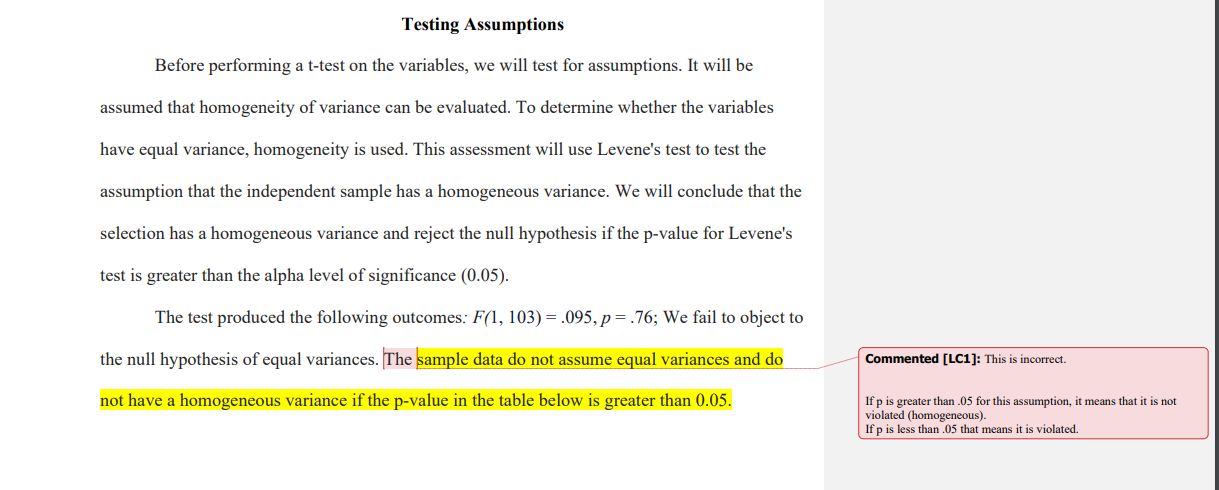
Testing Assumptions Before performing a t-test on the variables, we will test for assumptions. It will be assumed that homogeneity of variance can be evaluated. To determine whether the variables have equal variance, homogeneity is used. This assessment will use Levene's test to test the assumption that the independent sample has a homogeneous variance. We will conclude that the selection has a homogeneous variance and reject the null hypothesis if the p-value for Levene's test is greater than the alpha level of significance (0.05). The test produced the following outcomes: F(1, 103) = .095, p = .76; We fail to object to the null hypothesis of equal variances. The sample data do not assume equal variances and do not have a homogeneous variance if the p-value in the table below is greater than 0.05. Commented [LC1]: This is incorrect. If p is greater than .05 for this assumption, it means that it is not violated (homogeneous). If p is less than .05 that means it is violated.
Step by Step Solution
There are 3 Steps involved in it

Get step-by-step solutions from verified subject matter experts
 Study Help