


Question: Text description- ElectronPlus manufactures and sells a unique electronic part. Operating results for the first three years of activity were as follows (absorption costing basis):
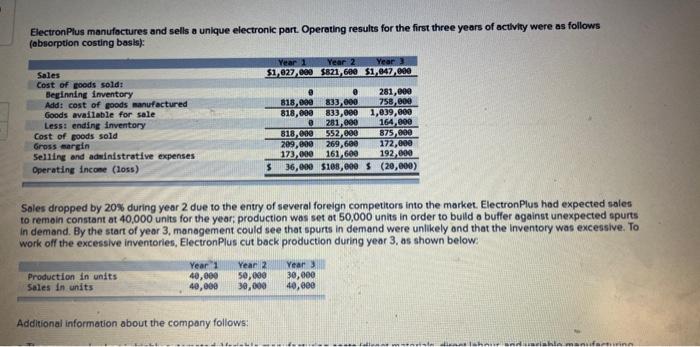
 Text description- ElectronPlus manufactures and sells a unique electronic part. Operating
results for the first three years of activity were as follows (absorption
costing basis): Year 1 Year 2 Year 3 Sales $ 1,027,000 $
821,600 $ 1,047,000 Cost of goods sold: Beginning inventory 0 0 281,000
Text description-
ElectronPlus manufactures and sells a unique electronic part. Operating results for the first three years of activity were as follows (absorption costing basis):
Year 1 Year 2 Year 3
Sales $ 1,027,000 $ 821,600 $ 1,047,000
Cost of goods sold:
Beginning inventory 0 0 281,000
Add: cost of goods manufactured 818,000 833,000 758,000
Goods available for sale 818,000 833,000 1,039,000
Less: ending inventory 0 281,000 164,000
Cost of goods sold 818,000 552,000 875,000
Gross margin 209,000 269,600 172,000
Selling and administrative expenses 173,000 161,600 192,000
Operating income (loss) $ 36,000 $ 108,000 $ (20,000 )
Sales dropped by 20% during year 2 due to the entry of several foreign competitors into the market. ElectronPlus had expected sales to remain constant at 40,000 units for the year; production was set at 50,000 units in order to build a buffer against unexpected spurts in demand. By the start of year 3, management could see that spurts in demand were unlikely and that the inventory was excessive. To work off the excessive inventories, ElectronPlus cut back production during year 3, as shown below:
Year 1 Year 2 Year 3
Production in units 40,000 50,000 30,000
Sales in units 40,000 30,000 40,000
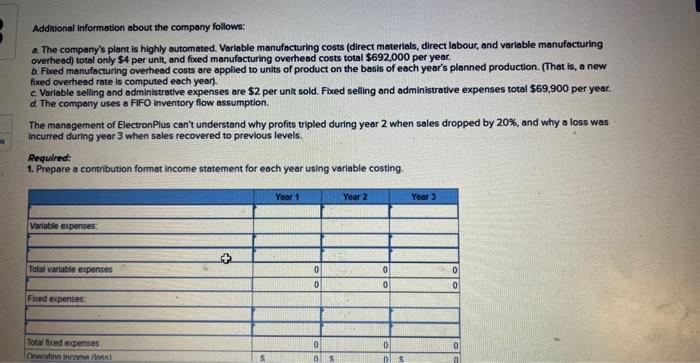
Additional information about the company follows:
a. The companys plant is highly automated. Variable manufacturing costs (direct materials, direct labour, and variable manufacturing overhead) total only $4 per unit, and fixed manufacturing overhead costs total $692,000 per year.
b. Fixed manufacturing overhead costs are applied to units of product on the basis of each years planned production. (That is, a new fixed overhead rate is computed each year).
c. Variable selling and administrative expenses are $2 per unit sold. Fixed selling and administrative expenses total $69,900 per year.
d. The company uses a FIFO inventory flow assumption.
The management of ElectronPlus cant understand why profits tripled during year 2 when sales dropped by 20%, and why a loss was incurred during year 3 when sales recovered to previous levels.
Required:
1. Prepare a contribution format income statement for each year using variable costing.
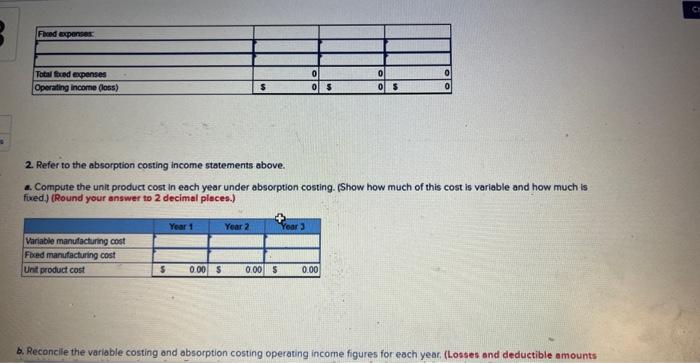
2. Refer to the absorption costing income statements above.
a. Compute the unit product cost in each year under absorption costing. (Show how much of this cost is variable and how much is fixed.) (Round your answer to 2 decimal places.)
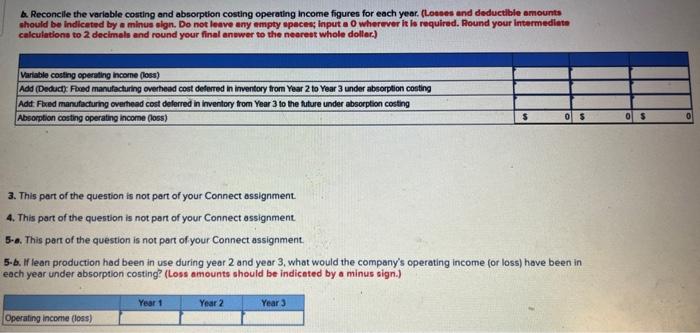
b. Reconcile the variable costing and absorption costing operating income figures for each year. (Losses and deductible amounts should be indicated by a minus sign. Do not leave any empty spaces; input a 0 wherever it is required. Round your intermediate calculations to 2 decimals and round your final answer to the nearest whole dollar.)
3. This part of the question is not part of your Connect assignment.
4. This part of the question is not part of your Connect assignment.
5-a. This part of the question is not part of your Connect assignment.
5-b. If lean production had been in use during year 2 and year 3, what would the companys operating income (or loss) have been in each year under absorption costing? (Loss amounts should be indicated by a minus sign.)

ElectronPlus manufoctures and sells a unique electronic part. Operating results for the first three years of activity were as follows (absorption costing basis): Soles dropped by 20% during year 2 due to the entry of several foreign competitors into the market. ElectronPlus had expected sales to remain constant at 40,000 units for the year; production was set at 50,000 units in order to bulld a buffer against unexpected spurts in demand. By the start of year 3, management could see that spurts in demand were unlikely and that the inventory was excessive. To work off the excessive inventories, ElectronPlus cut bock production during year 3 , as shown below: Additional information about the company follows: Additional information about the company follows: a. The company's plant is highly automated. Variable manufacturing costs (direct materials, direct labour, and variable manufacturing overhead) total only $4 per unit, and fixed manufacturing overhead costs total $692,000 per year. b. Fixed manufacturing overhead costs are applied to units of product on the basis of each year's planned production. (That is, a new fixed overhead rate is computed each year). c. Variable selling and administrative expenses are $2 per unit sold. Fixed selling and administrative expenses total $69,900 per year. d. The company uses a FIFO inventory flow assumption. The management of ElectronPlus can't understand why profits tripled during year 2 when sales dropped by 20%, and why a loss was Incurred during year 3 when sales recovered to previous levels. Required: 1. Prepare a contribution format income statement for each year using variable costing. 2. Refer to the absorption costing income statements above. a. Compute the unit product cost in each year under absorption costing. (Show how much of this cost is variable and how much is fived.) (Round your answer to 2 decimal pleces.) A. Reconclle the variable costing and absorption costing operating income figures for each year. (Losses and deductlble amounts should be indiceted by a minus sign. Do not leave any empty speces; input a 0 wherever it ls required. Pound your intermediate calculations to 2 decimals and round your final anower to the neerest whole doller) 3. This part of the question is not part of your Connect assignment. 4. This part of the question is not part of your Connect assignment. 5- a. This part of the question is not part of your Connect assignment. 5.b. If lean production had been in use during year 2 and year 3 , what would the company's operating income (or loss) have been in each year under absorption costing? (Loss amounts should be indicated by a minus sign.)

Step by Step Solution

There are 3 Steps involved in it

1 Expert Approved Answer
Step: 1 Unlock blur-text-image
Question Has Been Solved by an Expert!

Get step-by-step solutions from verified subject matter experts

Step: 2 Unlock
Step: 3 Unlock

Students Have Also Explored These Related Accounting Questions!