



Question: Textbook: Applied Combinatorics by Alan Tucker Sixth Edition, Pg. 43 Question 24 24. A Platonic graph is a planar graph in which all vertices have
Textbook: Applied Combinatorics by Alan Tucker Sixth Edition, Pg. 43 Question 24
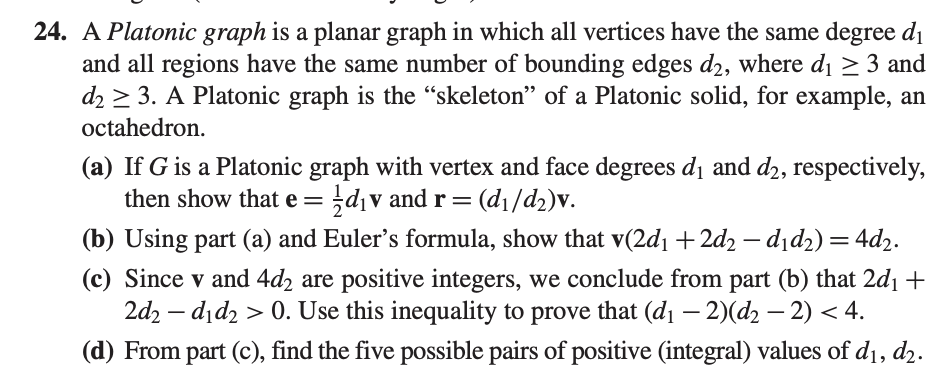
24. A Platonic graph is a planar graph in which all vertices have the same degree d, and all regions have the same number of bounding edges d,, where d; > 3 and d> > 3. A Platonic graph is the \"skeleton\" of a Platonic solid, for example, an octahedron. (a) If G is a Platonic graph with vertex and face degrees d; and d,, respectively, then show that e = 1d,v and r = (d, /d>)Vv. (b) Using part (a) and Euler's formula, show that v(2d; + 2d, d d,) = 4d,. () Since v and 4d, are positive integers, we conclude from part (b) that 2d, + 2d; did; > 0. Use this inequality to prove that (d; 2)(d, 2)
Step by Step Solution
There are 3 Steps involved in it

Get step-by-step solutions from verified subject matter experts