







Question: . Textbook Questions for Chapter 10 (answer these questions throughly in a paragraph per question) Reference: Mallicoat Gardiner (2014). Criminal Justice Policy. Thousand Oaks, CA:
. Textbook Questions for Chapter 10 (answer these questions throughly in a paragraph per question)
Reference: Mallicoat
- How are the statuses of white-collar criminals reflected in statutes that favor them? Give two specific examples from cases in the chapter.
- Do you believe that the traditional half-hearted policy responses to white-collar and corporate crime have changed? Explain your response with examples.
- Do you agree with the authors' conclusions regarding how to fix policy responses to white-collar and corporate crime so that they can be more effective? Explain why or why not.
C. First Journal Article and Assigned Questions: (answer these questions throughly in a paragraph per question)
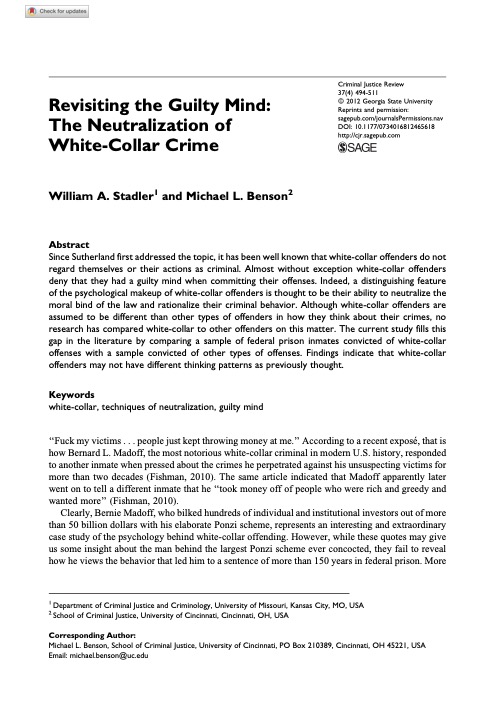
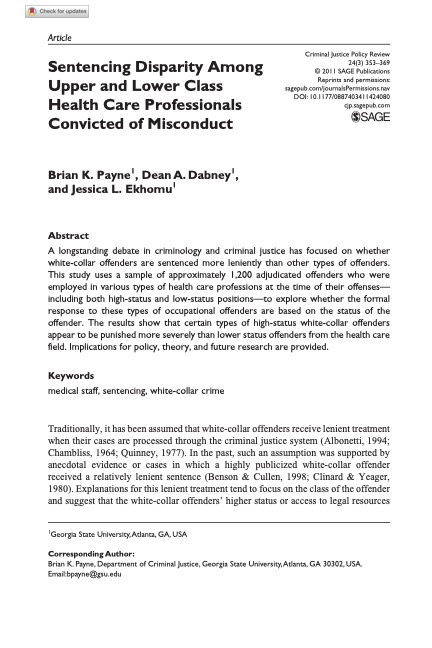 Check for updates Criminal Justice Review 3714) 494-511 Revisiting the Guilty Mind: O 10 12 Georgha Srace University Raprince and parmasion: The Neutralization of sagepub.com/journals Permissions.raw DOI: 10.1 177/07340-16812465618 hops//gruagepub.com White-Collar Crime SSAGE William A. Stadler' and Michael L. Benson Abstract Since Sutherland first addressed the topic, it has been well known that white-collar offenders do not regard themselves or their actions as criminal. Almost without exception white-collar offenders deny that they had a guilty mind when committing their offenses. Indeed, a distinguishing feature of the psychological makeup of white-collar offenders is thought to be their ability to neutralize the moral bind of the law and rationalize their criminal behavior. Although white-collar offenders are assumed to be different than other types of offenders in how they think about their crimes, no research has compared white-collar to other offenders on this matter. The current study fills this gap in the licerature by comparing a sample of federal prison inmates convicted of white-collar offenses with a sample convicted of other types of offenses. Findings indicate that white-collar offenders may not have different thinking patterns as previously thought. Keywords white-collar, techniques of neutralization, guilty mind "Fuck my victims . . . people just kept throwing money at me. " According to a recent expose, that is how Bernard L. Madoff, the most notorious white-collar criminal in modern U.S. history, responded to another inmate when pressed about the crimes he perpetrated against his unsuspecting victims for more than two decades (Fishman, 2010). The same article indicated that Madoff apparently later went on to tell a different inmate that he "took money off of people who were rich and greedy and wanted more" (Fishman, 2010). Clearly, Bernie Madoff, who bilked hundreds of individual and institutional investors out of more than 50 billion dollars with his elaborate Ponzi scheme, represents an interesting and extraordinary case study of the psychology behind white-collar offending. However, while these quotes may give us some insight about the man behind the largest Ponzi scheme ever concocted, they fail to reveal how he views the behavior that led him to a sentence of more than 150 years in federal prison. More Department of Criminal Justice and Criminology, University of Missouri, Kansas City, MO. USA School of Criminal Justice, University of Cincinnati, Cincinnad, OH, USA Corresponding Author: Michael L. Benson, School of Criminal Justice, University of Cincinnad, PO Box 210389, Cincinnati, OH 45221, USA Email: michaelbenson @uc.eduCheck for updates Article Criminal Justice Policy Review Sentencing Disparity Among 1401 353-165 Q 201 1 SAGE Publiacions Upper and Lower Class Reprints and parmasione wagepub.com/joumakPermissions rev DOI: 10.1 177/083740341 1434080 Health Care Professionals p sizepub.com Convicted of Misconduct SISAGE Brian K. Payne', Dean A. Dabney', and Jessica L. Ekhomu' Abstract A longstanding debate in criminology and criminal justice has focused on whether white-collar offenders are sentenced more leniently than other types of offenders. This study uses a sample of approximately 1,200 adjudicated offenders who were employed in various types of health care professions at the time of their offenses- including both high-status and low-status positions-to explore whether the formal response to these types of occupational offenders are based on the status of the offender. The results show that certain types of high-status white-collar offenders appear to be punished more severely than lower status offenders from the health care field. Implications for policy, theory, and future research are provided. Keywords medical staff, sentencing, white-collar crime Traditionally, it has been assumed that white-collar offenders receive lenient treatment when their cases are processed through the criminal justice system (Albonetti, 1994; Chambliss, 1964; Quinney, 1977). In the past, such an assumption was supported by anecdotal evidence or cases in which a highly publicized white-collar offender received a relatively lenient sentence (Benson
 Step by Step Solution
There are 3 Steps involved in it
1 Expert Approved Answer
Step: 1 Unlock

Question Has Been Solved by an Expert!
Get step-by-step solutions from verified subject matter experts
Step: 2 Unlock
Step: 3 Unlock
 Study Help