







Question: Textbook Questions for Chapter 9 (answer these questions throughly in a paragraph per question) Reference: Mallicoat Gardiner (2014). Criminal Justice Policy. Thousand Oaks, CA: Sage
Textbook Questions for Chapter 9 (answer these questions throughly in a paragraph per question)
Reference: Mallicoat
- There is a great deal of controversy surrounding civil commitment laws. Explain the controversy.
- How do sex offender recidivism rates and patterns compare to criminals convicted of nonsexual offenses?
- Describe the similarities and differences between the Jacob Wetterling Act, Megan's Law, and the Pam Lychner Act.
C. First Journal Article and Assigned Questions: (answer these questions throughly in a paragraph per question)
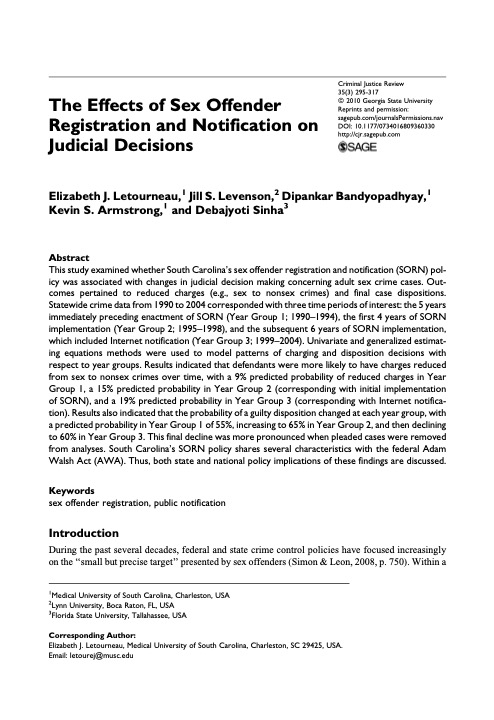
 Criminal Justice Arelow The Effects of Sex Offender (2 1010 Georgia Seven University Reprince and permision Registration and Notification on sarspub.com/journalaPermision ray DOi: 10.1 177/0734016805360130 hopolar sagepub.com Judicial Decisions OSAGE Elizabeth J. Letourneau, ' Jill S. Levenson," Dipankar Bandyopadhyay,' Kevin S. Armstrong,' and Debajyoti Sinha* Abstract This study examined whether South Carolina's sex offender registration and notification (SORN) pol- cy was associated with changes in judicial decision making concerning adult sex crime cases. Out- comes pertained to reduced charges (e.g. sex to nonsex crimes) and final case dispositions. Statewide crime data from 1 990 to 2004 corresponded with three time periods of interest the 5 years immediately preceding enactment of SORN (Year Group I; 1990-1994). the first 4 years of SORN implementation (Year Group 2; 1995-1998), and the subsequent 6 years of SORN implementation, which included Internet notification (Year Group 3; 1999-2004). Univariate and generalized estimat- ing equations methods were used to model patterns of charging and disposition decisions with respect to year groups. Results indicated that defendants were more likely to have charges reduced from sex to nonsex crimes over time, with a 9% predicted probability of reduced charges in Year Group I, a 15% predicted probability in Year Group 2 (corresponding with initial implementation of SORN), and a 19% predicted probability in Year Group 3 (corresponding with Internet noufica- tion). Results also indicated that the probability of a guilty disposition changed at each year group, with a predicted probability in Year Group I of 55%, increasing to 65% in Year Group 2, and then declining to 60% in Year Group 3. This final decline was more pronounced when pleaded cases were removed from analyses. South Carolina's SORN policy shares several characteristics with the federal Adam Walsh Act (AWA). Thus, both state and national policy implications of these findings are discussed. Keywords sex offender registration, public notification Introduction During the past several decades, federal and state crime control policies have focused increasingly on the "small but precise target" presented by sex offenders (Simon
 Step by Step Solution
There are 3 Steps involved in it
1 Expert Approved Answer
Step: 1 Unlock

Question Has Been Solved by an Expert!
Get step-by-step solutions from verified subject matter experts
Step: 2 Unlock
Step: 3 Unlock
 Study Help