







Question: T/F D) Data Analysis Read Data Analysis on pages 9-16 and answer the following as true or false. 1. The laboratory instrumentation determines the number
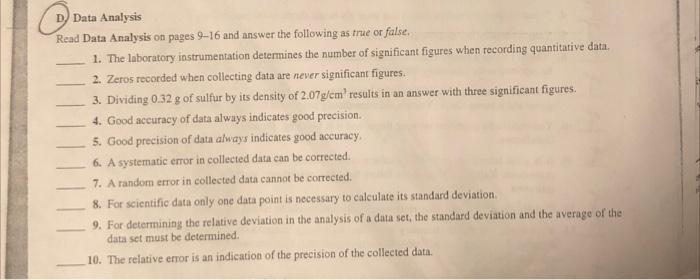
D) Data Analysis Read Data Analysis on pages 9-16 and answer the following as true or false. 1. The laboratory instrumentation determines the number of significant figures when recording quantitative data. 2. Zeros recorded when collecting data are never significant figures. 3. Dividing 0.32g of sulfur by its density of 2.07g/cm3 results in an answer with three significant figures. 4. Good accuracy of data always indicates good precision. 5. Good precision of data always indicates good accuracy. 6. A systematic error in collected data can be corrected. 7. A random error in collected data cannot be corrected. 8. For scientific data only one data point is necessary to calculate its standard deviation. 9. For determining the relative deviation in the analysis of a data set, the standard deviation and the average of the data set must be determined. 10. The relative emor is an indieation of the precision of the collected data
Step by Step Solution
There are 3 Steps involved in it

Get step-by-step solutions from verified subject matter experts
 Study Help