







Question: Th is programming project involves writing a program to calculate the terms of the following sequence of numbers: 0 1 2 5 12 29 ...
Th is programming project involves writing a program to calculate the terms of the following sequence of numbers: 0 1 2 5 12 29 ... where each term of the sequence is twice the previous term plus the second previous term. The 0 th term of the sequence is 0 and the 1 st term of the sequence is 1. For example: 0 1 2 - > (0 + 1 + 2) + 2 = 5 0 1 2 5 - > (0 + 1 + 2 + 5) + 5 = 12 0 1 2 5 12 - > (0 + 1 + 2 + 5 + 12) + 12 = 29 ... The interface to the program should be a GUI that looks similar to the following: 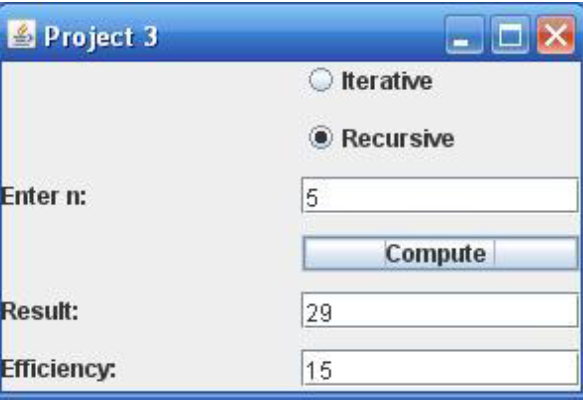
The pair of radio buttons allows the user to choose whether an iterative or recursive method is used to c ompute the term of the sequence. When the user enters a value for n and then clicks the Compute button, the n th term of the sequence should be displayed in the Result field. The Efficiency field should contain the number of calls to the recursive method wh en the recursive option is chosen and the number of iterations of the loop when the iterative option is selected. The Iterative radio button should be initially set to selected. When the window is closed, the efficiency values should be computed with value s of n from 0 to 10 and written to a file. Each line of the file should contain the value of n , the efficiency of the iterative method for that value of n and the efficiency of the recursive method. The values should be separated by commas so the file can be opened with Excel and used to graph the value of the efficiencies for both the iterative and recursive options along the y axis with the value of n along the x - axis. The graph should be included in the Word document that accompanies this project and sho uld also contain a brief explanation of the observed results. The program should consist of two classes. 1. The fi rst class should define the GUI. In addition to the main method and a constructor to build the GUI, an event handler will be needed to handle the Compute button click and another handler will be needed to produce the file described above when the window is closed. The latter handler shoul d be an object of an inner class that extends the WindowAdapter class. 2 2. The other class should be named Sequence . It should be a utility class meaning that all its methods must be class (static) methods and no objects should be able to be generated for that class. It should contain three public methods: a. The first method computeIterative should accept a value of n and return the correspond ing element in the sequence using iteration. b. The second method computeRecursive should accept a value of n and return the correspond ing element in the sequence using recursion. This method wi ll be a helper method because it will need to initialize the efficiency counter before calling the private recursive method that will actually perform the recursive computation. c. The third method getEfficiency will return the efficiency counter left behind by the previous call to either of the above two methods. The google recommended Java style guide, provided as link in the week 2 content, should be used to format and document your code. Specifically, the following style guide attributes should be addressed: Header comments include filename, author, date and brief purpose of the program. In - line comments used to describe major functionality of the code. Meaningful variable names and prompt s applied. Class names are written in UpperCamelCase. Variable names are written in lowerCamelCase. Constant names are in written in All Capitals. Braces use K&R style . In addition the following design constraints should be followed: Declare all instance variables private Avoid the duplication of code Test cases should be supplied in the form of table with columns indicating the input values, expected output, actual output and if the test case passed or failed. This table should contain 4 columns with appr opriate labels and a row for each test case. Note that the actual output should be the actual results you receive when running your program and applying the input for the test record. Be sure to select enough different scenarios to completely test the program .
Project 3 O Iterative Recursive Enter n: Compute Result: 29 Efficiency: 15
Step by Step Solution
There are 3 Steps involved in it

Get step-by-step solutions from verified subject matter experts
 Study Help