







Question: Thank you! 1. Consider the function f (x) : 2, /1 _ m2 .The graph of this function is the top half of an ellipse.
Thank you!
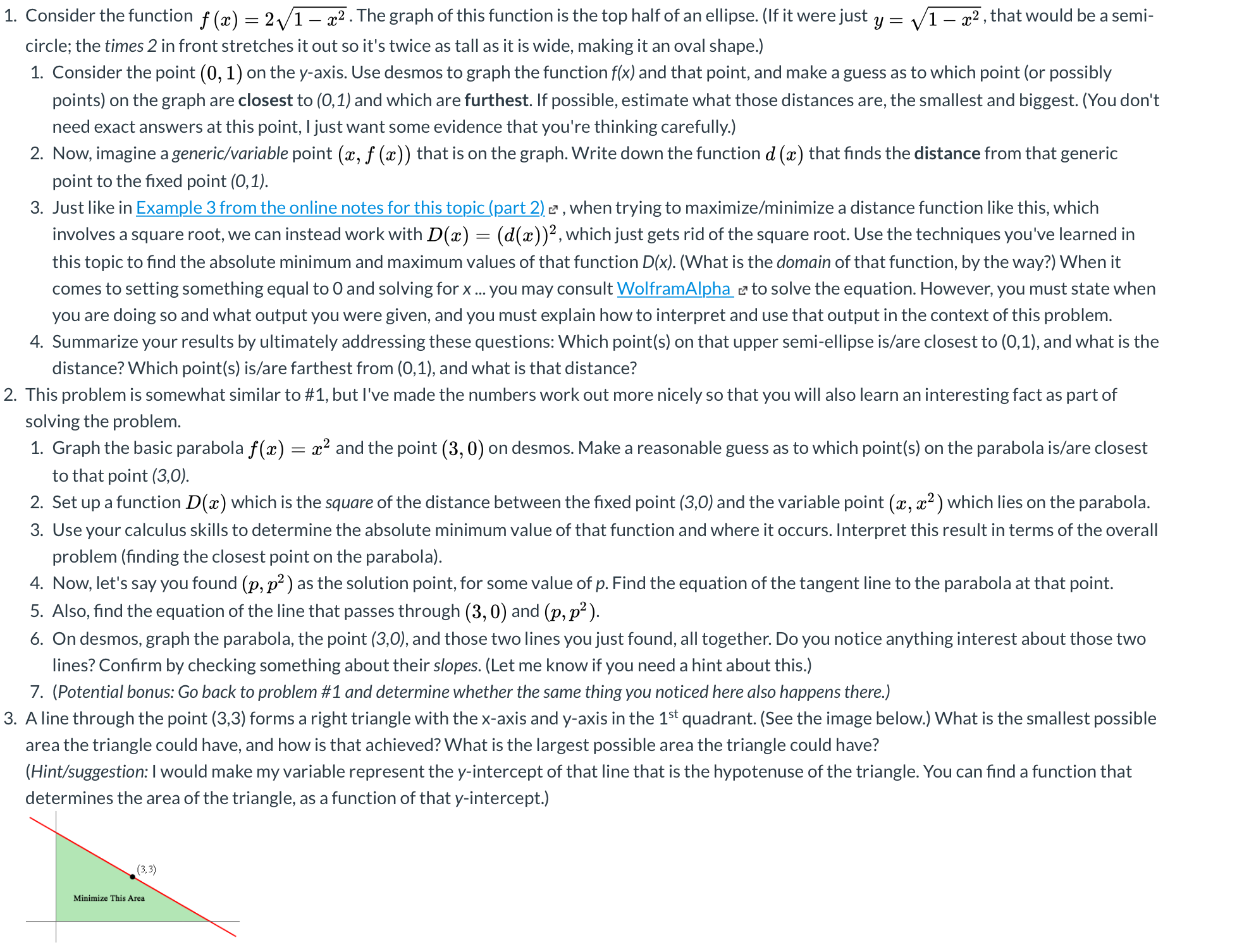
1. Consider the function f (x) : 2, /1 _ m2 .The graph of this function is the top half of an ellipse. (If it werejust y : , /1 _ $2 ,thatwould be a semi- circle; the times 2 in front stretches it out so it's twice as tall as it is wide, making it an oval shape.) 1. 4. Consider the point (0, 1) on the y-axis. Use desmos to graph the function f(x) and that point, and make a guess as to which point (or possibly points) on the graph are closest to (0,1) and which are furthest. If possible, estimate what those distances are, the smallest and biggest. (You don't need exact answers at this point, I just want some evidence that you're thinking carefully.) Now, imagine ageneric/variable point (2:, f (33)) that is on the graph. Write down the function :1 (m) that nds the distance from that generic point to the xed point (0,1). . Just like in Example 3 from the online notes for this topic (part 2)_ e , when trying to maximize/minimize a distance function like this, which involves a square root, we can instead work with D(:c) = (01(1))2, which just gets rid of the square root. Use the techniques you've learned in this topic to nd the absolute minimum and maximum values of that function D(x). (What is the domain of that function, by the way?) When it comes to setting something equal to 0 and solving for x you may consult WolframAlph_a e to solve the equation. However, you must state when you are doing so and what output you were given, and you must explain how to interpret and use that output in the context of this problem. Summarize your results by ultimately addressing these questions: Which point(s) on that upper semi-ellipse is/are closest to (0,1), and what is the distance? Which point(s) is/are farthest from (0,1), and what is that distance? 2. This problem is somewhat similar to #1, but I've made the numbers work out more nicely so that you will also learn an interesting fact as part of solving the problem. 1. 2. 3. U1 Graph the basic parabola f(a:) : x2 and the point (3, 0) on desmos. Make a reasonable guess as to which point(s) on the parabola is/are closest to that point (3,0). Set up a function D(:c) which is the square of the distance between the xed point (3,0) and the variable point (3,132) which lies on the parabola. Use your calculus skills to determine the absolute minimum value of that function and where it occurs. Interpret this result in terms of the overall problem (nding the closest point on the parabola). Now, let's say you found (p, 132) as the solution point, for some value of p. Find the equation of the tangent line to the parabola at that point. . Also, nd the equation of the line that passes through (3, 0) and (p, p2). 6. On desmos, graph the parabola, the point (3,0), and those two lines you just found, all together. Do you notice anything interest about those two 7. lines? Conrm by checking something about their slopes. (Let me know if you need a hint about this.) (Potential bonus: Go back to problem #1 and determine whether the same thing you noticed here also happens there.) 3. A line through the point (3,3) forms a right triangle with the x-axis and y-axis in the 15' quadrant. (See the image below.) What is the smallest possible area the triangle could have, and how is that achieved? What is the largest possible area the triangle could have? (Hint/suggestion: I would make my variable represent the y-intercept of that line that is the hypotenuse of the triangle. You can nd a function that determines the area of the triangle, as a function of that y-intercept.) (2,2)
Step by Step Solution
There are 3 Steps involved in it

Get step-by-step solutions from verified subject matter experts
 Study Help