



Question: THANK YOU A coffee machine may be defective because it dispenses the wrong amount of coffee (C) and / or it dispenses the wrong amount
 THANK YOU
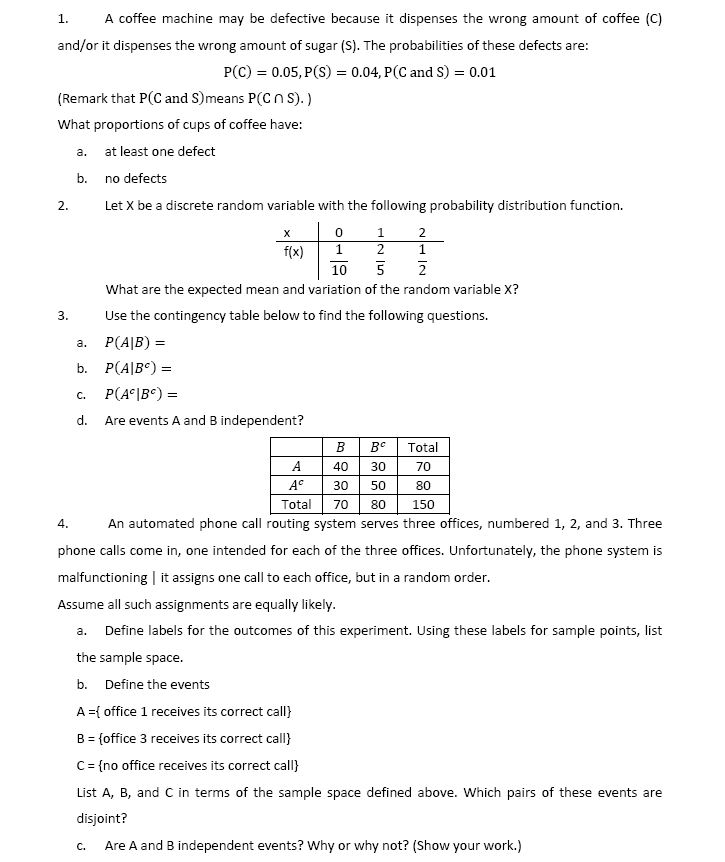
A coffee machine may be defective because it dispenses the wrong amount of coffee (C) and / or it dispenses the wrong amount of sugar (S). The probabilities of these defects are: P(C) = 0.05, P(S) = 0.04, P(C and S) = 0.01 (Remark that P(C and S) means P(C S).) What proportions of cups of coffee have: at least one defect no defects Let X be a discrete random variable with the following probability distribution function. What are the expected mean and variation of the random variable X? Use the contingency table below to find the following questions. An automated phone call routing system serves three offices, numbered 1, 2, and 3. Three phone calls come in, one intended for each of the three offices. Unfortunately, the phone system is malfunctioning | it assigns one call to each office, but in a random order. Assume all such assignments are equally likely. Define labels for the outcomes of this experiment. Using these labels for sample points, list the sample space. Define the events A ={ office 1 receives its correct call} B = {office 3 receives its correct call} C = {no office receives its correct call} List A, B, and C in terms of the sample space defined above. Which pairs of these events are disjoint? Are A and B independent events? Why or why not? (Show your work.)
Step by Step Solution
There are 3 Steps involved in it

Get step-by-step solutions from verified subject matter experts