







Question: thank you for your help Evaluate each division expression. A frog starts at 0 on a number line. It jumps 100 units to the right,
thank you for your help
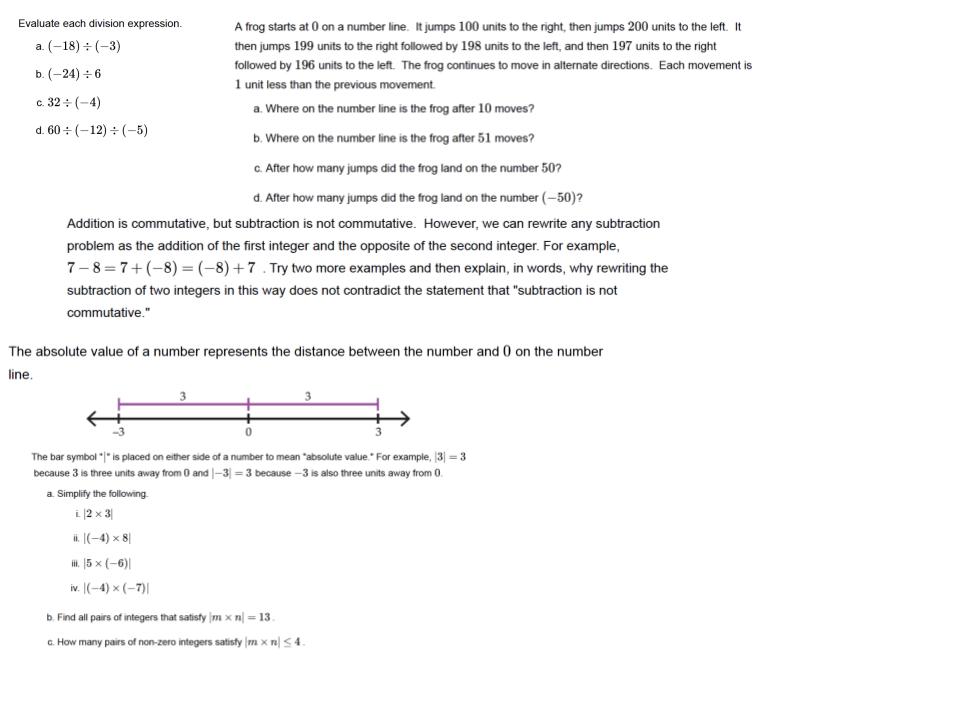
Evaluate each division expression. A frog starts at 0 on a number line. It jumps 100 units to the right, then jumps 200 units to the left. It a. (-18) + (-3) then jumps 199 units to the right followed by 198 units to the left, and then 197 units to the right b. (-24) : 6 followed by 196 units to the left. The frog continues to move in alternate directions. Each movement is 1 unit less than the previous movement. c. 32 + (-4) a. Where on the number line is the frog after 10 moves? d. 60 + (-12) + (-5) b. Where on the number line is the frog after 51 moves? G. After how many jumps did the frog land on the number 50? d. After how many jumps did the frog land on the number (-50)? Addition is commutative, but subtraction is not commutative. However, we can rewrite any subtraction problem as the addition of the first integer and the opposite of the second integer. For example, 7-8=7+(-8) = (-8) +7 . Try two more examples and then explain, in words, why rewriting the subtraction of two integers in this way does not contradict the statement that "subtraction is not commutative." The absolute value of a number represents the distance between the number and 0 on the number line The bar symbol "|" is placed on either side of a number to mean "absolute value. " For example, |3| = 3 because 3 is three units away from 0 and |-3) = 3 because -3 is also three units away from 0. a. Simplify the following 1 2 x3 i. (-4) x 81 1. 15 x (-6)1 W. |(-4) x (-7)1 b. Find all pairs of integers that satisfy Im x n| = 13 G. How many pairs of non-zero integers satisfy |m x n| $ 4
Step by Step Solution
There are 3 Steps involved in it

Get step-by-step solutions from verified subject matter experts
 Study Help