



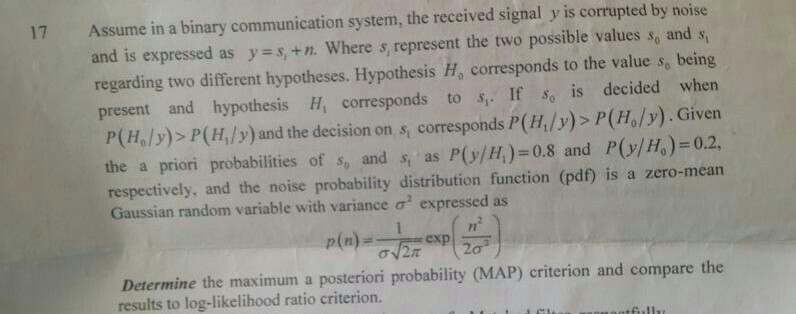
Question: Thanks 17 and si Assume in a binary communication system, the received signal y is corrupted by noise and is expressed as y=s, +n. Where
Thanks
17 and si Assume in a binary communication system, the received signal y is corrupted by noise and is expressed as y=s, +n. Where s, represent the two possible values So regarding two different hypotheses. Hypothesis H, corresponds to the value se being present and hypothesis H, corresponds to $. If so is decided when P(H./y)> P(H/y) and the decision on s, corresponds P(H/y) > P(H/y). Given the a priori probabilities of s, and s, as P(y/H)=0.8 and P(y/H)=0.2, respectively, and the noise probability distribution function (pdf) is a zero-mean Gaussian random variable with variance o expressed as pl exp V2 Determine the maximum a posteriori probability (MAP) criterion and compare the results to log-likelihood ratio criterion. full 17 and si Assume in a binary communication system, the received signal y is corrupted by noise and is expressed as y=s, +n. Where s, represent the two possible values So regarding two different hypotheses. Hypothesis H, corresponds to the value se being present and hypothesis H, corresponds to $. If so is decided when P(H./y)> P(H/y) and the decision on s, corresponds P(H/y) > P(H/y). Given the a priori probabilities of s, and s, as P(y/H)=0.8 and P(y/H)=0.2, respectively, and the noise probability distribution function (pdf) is a zero-mean Gaussian random variable with variance o expressed as pl exp V2 Determine the maximum a posteriori probability (MAP) criterion and compare the results to log-likelihood ratio criterion. full
Step by Step Solution
There are 3 Steps involved in it

Get step-by-step solutions from verified subject matter experts