







Question: thanks for the help Case Notes It is early September 2009. You are a member of the consultant team hired by GBI's Management to review
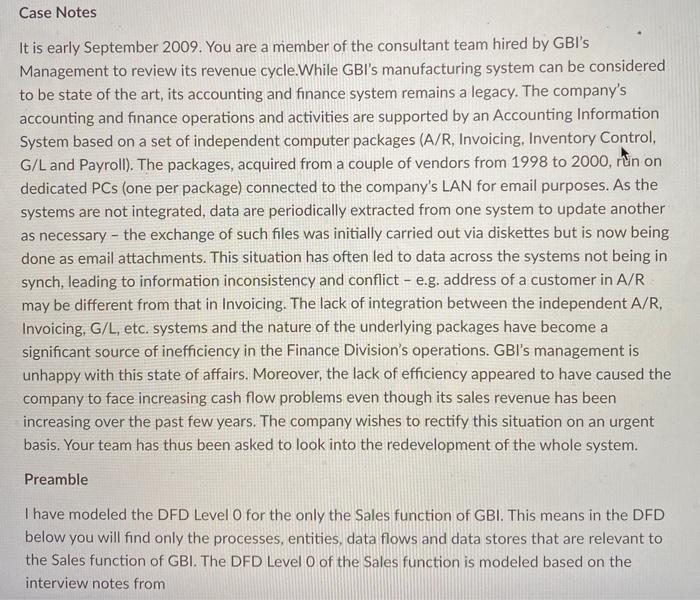
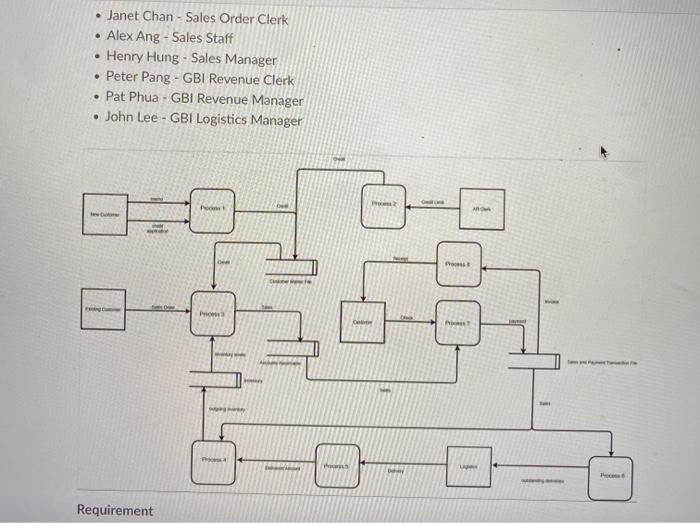
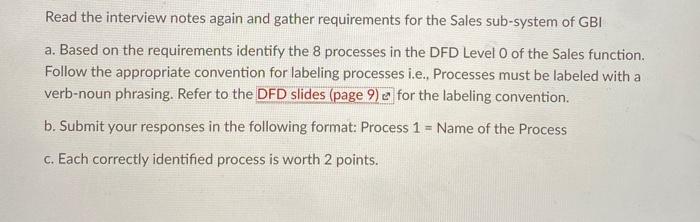
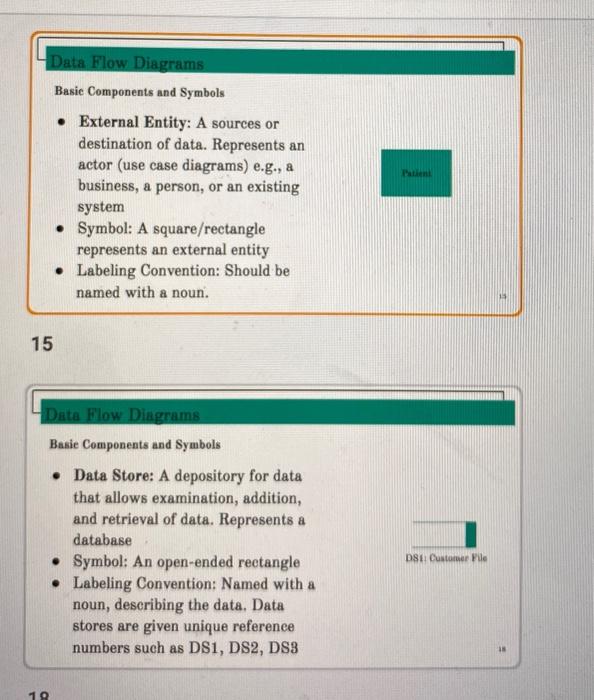
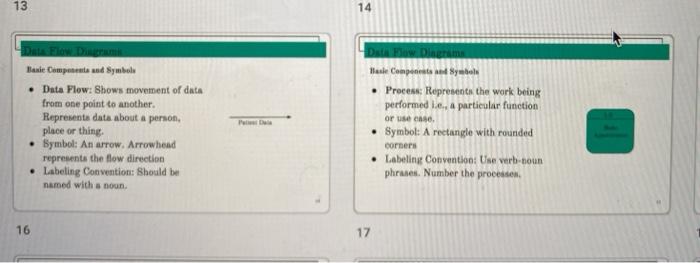
Case Notes It is early September 2009. You are a member of the consultant team hired by GBI's Management to review its revenue cycle.While GBI's manufacturing system can be considered to be state of the art, its accounting and finance system remains a legacy. The company's accounting and finance operations and activities are supported by an Accounting Information System based on a set of independent computer packages (A/R, Invoicing, Inventory Control, G/L and Payroll). The packages, acquired from a couple of vendors from 1998 to 2000, run on dedicated PCs (one per package) connected to the company's LAN for email purposes. As the systems are not integrated, data are periodically extracted from one system to update another as necessary - the exchange of such files was initially carried out via diskettes but is now being done as email attachments. This situation has often led to data across the systems not being in synch, leading to information inconsistency and conflict - e.g. address of a customer in A/R may be different from that in Invoicing. The lack of integration between the independent A/R. Invoicing, G/L, etc. systems and the nature of the underlying packages have become a significant source of inefficiency in the Finance Division's operations. GBI's management is unhappy with this state of affairs. Moreover, the lack of efficiency appeared to have caused the company to face increasing cash flow problems even though its sales revenue has been increasing over the past few years. The company wishes to rectify this situation on an urgent basis. Your team has thus been asked to look into the redevelopment of the whole system. Preamble I have modeled the DFD Level O for the only the Sales function of GBI. This means in the DFD below you will find only the processes, entities, data flows and data stores that are relevant to the Sales function of GBI. The DFD Level O of the Sales function is modeled based on the interview notes from Janet Chan - Sales Order Clerk Alex Ang - Sales Staff Henry Hung - Sales Manager Peter Pang - GBI Revenue Clerk Pat Phua - GBI Revenue Manager John Lee - GBI Logistics Manager AN w Pros P. Requirement Read the interview notes again and gather requirements for the Sales sub-system of GBI a. Based on the requirements identify the 8 processes in the DFD Level 0 of the Sales function. Follow the appropriate convention for labeling processes i.e., Processes must be labeled with a verb-noun phrasing. Refer to the DFD slides (page 9) 2 for the labeling convention. b. Submit your responses in the following format: Process 1 = Name of the Process c. Each correctly identified process is worth 2 points. Data Flow Diagrams Basic Components and Symbols External Entity: A sources or destination of data. Represents an actor (use case diagrams) e.g., a business, a person, or an existing system Symbol: A square/rectangle represents an external entity Labeling Convention: Should be named with a noun. Patient 13 15 Data Flow Diagrams Basic Components and Symbols Data Store: A depository for data that allows examination, addition, and retrieval of data. Represents a database Symbol: An open-ended rectangle Labeling Convention: Named with a noun, describing the data. Data stores are given unique reference numbers such as DS1, DS2, DS3 DS Customer Pile 13 19 13 14 Hasle Cempat and Symbol Data Flow: Shows movement of data from one point to another Representa data about a person, place or thing Symbol: An arrow. Arrowhead represents the flow direction Labeling Convention: Should be named with a noun De How Dinam Base Companybolt Proces: Represents the work being performed a particular function or use is Symbol: A rectangle with rounded Labeling Convention: Une verb noun phrases Number the process corners 16 17 Case Notes It is early September 2009. You are a member of the consultant team hired by GBI's Management to review its revenue cycle.While GBI's manufacturing system can be considered to be state of the art, its accounting and finance system remains a legacy. The company's accounting and finance operations and activities are supported by an Accounting Information System based on a set of independent computer packages (A/R, Invoicing, Inventory Control, G/L and Payroll). The packages, acquired from a couple of vendors from 1998 to 2000, run on dedicated PCs (one per package) connected to the company's LAN for email purposes. As the systems are not integrated, data are periodically extracted from one system to update another as necessary - the exchange of such files was initially carried out via diskettes but is now being done as email attachments. This situation has often led to data across the systems not being in synch, leading to information inconsistency and conflict - e.g. address of a customer in A/R may be different from that in Invoicing. The lack of integration between the independent A/R. Invoicing, G/L, etc. systems and the nature of the underlying packages have become a significant source of inefficiency in the Finance Division's operations. GBI's management is unhappy with this state of affairs. Moreover, the lack of efficiency appeared to have caused the company to face increasing cash flow problems even though its sales revenue has been increasing over the past few years. The company wishes to rectify this situation on an urgent basis. Your team has thus been asked to look into the redevelopment of the whole system. Preamble I have modeled the DFD Level O for the only the Sales function of GBI. This means in the DFD below you will find only the processes, entities, data flows and data stores that are relevant to the Sales function of GBI. The DFD Level O of the Sales function is modeled based on the interview notes from Janet Chan - Sales Order Clerk Alex Ang - Sales Staff Henry Hung - Sales Manager Peter Pang - GBI Revenue Clerk Pat Phua - GBI Revenue Manager John Lee - GBI Logistics Manager AN w Pros P. Requirement Read the interview notes again and gather requirements for the Sales sub-system of GBI a. Based on the requirements identify the 8 processes in the DFD Level 0 of the Sales function. Follow the appropriate convention for labeling processes i.e., Processes must be labeled with a verb-noun phrasing. Refer to the DFD slides (page 9) 2 for the labeling convention. b. Submit your responses in the following format: Process 1 = Name of the Process c. Each correctly identified process is worth 2 points. Data Flow Diagrams Basic Components and Symbols External Entity: A sources or destination of data. Represents an actor (use case diagrams) e.g., a business, a person, or an existing system Symbol: A square/rectangle represents an external entity Labeling Convention: Should be named with a noun. Patient 13 15 Data Flow Diagrams Basic Components and Symbols Data Store: A depository for data that allows examination, addition, and retrieval of data. Represents a database Symbol: An open-ended rectangle Labeling Convention: Named with a noun, describing the data. Data stores are given unique reference numbers such as DS1, DS2, DS3 DS Customer Pile 13 19 13 14 Hasle Cempat and Symbol Data Flow: Shows movement of data from one point to another Representa data about a person, place or thing Symbol: An arrow. Arrowhead represents the flow direction Labeling Convention: Should be named with a noun De How Dinam Base Companybolt Proces: Represents the work being performed a particular function or use is Symbol: A rectangle with rounded Labeling Convention: Une verb noun phrases Number the process corners 16 17
Step by Step Solution
There are 3 Steps involved in it

Get step-by-step solutions from verified subject matter experts
 Study Help