







Question: Thanks in advance! Task 1 Python When John gambles at the casino, he always uses a special system of tactics that he devised himself. It's
Thanks in advance!
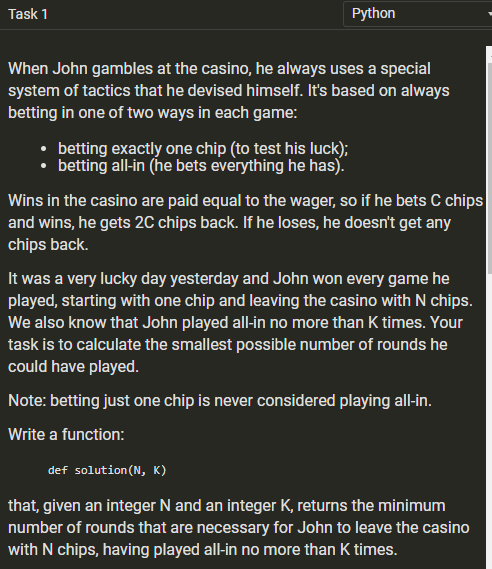
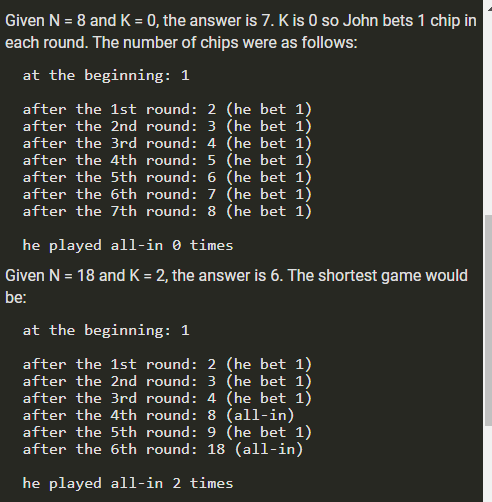
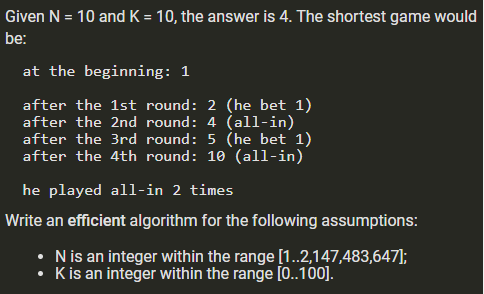
Task 1 Python When John gambles at the casino, he always uses a special system of tactics that he devised himself. It's based on always betting in one of two ways in each game: betting exactly one chip (to test his luck); . betting all-in (he bets everything he has). Wins in the casino are paid equal to the wager, so if he bets C chips and wins, he gets 2C chips back. If he loses, he doesn't get any chips back. It was a very lucky day yesterday and John won every game he played, starting with one chip and leaving the casino with N chips. We also know that John played all-in no more than K times. Your task is to calculate the smallest possible number of rounds he could have played. Note: betting just one chip is never considered playing all-in. Write a function: def solution (N, K) that, given an integer N and an integer K, returns the minimum number of rounds that are necessary for John to leave the casino with N chips, having played all-in no more than K times.Given N = 8 and K = 0, the answer is 7. K is 0 so John bets 1 chip in each round. The number of chips were as follows: at the beginning: 1 after the 1st round: 2 (he bet 1) after the 2nd round: 3 (he bet 1) after the 3rd round: 4 (he bet 1) after the 4th round: 5 (he bet 1) after the 5th round: 6 (he bet 1) after the 6th round: 7 (he bet 1) after the 7th round: 8 (he bet 1) he played all-in 0 times Given N = 18 and K = 2, the answer is 6. The shortest game would be: at the beginning: 1 after the 1st round: 2 (he bet 1) after the 2nd round: 3 (he bet 1) after the 3rd round: 4 (he bet 1) after the 4th round: 8 (all-in) after the 5th round: 9 (he bet 1) after the 6th round: 18 (all-in) he played all-in 2 timesGiven N = 10 and K = 10, the answer is 4. The shortest game would be: at the beginning: 1 after the 1st round: 2 (he bet 1) after the 2nd round: 4 (all-in) after the 3rd round: 5 (he bet 1) after the 4th round: 10 (all-in) he played all-in 2 times Write an efficient algorithm for the following assumptions: N is an integer within the range [1..2,147,483,647]; K is an integer within the range [0..100]
Step by Step Solution
There are 3 Steps involved in it

Get step-by-step solutions from verified subject matter experts
 Study Help