







Question: That answer was incorrect, besides the part about replacing the old machine. I have used 3 of my expert answer's and they have all been
That answer was incorrect, besides the part about replacing the old machine. I have used of my expert answer's and they have all been wrong can you please help?
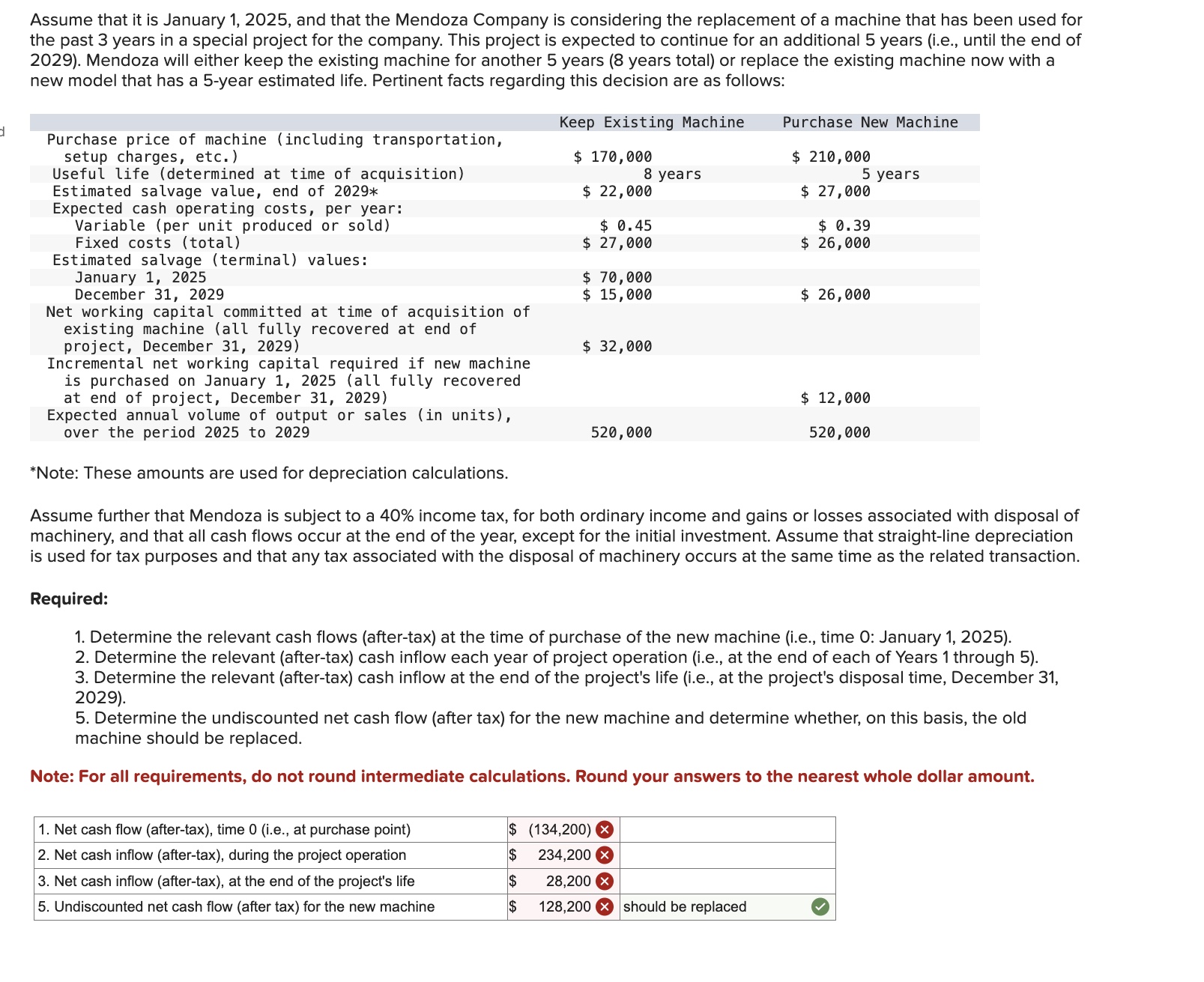
Assume that it is January and that the Mendoza Company is considering the replacement of a machine that has been used for the past years in a special project for the company. This project is expected to continue for an additional years ie until the end of Mendoza will either keep the existing machine for another years years total or replace the existing machine now with a new model that has a year estimated life. Pertinent facts regarding this decision are as follows: Assume further that Mendoza is subject to a income tax, for both ordinary income and gains or losses associated with disposal ofmachinery, and that all cash flows occur at the end of the year, except for the initial investment. Assume that straightline depreciation
is used for tax purposes and that any tax associated with the disposal of machinery occurs at the same time as the related transaction.
Required:
Determine the relevant cash flows aftertax at the time of purchase of the new machine ie time : January
Determine the relevant aftertax cash inflow each year of project operation ie at the end of each of Years through
Determine the relevant aftertax cash inflow at the end of the project's life ie at the project's disposal time, December
Determine the undiscounted net cash flow after tax for the new machine and determine whether, on this basis, the old
machine should be replaced.
Note: For all requirements, do not round intermediate calculations. Round your answers to the nearest whole dollar amount.
Answer is complete but not entirely correct.
Assume that it is January and that the Mendoza Company is considering the replacement of a machine that has been used for the past years in a special project for the company. This project is expected to continue for an additional years ie until the end of Mendoza will either keep the existing machine for another years years total or replace the existing machine now with a new model that has a year estimated life. Pertinent facts regarding this decision are as follows:
Keep Existing Machine Purchase New Machine Purchase price of machine including transportation, setup charges, etc. $ $ Useful life determined at time of acquisition years years Estimated salvage value, end of $ $ Expected cash operating costs, per year: Variable per unit produced or sold $ $ Fixed costs total $ $ Estimated salvage terminal values: January $ December $ $ Net working capital committed at time of acquisition of existing machine all fully recovered at end of project, December $ Incremental net working capital required if new machine is purchased on January all fully recovered at end of project, December $ Expected annual volume of output or sales in units over the period to
Note: These amounts are used for depreciation calculations.
Assume further that Mendoza is subject to a income tax, for both ordinary income and gains or losses associated with disposal of machinery, and that all cash flows occur at the end of the year, except for the initial investment. Assume that straightline depreciation is used for tax purposes and that any tax associated with the disposal of machinery occurs at the same time as the related transaction.
Required:
Determine the relevant cash flows aftertax at the time of purchase of the new machine ie time : January Determine the relevant aftertax cash inflow each year of project operation ie at the end of each of Years through Determine the relevant aftertax cash inflow at the end of the project's life ie at the project's disposal time, December Determine the undiscounted net cash flow after tax for the new machine and determine whether, on this basis, the old machine should be replaced.
Note: For all requirements, do not round intermediate calculations. Round your answers to the nearest whole dollar amount.
Answer is not complete.
Net cash flow aftertax time ie at purchase point $ xx Net cash inflow aftertax during the project operation $ xx Net cash inflow aftertax at the end of the project's life $ xx Undiscounted net cash flow after tax for the new machine $ xx
Step by Step Solution
There are 3 Steps involved in it
1 Expert Approved Answer
Step: 1 Unlock

Question Has Been Solved by an Expert!
Get step-by-step solutions from verified subject matter experts
Step: 2 Unlock
Step: 3 Unlock
 Study Help