







Question: We saw in lecture methods to store integers (both negative and non-negative) and real numbers as sequences of Os and 1s. Integers can be
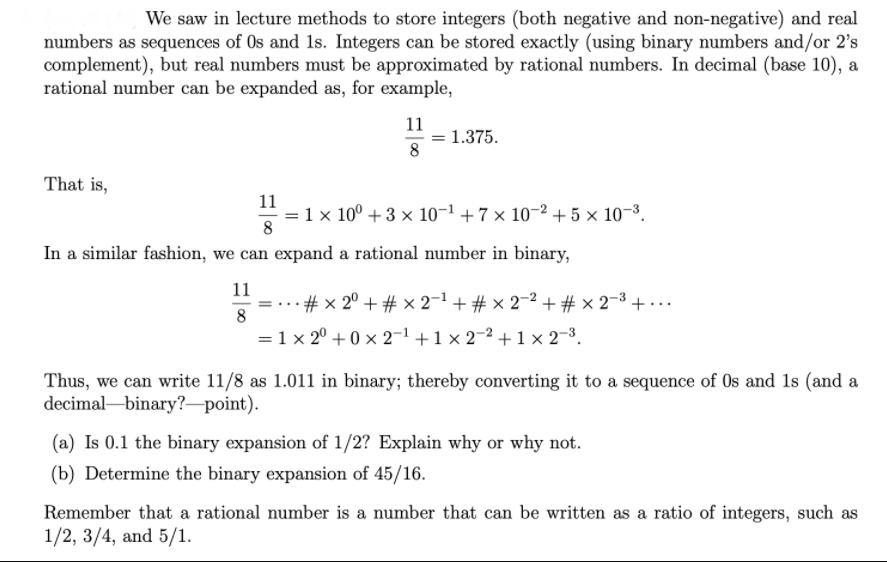
We saw in lecture methods to store integers (both negative and non-negative) and real numbers as sequences of Os and 1s. Integers can be stored exactly (using binary numbers and/or 2's complement), but real numbers must be approximated by rational numbers. In decimal (base 10), a rational number can be expanded as, for example, 11 1.375. 8 That is, 11 = 1 x 10 +3 x 10⁻¹ +7 x 10⁻² + 5 x 10⁻³. 8 In a similar fashion, we can expand a rational number in binary, 11 ...# x 2 + # x 2-1 + # x 2-2 + # x 2-3 + ... 8 = 1 x 2 +0 x 2-1 +1x 2-2+1 x 2-3. Thus, we can write 11/8 as 1.011 in binary; thereby converting it to a sequence of Os and 1s (and a decimal-binary?-point). (a) Is 0.1 the binary expansion of 1/2? Explain why or why not. (b) Determine the binary expansion of 45/16. Remember that a rational number is a number that can be written as a ratio of integers, such as 1/2, 3/4, and 5/1.
Step by Step Solution
There are 3 Steps involved in it
Cary 2 0 50 00 3D ... View full answer

Get step-by-step solutions from verified subject matter experts
 Study Help