







Question: that is all information i got . Problem 8. The owner of a chain of three grocery stores has purchased three crates of fresh strawberries.
that is all information i got
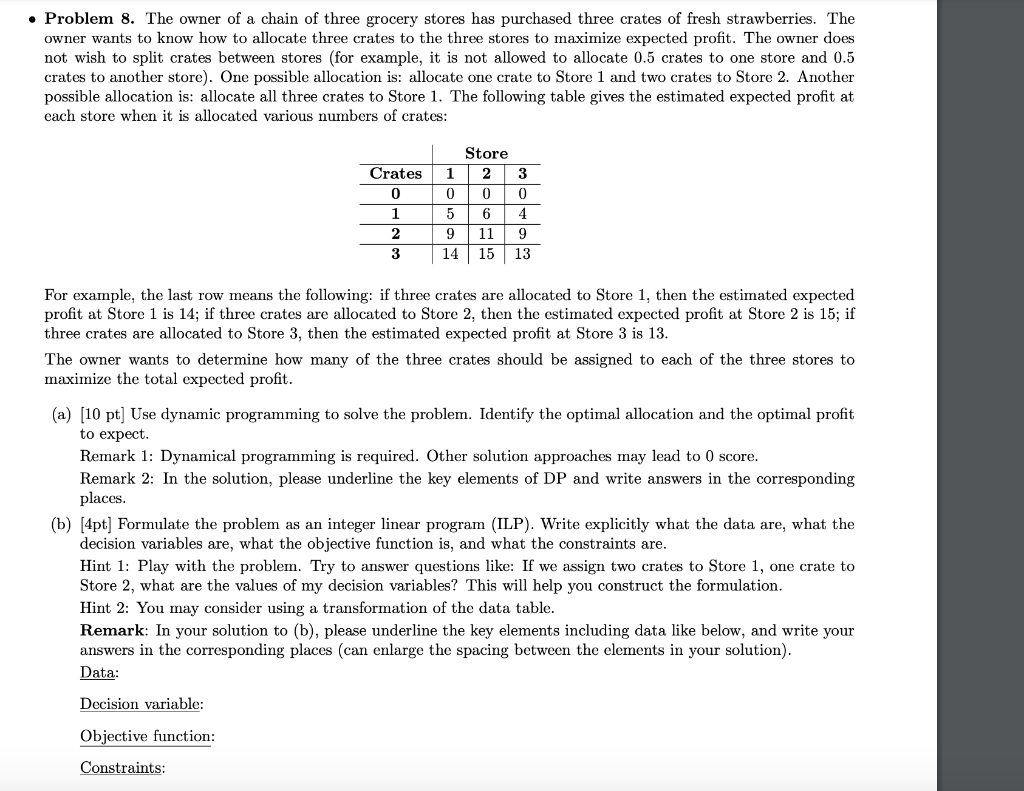
. Problem 8. The owner of a chain of three grocery stores has purchased three crates of fresh strawberries. The owner wants to know how to allocate three crates to the three stores to maximize expected profit. The owner does not wish to split crates between stores (for example, it is not allowed to allocate 0.5 crates to one store and 0.5 crates to another store). One possible allocation is: allocate one crate to Store 1 and two crates to Store 2. Another possible allocation is: allocate all three crates to Store 1. The following table gives the estimated expected profit at each store when it is allocated various numbers of crates: Crates 0 1 2 3 Store 1 2 3 0 0 0 5 6 4 9 11 9 14 15 13 For example, the last row means the following: if three crates are allocated to Store 1, then the estimated expected profit at Store 1 is 14; if three crates are allocated to Store 2, then the estimated expected profit at Store 2 is 15; if three crates are allocated to Store 3, then the estimated expected profit at Store 3 is 13. The owner wants to determine how many of the three crates should be assigned to each of the three stores to maximize the total expected profit. (a) (10 pt) Use dynamic programming to solve the problem. Identify the optimal allocation and the optimal profit to expect. Remark 1: Dynamical programming is required. Other solution approaches may lead to 0 score. Remark 2: In the solution, please underline the key elements of DP and write answers in the corresponding places. (b) [4pt] Formulate the problem as an integer linear program (ILP). Write explicitly what the data are, what the decision variables are, what the objective function is, and what the constraints are. Hint 1: Play with the problem. Try to answer questions like: If we assign two crates to Store 1, one crate to Store 2, what are the values of my decision variables? This will help you construct the formulation. Hint 2: You may consider using a transformation of the data table. Remark: In your solution to (b), please underline the key elements including data like below, and write your answers in the corresponding places (can enlarge the spacing between the elements in your solution). Data: Decision variable: Objective function: Constraints: . Problem 8. The owner of a chain of three grocery stores has purchased three crates of fresh strawberries. The owner wants to know how to allocate three crates to the three stores to maximize expected profit. The owner does not wish to split crates between stores (for example, it is not allowed to allocate 0.5 crates to one store and 0.5 crates to another store). One possible allocation is: allocate one crate to Store 1 and two crates to Store 2. Another possible allocation is: allocate all three crates to Store 1. The following table gives the estimated expected profit at each store when it is allocated various numbers of crates: Crates 0 1 2 3 Store 1 2 3 0 0 0 5 6 4 9 11 9 14 15 13 For example, the last row means the following: if three crates are allocated to Store 1, then the estimated expected profit at Store 1 is 14; if three crates are allocated to Store 2, then the estimated expected profit at Store 2 is 15; if three crates are allocated to Store 3, then the estimated expected profit at Store 3 is 13. The owner wants to determine how many of the three crates should be assigned to each of the three stores to maximize the total expected profit. (a) (10 pt) Use dynamic programming to solve the problem. Identify the optimal allocation and the optimal profit to expect. Remark 1: Dynamical programming is required. Other solution approaches may lead to 0 score. Remark 2: In the solution, please underline the key elements of DP and write answers in the corresponding places. (b) [4pt] Formulate the problem as an integer linear program (ILP). Write explicitly what the data are, what the decision variables are, what the objective function is, and what the constraints are. Hint 1: Play with the problem. Try to answer questions like: If we assign two crates to Store 1, one crate to Store 2, what are the values of my decision variables? This will help you construct the formulation. Hint 2: You may consider using a transformation of the data table. Remark: In your solution to (b), please underline the key elements including data like below, and write your answers in the corresponding places (can enlarge the spacing between the elements in your solution). Data: Decision variable: Objective function: ConstraintsStep by Step Solution
There are 3 Steps involved in it
1 Expert Approved Answer
Step: 1 Unlock

Question Has Been Solved by an Expert!
Get step-by-step solutions from verified subject matter experts
Step: 2 Unlock
Step: 3 Unlock
 Study Help