







Question: =thats the question and this is the case study The Analysis and Report Case: Canberra Seasons The case below is the case with respect to
=thats the question and this is the case study
The Analysis and Report Case: Canberra Seasons
The case below is the case with respect to the individual analysis and report.
You are working on behalf of a management consultancy interviewing a wide range of staff within a government department. As a result of a recent election, the new minister for this department has asked its senior leadership to report on the nature and causes of problems in this workplace and come up with some ideas to remedy them. The minister believes this will be critical as it is apparent that the department seems to have been dogged by problems relating to an aging workforce, falling productivity and morale. As the new minister noted when taking office This department among others has been run inefficiently and ineffectively for some time. I have been elected to manage it effectively and on my watch I intend to transform this department and to leave it in better condition than I found it. You have been commissioned by this departments Human Resources area to make assessments about the nature of workforce problems and report to it and the minister about what is going wrong, why its going wrong and what can be done about it.
Your first interview was with the HR Director Leonard in which a staff retention issue was highlighted that was of obvious concern. The department doesnt seem to be retaining younger staff for very long and while the core of older employees in senior roles have been there for many years, nearly all of the younger employees have been there for no more than a three years. It seems many decide to leave before theyve had five years accrued experience at the department; choosing instead to pursue careers in other departments or the private sector as a contractor to government. As a consequence the department is in danger of losing critical knowledge and experience very quickly when the older senior employees retire. According to Leonard, nearly all senior staff are due to retire over the next four years. He notes that to some degree the opportunities elsewhere are always going to be tempting for some. This isnt one of the seats of power so to speak... he noted, We are a small department without a lot of clout. So its little wonder that weve lost several staff to bigger departments such as The Department of Finance, as they will always have greater career opportunities.
However, further interviews suggested there were a number of factors at work. Inspection of the exit interviews (Done when staff leave the department to determine the reasons etc for their resignation) and staff surveys suggested there were deep rooted morale problems in key sections of the department. Many younger staff noted that once skill based promotional opportunities dried up, there was little room for development within the department as most senior positions were occupied by the long standing employees. Additionally, despite all the hard work being done, there were also problems with a lack of coordination between different work groups. Project staff often felt their work required people to be permanently assigned from specialist areas such as Research and Accounting from the beginning. Simply waiting for comment on draft reports from these areas wasnt providing the kind of informed and ongoing input that is ideally needed throughout the projects life. This was directly undermining prospects for timely, quality outcomes because it generated avoidable work. There also seemed to be a considerable degree of resentment among staff over the lack of appreciation shown by senior managers towards subordinates and their work conditions.
Many employees noted there is some great work being done but, that there appeared to be a growing disinterest in their achievements and difficulties by successive ministers and many long standing departmental leaders. One senior staff member named Steven; one of the few senior managers that junior staff respected, spoke openly to you about problems in the department. He said Much of the work we do involves promoting change but, change isnt always a popular thing with ministers. Generally ministers are concerned about their interests which ultimately are the interests of those that put them in power. So the last thing they want are leaks or reports that go out without due vetting. He also noted with some regret that the days of frank and fearless advice are long gone. These days many top positions in each department are political appointments. So theres fewer promotion prospects for the career senior public servants and whether its justified or not, a growing sense that you shouldnt rock the boat. He contended that this has also aggravated the problems that arise from doing more with less as senior staff sought to make ministers look good by cutting budgets.
In this environment the pressures on lower and mid-level staff have been immense and had many consequences. Unpaid overtime had increasingly become the norm in many sections as staff do their best to look good in the hope of getting promoted or getting their supervisors support for reassignment. Staff also complain that many senior staff seem to be untrustworthy and incapable of making good on promises of time off and development opportunities. While some suggested a few senior staff are good at addressing such issues, they argued many were promoted merely out of their ability to work subordinates harder or because they were one of the ministers political cronies posted to keep an eye on things. Additionally, information from exit interviews confirmed the improved pay, promotion and work conditions in industry (particularly mining) and other departments was a major reason for leaving.
Past attempts to remedy these problems also didnt help. The HR Director noted that even the pay increases he worked hard to have approved by the last minister failed to stem the flow of resignations. He worries that despite having a strong reputation for developing people and having interesting and challenging project work, we are now losing staff at such a great rate we risk losing the needed critical mass of essential skills and knowledge. Something needs to be done before our most experienced senior staff start retiring, or we are in real trouble. While the skilled immigration rules have been relaxed recently, you are also concerned about this worrying picture.
End of Case Background
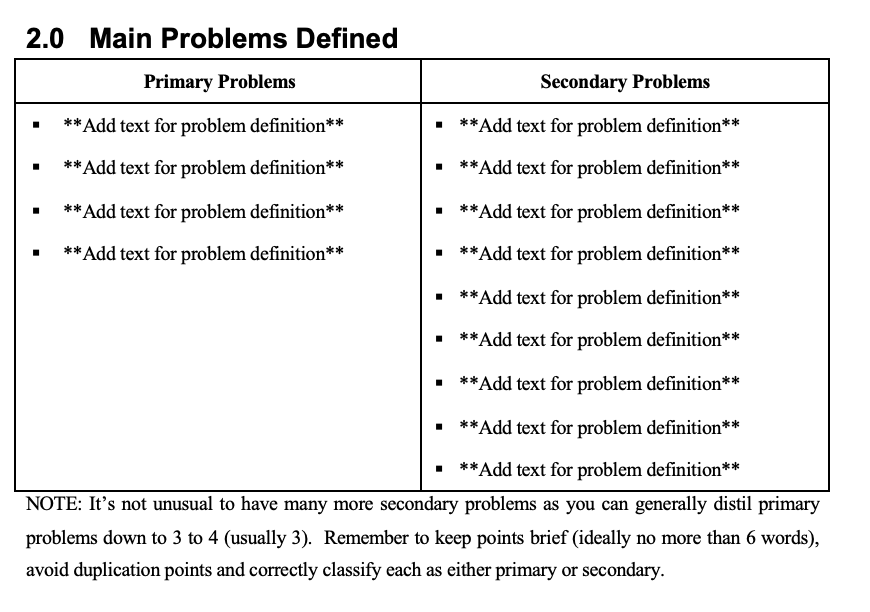
2.0 Main Problems Defined Primary Problems Secondary Problems **Add text for problem definition** **Add text for problem definition** **Add text for problem definition** **Add text for problem definition** **Add text for problem definition** **Add text for problem definition** **Add text for problem definition** **Add text for problem definition** **Add text for problem definition** **Add text for problem definition** **Add text for problem definition** . **Add text for problem definition* **Add text for problem definition** NOTE: It's not unusual to have many more secondary problems as you can generally distil primary problems down to 3 to 4 (usually 3). Remember to keep points brief (ideally no more than 6 words), avoid duplication points and correctly classify each as either primary or secondaryStep by Step Solution
There are 3 Steps involved in it

Get step-by-step solutions from verified subject matter experts
 Study Help