Question: The above picture is a case. There are five problems in this case. Please help me solve them. Thank you very much 1) A) Please
The above picture is a case. There are five problems in this case. Please help me solve them. Thank you very much
1) A) Please elaborate at least five key features of the existing pattern of behavior and thoughts of the entire company that would hinder the Wengart Aircraft from successfully implementing Quality Management. Please also elaborate three most important roots (assumptions) of this pattern of behavior.
B) Please also identify the driving forces toward acceptance of the TQM programme at the top management level.
2) Please use a fish bone diagram (or Cause and Effect Diagram) to illustrate why the implementation of the TQM programme at this firm has been a failure up until now.
3) Please recommend at least 5 steps the leadership should take in order to help unfreeze the existing pattern of behavior and thoughts, before it can implement any quality management programme.
4) Please provide 3 reasons for and 3 reasons against the implementation of ISO9001 in Wengart Aircraft.
5) After President Ralph Larsen had realized the unfortunate situation as described in the case, he invited you to be a consultant to Wengarts top management. Please kindly outline a list of 5 feasible steps, in descending order of importance, that should be undertaken by Wengart Aircraft for it to succeedin the TQM programme implementation. Your recommendations should address the assumptions that you have identified in 1A above.
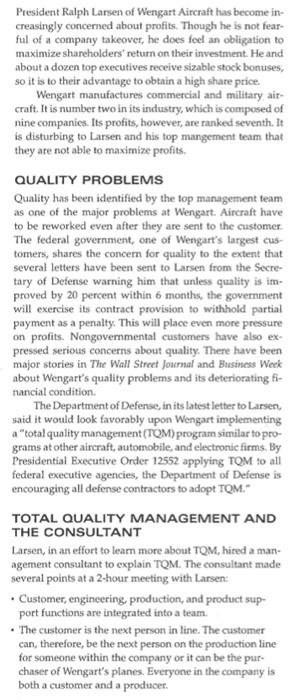
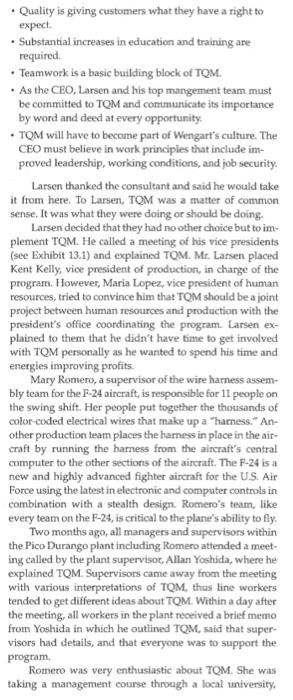
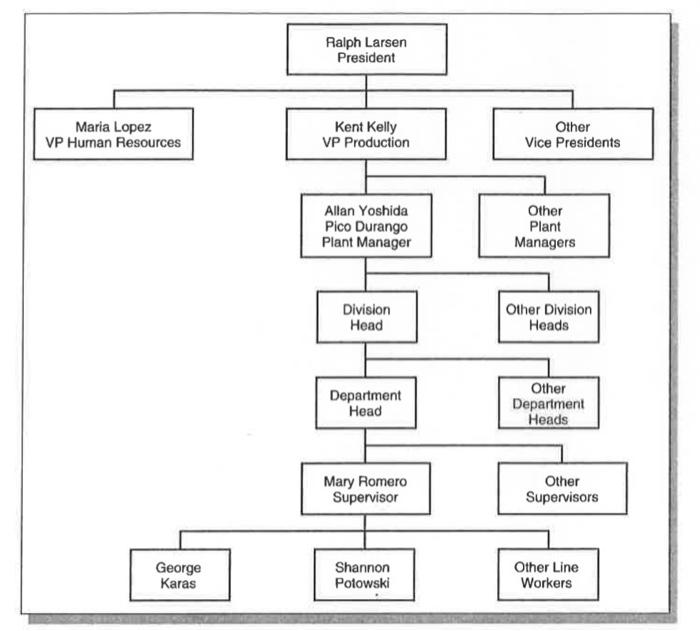
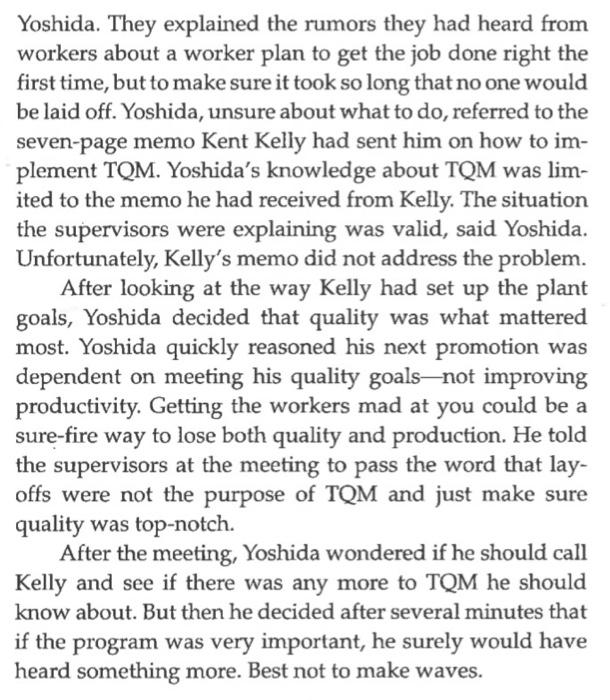
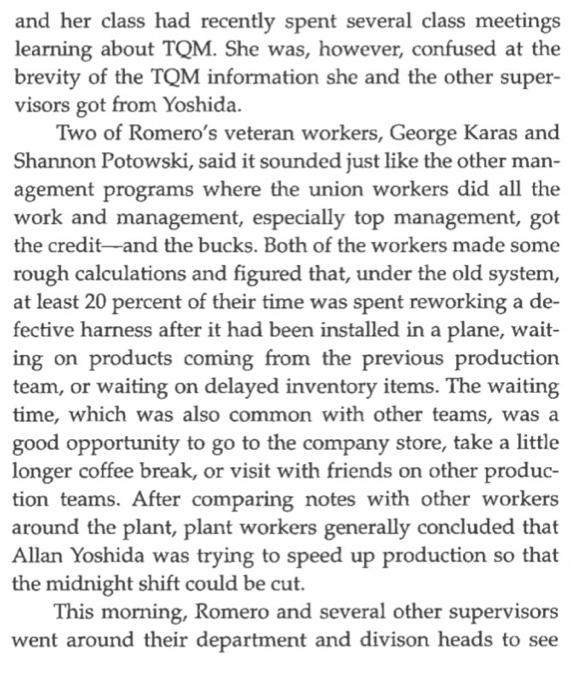
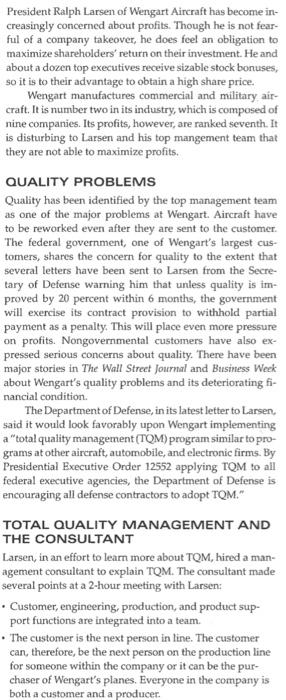
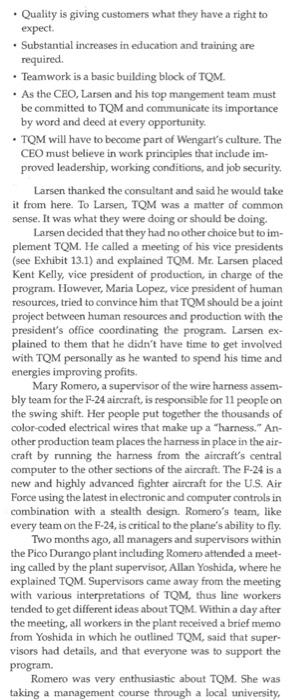
President Ralph Larsen of Wengart Aircraft has become increasingly concerned about profits. Though he is not fearful of a company takeover, he does feel an obligation to maximize shareholders' return on their investment. He and about a dozen top executives receive sizable stock bonuses, so it is to their advantage to obtain a high share price. Wengart manufactures commercial and military aircraft. It is number two in its industry, which is composed of nine companies. Its profits, however, are ranked seventh. It is disturbing to Larsen and his top mangement team that they are not able to maximize profits. QUALITY PROBLEMS Quality has been identified by the top management team as one of the major problems at Wengart. Aircraft have to be reworked even after they are sent to the customer. The federal government, one of Wengart's largest customers, shares the concern for quality to the extent that several letters have been sent to Larsen from the Secretary of Defense warning him that unless quality is improved by 20 percent within 6 months, the government will exercise its contract provision to withhold partial payment as a penalty. This will place even more pressure on profits. Nongovernmental customers have also expressed serious concerns about quality. There have been major stories in The Wall Street Journal and Business Weck about Wengart's quality problems and its deteriorating financial condition. The Department of Defense, in its latest letter to Larsen, said it would look favorably upon Wengart implementing a "total quality management (TQM) program similar to programs at other aircraft, automobile, and electronic firms. By Presidential Exectative Order 12552 applying TQM to all federal executive agencies, the Department of Defense is encouraging all defense contractors to adopt TQM." TOTAL QUALITY MANAGEMENT AND THE CONSULTANT Larsen, in an effort to leam more about TQM, hired a management consultant to explain TQM. The consultant made several points at a 2-hour meeting with Larsen: - Customer, engineering, production, and product support functions are integrated into a team. - The customer is the next person in line. The customer can, therefore, be the next person on the production line for someone within the company or it can be the purchaser of Wengart's planes. Everyone in the company is both a customer and a producer. - Quality is giving customers what they have a right to expect. - Substantial increases in education and training are required. - Teamwork is a basic building block of TQM. - As the CEO, Larsen and his top mangement team must be committed to TQM and communicate its importance by word and deed at every opportunity. - TQM will have to become part of Wengart's culture. The CEO must believe in work principles that include improved leadership, working conditions, and job security. Larsen thanked the consultant and said he would take it from here. To Larsen, TQM was a matter of common sense. It was what they were doing or should be doing. Larsen decided that they had no other choice but to implement TQM. He called a meeting of his vice presidents (see Exhibit 13.1) and explained TQM. Mr. Larsen placed Kent Kelly, vice president of production, in charge of the program. However, Maria Lopez, vice president of human resources, tried to convince him that TQM should be a joint project between human resources and production with the president's office coordinating the program. Larsen explained to them that he didn't have time to get involved with TQM personally as he wanted to spend his time and energies improving profits. Mary Romero, a supervisor of the wire harness assembly team for the F-24 aircraft, is responsible for 11 people on the swing shift. Her people put together the thousands of color-coded electrical wires that make up a "harness." Another production team places the hamess in place in the aircraft by running the hamess from the aircraft's central computer to the other sections of the aircraft. The P-24 is a new and highly advanced fighter aircraft for the US. Air Force using the latest in electronic and computer controls in combination with a stealth design. Romero's teatm, like every team on the F24, is critical to the plane's ability to fly. Two months ago, all managers and supervisors within the Pico Durango plant including Romero attended a meeting called by the plant supervisoc, Allan Yoshida, where he explained TQM. Supervisors came away from the meeting with various interpretations of TQM, thus line workers tended to get different ideas about TQM. Within a day after the meeting, all workers in the plant received a brief memo from Yoshida in which he outlined TQM, said that supervisors had details, and that everyone was to support the program. Romero was very enthusiastic about TQM. She was faking a management course through a local university. Other Division Heads \begin{tabular}{l} Other Line \\ Workers \\ \hline \end{tabular} Yoshida. They explained the rumors they had heard from workers about a worker plan to get the job done right the first time, but to make sure it took so long that no one would be laid off. Yoshida, unsure about what to do, referred to the seven-page memo Kent Kelly had sent him on how to implement TQM. Yoshida's knowledge about TQM was limited to the memo he had received from Kelly. The situation the supervisors were explaining was valid, said Yoshida. Unfortunately, Kelly's memo did not address the problem. After looking at the way Kelly had set up the plant goals, Yoshida decided that quality was what mattered most. Yoshida quickly reasoned his next promotion was dependent on meeting his quality goals-not improving productivity. Getting the workers mad at you could be a sure-fire way to lose both quality and production. He told the supervisors at the meeting to pass the word that layoffs were not the purpose of TQM and just make sure quality was top-notch. After the meeting, Yoshida wondered if he should call Kelly and see if there was any more to TQM he should know about. But then he decided after several minutes that if the program was very important, he surely would have heard something more. Best not to make waves. and her class had recently spent several class meetings learning about TQM. She was, however, confused at the brevity of the TQM information she and the other supervisors got from Yoshida. Two of Romero's veteran workers, George Karas and Shannon Potowski, said it sounded just like the other management programs where the union workers did all the work and management, especially top management, got the credit-and the bucks. Both of the workers made some rough calculations and figured that, under the old system, at least 20 percent of their time was spent reworking a defective harness after it had been installed in a plane, waiting on products coming from the previous production team, or waiting on delayed inventory items. The waiting time, which was also common with other teams, was a good opportunity to go to the company store, take a little longer coffee break, or visit with friends on other production teams. After comparing notes with other workers around the plant, plant workers generally concluded that Allan Yoshida was trying to speed up production so that the midnight shift could be cut. This morning, Romero and several other supervisors went around their department and divison heads to see President Ralph Larsen of Wengart Aircraft has become increasingly concerned about profits. Though he is not fearful of a company takeover, he does fcel an obligation to maximize shareholders' return on their investment. He and about a dozen top executives receive sizable stock bonuses, so it is to their advantage to obtain a high share price. Wengart manufactures commercial and military aircraft. It is number two in its industry, which is composed of nine companies. Its profits, however, are ranked seventh. It is disturbing to Larsen and his top mangement team that they are not able to maximize profits. QUALITY PROBLEMS Quality has been identified by the top management team as one of the major problems at Wengart. Aircraft have to be reworked even after they are sent to the customer. The federal government, one of Wengart's largest customers, shares the concern for quality to the extent that several letters have been sent to Larsen from the Secretary of Deferise warning him that unless quality is improved by 20 percent within 6 months, the govermment will exercise its contract provision to withhold partial payment as a penalty. This will place even more pressure on profits. Nongovernmental customers have also expressed serious concerns about quality. There have been major stories in The Wall Street Jourmal and Business Week about Wengart's quality problems and its deteriorating financial condition. The Department of Defense, in its latest letter to Larsen, said it would look favorably upon Wengart implementing a "total quality management(TQM) program similar to programs at other aircraft, automobile, and electronic firms. By Presidential Executive Order 12552 applying TQM to all federal executive agencies, the Department of Defense is encouraging all defense contractors to adopt TQM." TOTAL QUALITY MANAGEMENT AND THE CONSULTANT Larsen, in an effort to learn more about TQM, hired a management consultant to explain TQM. The consultant made several points at a 2-hour meeting with Larsen: - Customer, engineering, production, and product support functions are integrated into a team. - The customer is the next person in line. The customer can, therefore, be the next person on the production line for someone within the company or it can be the purchaser of Wengart's planes. Everyone in the company is both a customer and a producer. - Quality is giving customers what they have a right to expect. - Substantial increases in education and training are required. - Teamwork is a basic building block of TQM. - As the CEO, Larsen and his top mangement team must be committed to TQM and communicate its importance by word and deed at every opportunity. - TQM will have to become part of Wengart's culture. The CEO must believe in work principles that include improved leadership, working canditions, and job security. Larsen thanked the consultant and said he would take it from here. To Larsen, TQM was a matter of common sense. It was what they were doing or should be doing. Larsen decided that they had no other choice but to implement TQM. He called a meeting of his vice presidents (see Exhibit 13.1) and explained TQM. Mr. Larsen placed Kent Kelly, vice president of production, in charge of the program. However, Maria Lopez, vice president of human resources, tried to convince him that TQM should be a joint project between human resources and production with the president's office coordinating the programt. Larsen explained to them that he didn't have time to get involved with TQM personally as he wanted to spend his time and energies improving profits. Mary Romero, a supervisor of the wire harness assembly team for the F-24 aircraft, is responsible for 11 people on the swing shift. Her people put together the thousands of color-coded electrical wires that make up a "harness." Another production team places the harress in place in the aircraft by running the harness from the aircraft's central computer to the other sections of the aircraft. The F-24 is a new and highly advanced. fighter aircraft for the U.S. Air Force using the latest in electronic and computer controls in combination with a stealth design. Romero's team, like every team on the F24, is critical to the plane's ability to fly. Two months ago, all managers and supervisors within the Pico Durango plant including Romero attended a meeting called by the plant supervisot, Allan Yoshida, where he explained TQM. Supervisors came away from the meeting with various interpretations of TQM, thus line workers tended to get different ideas about TQM. Within a day after the meeting, all workers in the plant received a brief memo from Yoshida in which he outlined TQM, said that supervisors had details, and that everyone was to support the program. Romero was very enthusiastic about TQM. She was taking a management course through a local university









 Study Help