







Question: The accounting function and accounting profession in general have often been neglected in domestic business conditions without plausible reason. In numerous situations, accounting staff have
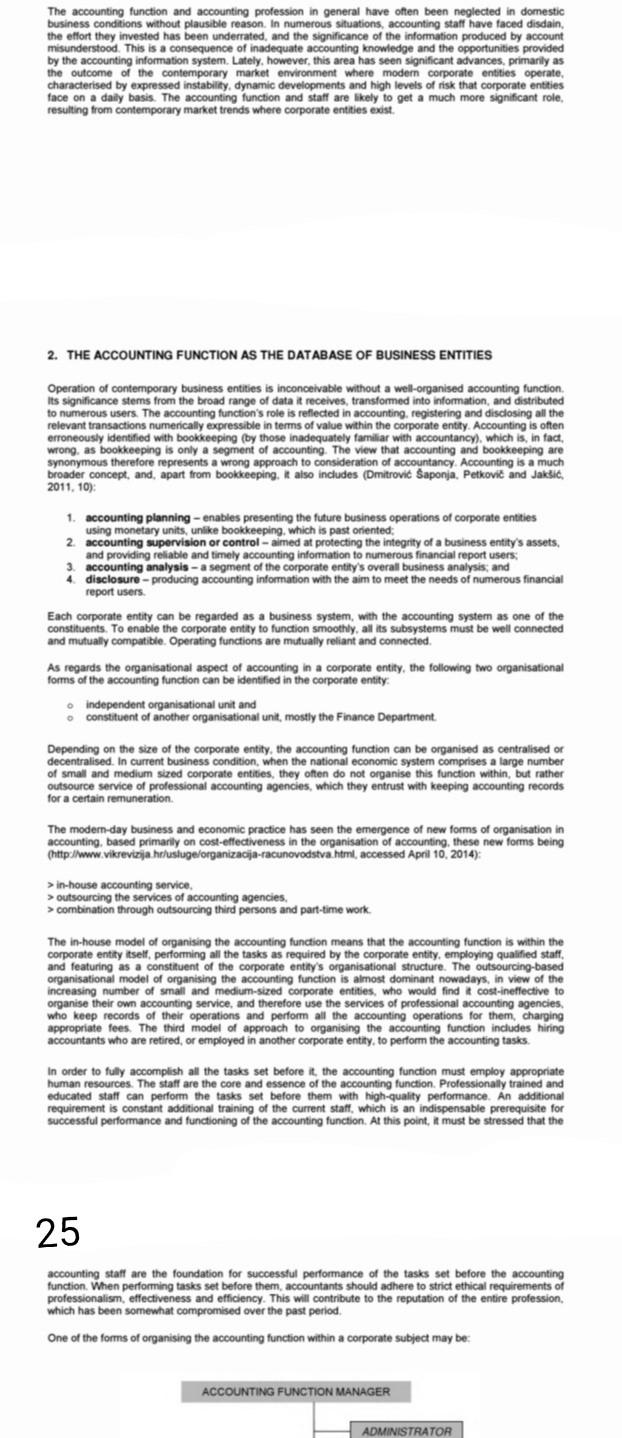
The accounting function and accounting profession in general have often been neglected in domestic business conditions without plausible reason. In numerous situations, accounting staff have faced disdain, the effort they invested has been underrated, and the significance of the information produced by account misunderstood. This is a consequence of inadequate accounting knowledge and the opportunities provided by the accounting information system. Lately, however, this area has seen significant advances, primarily as the outcome of the contemporary market environment where modern corporate entities operate, characterised by expressed instability, dynamic developments and high levels of risk that corporate entities face on a daily basis. The accounting function and staff are likely to get a much more significant role, resulting from contemporary market trends where corporate entities exist 2. THE ACCOUNTING FUNCTION AS THE DATABASE OF BUSINESS ENTITIES Operation of contemporary business entities is inconceivable without a well-organised accounting function, its significance stems from the broad range of data it receives, transformed into information, and distributed to numerous users. The accounting function's role is reflected in accounting, registering and disclosing all the relevant transactions numerically expressible in terms of value within the corporate entity. Accounting is often erroneously identified with bookkeeping (by those inadequately familiar with accountancy), which is, in fact, wrong. as bookkeeping is only a segment of accounting. The view that accounting and bookkeeping are synonymous therefore represents a wrong approach to consideration accountancy Accou is a much broader concept, and, apart from bookkeeping. It also includes (Dmitrovi aponja. Petkovi and Jaki. 2011, 10): 1. accounting planning - enables presenting the future business operations of corporate entities using monetary units, unlike bookkeeping, which is past oriented 2. accounting supervision or control - aimed at protecting the integrity of a business entity's assets, and providing reliable and timely accounting information to numerous financial report users 3. accounting analysis - a segment of the corporate entity's overall business analysis and 4 disclosure - producing accounting information with the aim to meet the needs of numerous financial report users. Each corporate entity can be regarded as a business system, with the accounting system as one of the constituents. To enable the corporate entity to function smoothly, all its subsystems must be well connected and mutually compatible. Operating functions are mutually reliant and connected. As regards the organisational aspect of accounting in a corporate entity, the following two organisational forms of the accounting function can be identified in the corporate entity independent organisational unit and constituent of another organisational unit, mostly the Finance Department Depending on the size of the corporate entity, the accounting function can be organised as centralised or decentralised. In current business condition, when the national economic system comprises a large number of small and medium sized corporate entities, they often do not organise this function within, but rather outsource service of professional accounting agencies, which they entrust with keeping accounting records for a certain remuneration The modern-day business and economic practice has seen the emergence of new forms of organisation in accounting, based primarily on cost-effectiveness in the organisation of accounting, these new forms being (http://www.vikrevizija.hr/usluge/organizacija-racunovodstva.html, accessed April 10, 2014): > in-house accounting service > outsourcing the services of accounting agencies, > combination through outsourcing third persons and part-time work The in-house model of organising the accounting function means that the accounting function is within the corporate entity itself, performing all the tasks as required by the corporate entity, employing qualified staff, and featuring as a constituent of the corporate entity's organisational structure. The outsourcing-based organisational model of organising the accounting function is almost dominant nowadays, in view of the increasing number of small and medium-sized corporate entities, who would find cost-ineffective to organise their own accounting service, and therefore use the services of professional accounting agencies, who keep records of their operations and perform all the accounting operations for them, charging appropriate fees. The third model of approach to organising the accounting function includes hiring accountants who are retired, or employed in another corporate entity, to perform the accounting tasks In order to fully accomplish all the tasks set before it the accounting function must employ appropriate human resources. The staff are the core and essence of the accounting function. Professionally trained and educated staff can perform the tasks set before them with high-quality performance. An additional requirement is constant additional training of the current staff, which is an indispensable prerequisite for successful performance and functioning of the accounting function. At this point, it must be stressed that the 25 accounting staff are the foundation for successful performance of the tasks set before the accounting function. When performing tasks set before accountants should adhere to strict ethical requirements of professionalism, effectiveness and efficiency. This will contribute to the reputation of the entire profession, which has been somewhat compromised over the past period One of the forms of organising the accounting function within a corporate subject may be ACCOUNTING FUNCTION MANAGER ADMINISTRATOR
Step by Step Solution
There are 3 Steps involved in it
1 Expert Approved Answer
Step: 1 Unlock

Question Has Been Solved by an Expert!
Get step-by-step solutions from verified subject matter experts
Step: 2 Unlock
Step: 3 Unlock
 Study Help