







Question: the Ackermann function 2. The Ackermann function is defined for nonnegative values of m, n as follows. n +1 if m = 0, A(m, n)
the Ackermann function
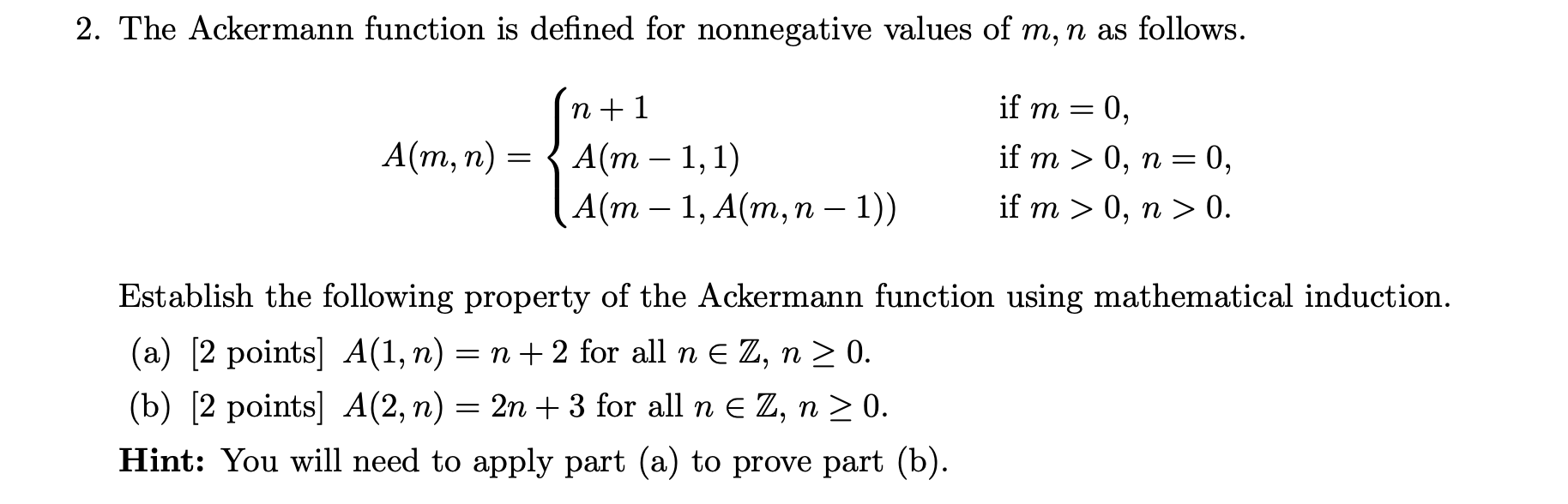
2. The Ackermann function is defined for nonnegative values of m, n as follows. n +1 if m = 0, A(m, n) = A(m - 1, 1) if m > 0, n = 0, A(m - 1, A(m, n - 1)) if m > 0, n > 0. Establish the following property of the Ackermann function using mathematical induction. (a) [2 points] A(1, n) = n + 2 for all n E Z, n 2 0. (b) [2 points] A(2, n) = 2n + 3 for all n E Z, n 2 0. Hint: You will need to apply part (a) to prove part (b)
Step by Step Solution
There are 3 Steps involved in it
1 Expert Approved Answer
Step: 1 Unlock

Question Has Been Solved by an Expert!
Get step-by-step solutions from verified subject matter experts
Step: 2 Unlock
Step: 3 Unlock
 Study Help