







Question: The activity rate for a particular activity is a computed by Multiplying the total cost in the activity's cost poof by the total amount of
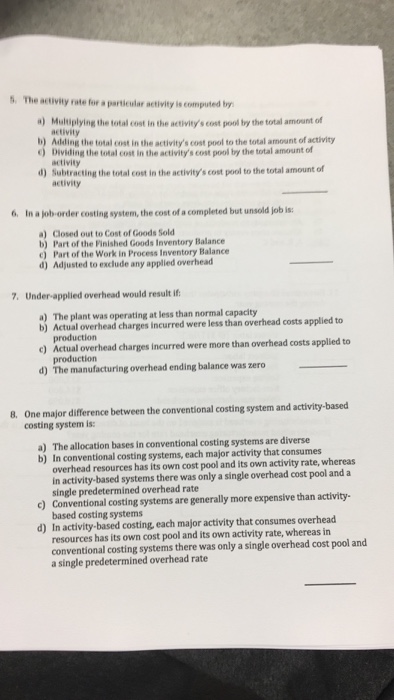
The activity rate for a particular activity is a computed by" Multiplying the total cost in the activity's cost poof by the total amount of activity Adding the total cost in the activity's cost poof to the total amount of activity Dividing the total cost in the activity's cost poof by the total amount of activity Subtracting the total cost in the activity's cost poof to the total amount of activity In a job-order costing system the cost of a completed but unsold job is: Closed out to Cost of Goods Sold Part of the Finished Goods Inventory Balance Part of the Work in Process Inventory Balance Adjusted to exclude any applied overhead Under applied overhead would result If: The plant was operating at less than normal capacity Actual overhead charges Incurred were lets than overhead costs applied to production Actual overhead charges Incurred were more than overhead costs applied to production The manufacturing overhead ending balance was zero One major difference between the conventional costing system and activity-based costing system It: The allocation bates In conventional costing systems are diverse In conventional costing systems, each major activity that consumes overhead resources has its own cost pool and Its own activity rate, whereas In activity-based systems there was only a single overhead cost pool and a >>Ingle predetermined overhead rate Conventional costing systems are generally more expensive than activity-based costing systems In activity-based costing, each major activity that consumes overhead resources has Its own cost pool and Its own activity rate, whereas in conventional costing systems there was only a single overhead cost pool and a single predetermined overhead rate
Step by Step Solution
There are 3 Steps involved in it

Get step-by-step solutions from verified subject matter experts
 Study Help