







Question: The answer is given on chegg is not completed at all, can someone please do all the parts a,b and c and d clearly and
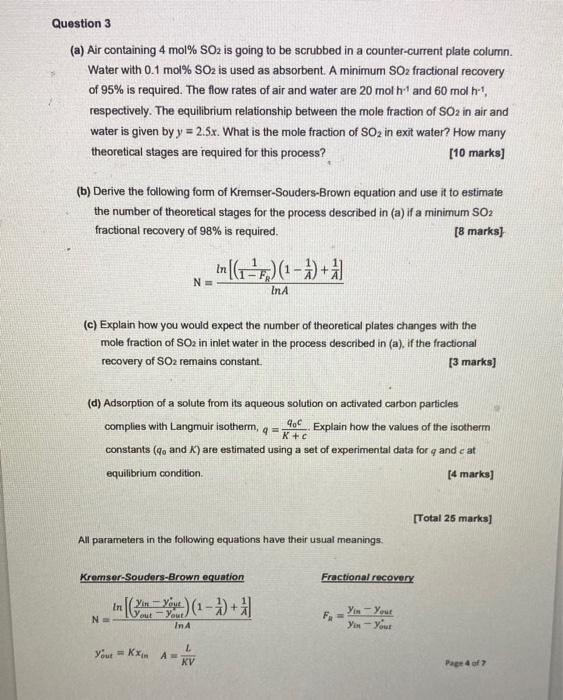
(a) Air containing 4mol%SO2 is going to be scrubbed in a counter-current plate column. Water with 0.1mol%SO2 is used as absorbent. A minimum SO2 fractional recovery of 95% is required. The flow rates of air and water are 20molh1 and 60molh1, respectively. The equilibrium relationship between the mole fraction of SO2 in air and water is given by y=2.5x. What is the mole fraction of SO2 in exit water? How many theoretical stages are required for this process? [10 marks] (b) Derive the following form of Kremser-Souders-Brown equation and use it to estimate the number of theoretical stages for the process described in (a) if a minimum SO2 fractional recovery of 98% is required. [8 marks] N=lnAln[(1FR1)(1A1)+A1] (c) Explain how you would expect the number of theoretical plates changes with the mole fraction of SO2 in inlet water in the process described in (a), if the fractional recovery of SO2 remains constant. [3 marks] (d) Adsorption of a solute from its aqueous solution on activated carbon particles complies with Langmuir isotherm, q=K+cq0c. Explain how the values of the isotherm constants (q0 and K) are estimated using a set of experimental data for q and c at equilibrium condition. [4 marks] [Total 25 marks] All parameters in the following equations have their usual meanings. Kremser-Souders-Brown equation Fractional recovery N=lnAln[(youtyoutyinyout)(1A1)+A1]Fif=yinyoutyinyoutyout=KxinA=KVL
Step by Step Solution
There are 3 Steps involved in it

Get step-by-step solutions from verified subject matter experts
 Study Help