







Question: The answer to 6 is A. The answer to 9 is E. I just want to know why those answers are correct, like an explanation
The answer to 6 is A. The answer to 9 is E. I just want to know why those answers are correct, like an explanation on why they are correct. Also why is D for 6 incorrect?
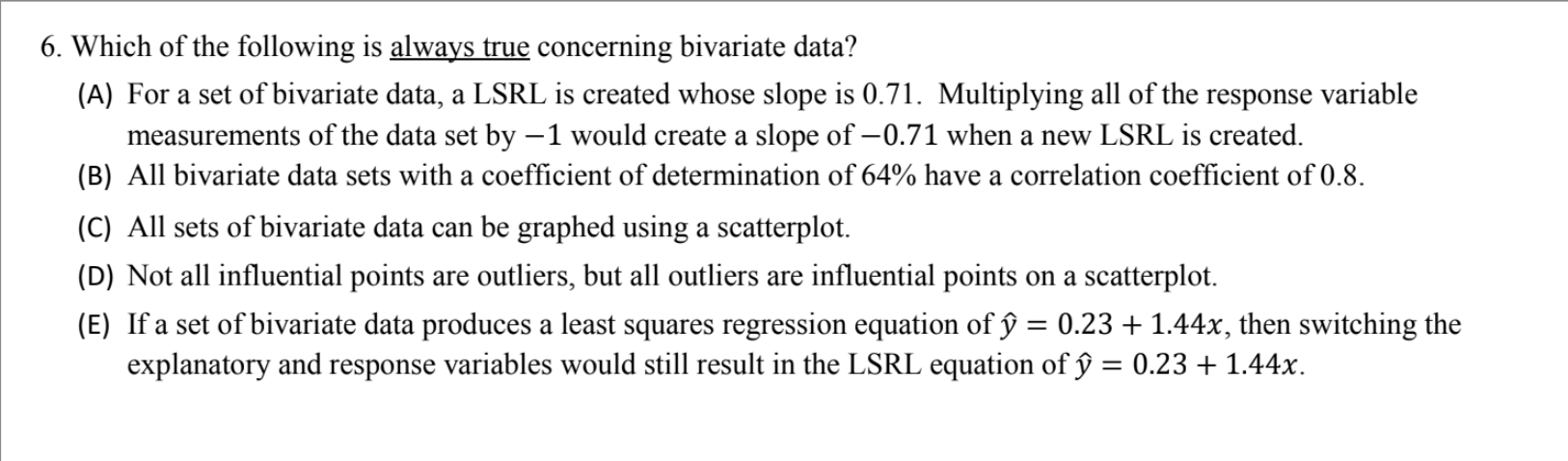
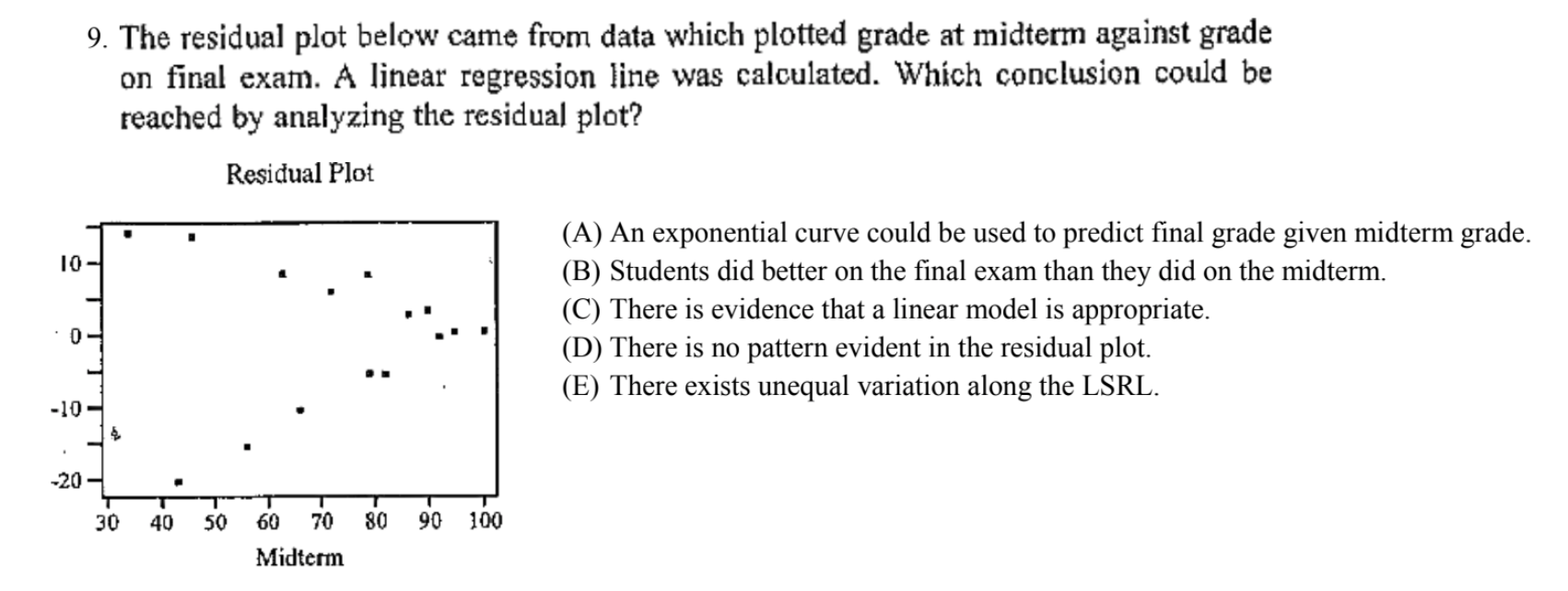
6. Which of the following is always true concerning bivariate data? (A) For a set of bivariate data, a LSRL is created whose slope is 0.71. Multiplying all of the response variable measurements of the data set by -1 would create a slope of -0.71 when a new LSRL is created. (B) All bivariate data sets with a coefficient of determination of 64% have a correlation coefficient of 0.8. (C) All sets of bivariate data can be graphed using a scatterplot. (D) Not all influential points are outliers, but all outliers are influential points on a scatterplot. (E) If a set of bivariate data produces a least squares regression equation of y = 0.23 + 1.44x, then switching the explanatory and response variables would still result in the LSRL equation of y = 0.23 + 1.44x.9. The residual plot below came from data which plotted grade at midterm against grade on final exam. A linear regression line was calculated. Which conclusion could be reached by analyzing the residual plot? Residual Plot 10 (A) An exponential curve could be used to predict final grade given midterm grade. (B) Students did better on the final exam than they did on the midterm. 0 - (C) There is evidence that a linear model is appropriate. (D) There is no pattern evident in the residual plot. -10 - (E) There exists unequal variation along the LSRL. -20 30 40 50 60 70 80 90 100 Midterm
Step by Step Solution
There are 3 Steps involved in it

Get step-by-step solutions from verified subject matter experts
 Study Help