







Question: The approximate IRR from the graph is %. (Round to the nearest integer.) c. Is the purchase attractive based on these estimates? (Select the best
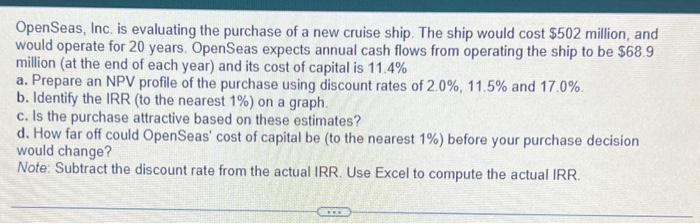
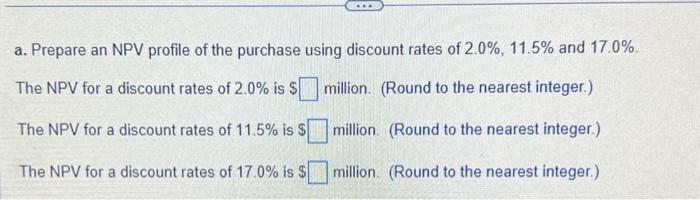
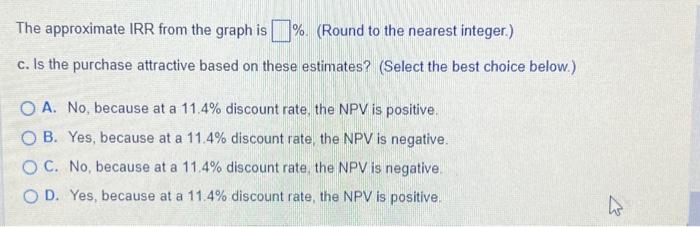

The approximate IRR from the graph is \%. (Round to the nearest integer.) c. Is the purchase attractive based on these estimates? (Select the best choice below.) A. No, because at a 11.4% discount rate, the NPV is positive. B. Yes, because at a 11.4% discount rate, the NPV is negative. C. No, because at a 11.4% discount rate, the NPV is negative. D. Yes, because at a 11.4% discount rate, the NPV is positive. a. Prepare an NPV profile of the purchase using discount rates of 2.0%,11.5% and 17.0%. The NPV for a discount rates of 2.0% is $ million. (Round to the nearest integer.) The NPV for a discount rates of 11.5% is \$ million. (Round to the nearest integer.) The NPV for a discount rates of 17.0% is $ million. (Round to the nearest integer.) d. How far off could OpenSeas' cost of capital be (to the nearest 1% ) before your purchase decision would change? The cost of capital estimate can be off by %. (Round to three decimal places.) OpenSeas, Inc. is evaluating the purchase of a new cruise ship. The ship would cost $502 million, and would operate for 20 years. OpenSeas expects annual cash flows from operating the ship to be $68.9 million (at the end of each year) and its cost of capital is 11.4% a. Prepare an NPV profile of the purchase using discount rates of 2.0%,11.5% and 17.0%. b. Identify the IRR (to the nearest 1% ) on a graph. c. Is the purchase attractive based on these estimates? d. How far off could OpenSeas' cost of capital be (to the nearest 1\%) before your purchase decision would change? Note: Subtract the discount rate from the actual IRR. Use Excel to compute the actual IRR
Step by Step Solution
There are 3 Steps involved in it

Get step-by-step solutions from verified subject matter experts
 Study Help