Question: The article described one experiment that was completed to show how social influence affects peoples behavior. Based on the description of the experiment, how would
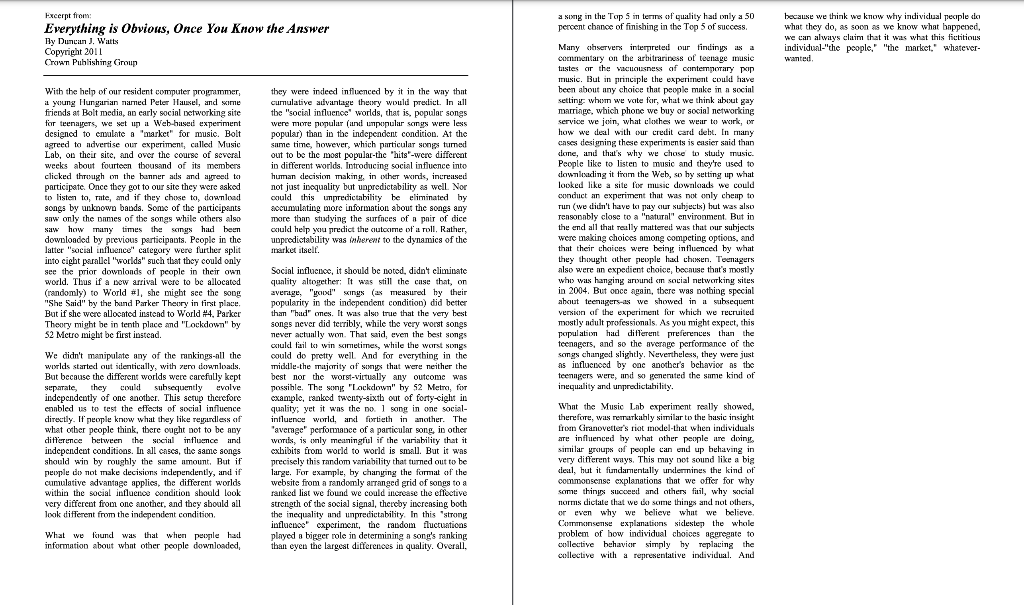
- The article described one experiment that was completed to show how social influence affects peoples behavior. Based on the description of the experiment, how would you state the null and alternative hypotheses in laymans terms? (6 points)
- What are the treatment(s) in the experiment? That is, what is being manipulated? (7 points)
- Does the experiment have a control group, and if so, which group serves as the control? (7 points)
- How would you describe their basic research design (e.g., one-shot case study)? (6 points)
- Do you think the study is high or low in internal validity? Why? (7 points)
- Do you think the study is high or low in external validity? Why? (7 points)
- How would you summarize the experiments findings? (5 points)
a song in the Top 5 in terms of quality had only a 50 percent chance of finishing in the Top 5 of success Excerpt from: Everything is obvious, Once You Know the Answer Hy Duncan J. Watts Copyright 2011 Crown Publishing Group because we think we know why indiviclul preciple do what they do, as soon as we know what happened, we can always claim that it was what this fictitious individual-"the poople," "the market." whatever- wanted With the help of our resident computer programmer a young Hungarian named Peter Havel and me friends at Bolt media, an early social networking site for teenagers, we set up a Web-based experiment designed to emulate a "marker" for music. Bolt agreed to advertise our experiment, called Music Lab, on their site, and over the course of several weeks about fourteen thousand of its members clicked through on the banner als and agreed to participate. Once they got to our site they were asked to listen to, rate, and if they chose to download songs by unknown bands. Some of the participants saw only the names of the songs while others also saw how many times the songs had been downloaded by previous participants, People in the latter "social influence category were further split into cight parallel "worlds" such that they could only see the prior downlonds of people in their own world. Thus if a bow arrival were to be allocated (randomly) to World #), she might see the song "She Said" by the hand Parker Theory in first place. But if she were allocated instead to World #4, Parker Theory might be in tenth place and "Lockdown" by S2 Metro miglit be first instead. they were indeed influenced by it in the way that cumulative advantage they would prelict. In all tbe "social influence worlds, that is, popular songs were more popular and unpopular songs were less popular) than in the independent condition. At the sime time, however, which particular songs tumed out to be the most popular the White-were differcat in different worlds. Introducing social influence into human decision making, in other winds, increased not just in quality but unpredictability as well Nor could this unpredictability be eliminated by accumulating more information about the songs any more than studying the surfnces of a pnir of dice could help you predict the cutcome of a roll. Rather, ubprodictability was inherent to the dynamics of the market itselt. Social influence, it should be noted, didn't climinate quality altogether: It was still the case that, on averige, "good" sinys (as measured by their popularity in the independent condition) did better than "hud omnes. It was also true that the very best songs never did terribly, while the very worst songs never actually wom. That said, even the best songs ciuld fail to win imetimes, while the worst songs could do pretty well. And for everything in the midille the majority of songs that were neither the best nor the worst-virtually any outcome was possible. The song "Lockdown" hy 52 Metro, for cxample, ranked twenty-sixth out of forty-cight in quality, yet it was the no. 1 song in one social- influence world, and furtieth in another. The "average performance of a particular song in other woriis, is my meaningful if the variability that it exhibits from world to world is small. But it was precisely this random variability that turned out to be large. For example, by changing the format of the website from a randomly arranged grid of songs to a ranked list we found we could increase the effoctive strength of the social signal, thereby increasing both the inequality and unpredictability. In this strong influence experiment, the random fluctuations played a bigger role in determining a song's ranking than eyes the largest differences in quality. Overall, Many chserver interpreted our findings commentary on the arbitrariness of teenage music tastes or the vacuousness of contemporary in music. But in principle the experiment could have been about any choice that people make in a social setting whom we voite fer, what we think about gay marriage, which phone we buy or social networking service we join, what clothes we wear to work, or how we deal with our credit card debt. In many cases designing these experiments is easier said than daine, and that's why we chose to study music. People like to listen to music and they're used to downloading it from the Web, so hy setting up what looked like a site for music downloads we could conduct an experiment that was not only cheap to run (we didn't have to pay ciuar subjects) hut was also Tensonably close to a "naturn" environment. But in the end all that really mattered was that our subjects were making choices among competing options, and that their choices were being influenced by what they thought ither people had chosen. Teenagers also were in expedient choice, because that's mostly who was hanging around cm social networking sites in 2004. But once again, there was nothing specin about teenagers as we showed in a subsequent version of the experiment for which we recruited mostly ndult professionals. As you might expect this population had different preferences than the teenagers, and so the average performance of the songs changed slightly. Nevertheless, they were just as influenced by one another's behavior as the teenagers were, and emerited the same kind of inequality and unpredictahility. What the Music Lab experiment really showed, therefore, was reinstahly similar to the basic insight from Granovetter's riot imodel that when individuals are influenced by what other people are doing similar groups of pexiple can end up behaving in very different ways. This may not sound like a big deal, hut it fundamentally undermines the kind of commonsense explanations that we offer for why same things suced and others fail, why wicial norms dictate that we ckt some things and not others, or even why we believe what we believe Concnsense explanations wicester the whole problem of how individual choices aggregnte to collective behavior simply by replacing the collective with a representative individual. And We didn't manipulate any of the rankings-all the worlds started out itentically, with zer diownloads But because the different worlds were carefully kept separate, they could subsequently evolve independeutly of one another. This actup therefore ennbled us to test the effects of social influence directly. If people know what they like regardless of what other people think, there ought not to be any difference between the social influence and independeat conditions. In all cases, the same songs should win by roughly the same amount. But if people do not make clecisions independently, and if cumulative advantage applics, the different worlds within the social intluence condition sboald look very differcut from one another, and they should all look different from the independent condition What we found was that when people had information about what other people downloaded, a song in the Top 5 in terms of quality had only a 50 percent chance of finishing in the Top 5 of success Excerpt from: Everything is obvious, Once You Know the Answer Hy Duncan J. Watts Copyright 2011 Crown Publishing Group because we think we know why indiviclul preciple do what they do, as soon as we know what happened, we can always claim that it was what this fictitious individual-"the poople," "the market." whatever- wanted With the help of our resident computer programmer a young Hungarian named Peter Havel and me friends at Bolt media, an early social networking site for teenagers, we set up a Web-based experiment designed to emulate a "marker" for music. Bolt agreed to advertise our experiment, called Music Lab, on their site, and over the course of several weeks about fourteen thousand of its members clicked through on the banner als and agreed to participate. Once they got to our site they were asked to listen to, rate, and if they chose to download songs by unknown bands. Some of the participants saw only the names of the songs while others also saw how many times the songs had been downloaded by previous participants, People in the latter "social influence category were further split into cight parallel "worlds" such that they could only see the prior downlonds of people in their own world. Thus if a bow arrival were to be allocated (randomly) to World #), she might see the song "She Said" by the hand Parker Theory in first place. But if she were allocated instead to World #4, Parker Theory might be in tenth place and "Lockdown" by S2 Metro miglit be first instead. they were indeed influenced by it in the way that cumulative advantage they would prelict. In all tbe "social influence worlds, that is, popular songs were more popular and unpopular songs were less popular) than in the independent condition. At the sime time, however, which particular songs tumed out to be the most popular the White-were differcat in different worlds. Introducing social influence into human decision making, in other winds, increased not just in quality but unpredictability as well Nor could this unpredictability be eliminated by accumulating more information about the songs any more than studying the surfnces of a pnir of dice could help you predict the cutcome of a roll. Rather, ubprodictability was inherent to the dynamics of the market itselt. Social influence, it should be noted, didn't climinate quality altogether: It was still the case that, on averige, "good" sinys (as measured by their popularity in the independent condition) did better than "hud omnes. It was also true that the very best songs never did terribly, while the very worst songs never actually wom. That said, even the best songs ciuld fail to win imetimes, while the worst songs could do pretty well. And for everything in the midille the majority of songs that were neither the best nor the worst-virtually any outcome was possible. The song "Lockdown" hy 52 Metro, for cxample, ranked twenty-sixth out of forty-cight in quality, yet it was the no. 1 song in one social- influence world, and furtieth in another. The "average performance of a particular song in other woriis, is my meaningful if the variability that it exhibits from world to world is small. But it was precisely this random variability that turned out to be large. For example, by changing the format of the website from a randomly arranged grid of songs to a ranked list we found we could increase the effoctive strength of the social signal, thereby increasing both the inequality and unpredictability. In this strong influence experiment, the random fluctuations played a bigger role in determining a song's ranking than eyes the largest differences in quality. Overall, Many chserver interpreted our findings commentary on the arbitrariness of teenage music tastes or the vacuousness of contemporary in music. But in principle the experiment could have been about any choice that people make in a social setting whom we voite fer, what we think about gay marriage, which phone we buy or social networking service we join, what clothes we wear to work, or how we deal with our credit card debt. In many cases designing these experiments is easier said than daine, and that's why we chose to study music. People like to listen to music and they're used to downloading it from the Web, so hy setting up what looked like a site for music downloads we could conduct an experiment that was not only cheap to run (we didn't have to pay ciuar subjects) hut was also Tensonably close to a "naturn" environment. But in the end all that really mattered was that our subjects were making choices among competing options, and that their choices were being influenced by what they thought ither people had chosen. Teenagers also were in expedient choice, because that's mostly who was hanging around cm social networking sites in 2004. But once again, there was nothing specin about teenagers as we showed in a subsequent version of the experiment for which we recruited mostly ndult professionals. As you might expect this population had different preferences than the teenagers, and so the average performance of the songs changed slightly. Nevertheless, they were just as influenced by one another's behavior as the teenagers were, and emerited the same kind of inequality and unpredictahility. What the Music Lab experiment really showed, therefore, was reinstahly similar to the basic insight from Granovetter's riot imodel that when individuals are influenced by what other people are doing similar groups of pexiple can end up behaving in very different ways. This may not sound like a big deal, hut it fundamentally undermines the kind of commonsense explanations that we offer for why same things suced and others fail, why wicial norms dictate that we ckt some things and not others, or even why we believe what we believe Concnsense explanations wicester the whole problem of how individual choices aggregnte to collective behavior simply by replacing the collective with a representative individual. And We didn't manipulate any of the rankings-all the worlds started out itentically, with zer diownloads But because the different worlds were carefully kept separate, they could subsequently evolve independeutly of one another. This actup therefore ennbled us to test the effects of social influence directly. If people know what they like regardless of what other people think, there ought not to be any difference between the social influence and independeat conditions. In all cases, the same songs should win by roughly the same amount. But if people do not make clecisions independently, and if cumulative advantage applics, the different worlds within the social intluence condition sboald look very differcut from one another, and they should all look different from the independent condition What we found was that when people had information about what other people downloaded









 Study Help