Question: The bank is working to develop an efficient work schedule for full-time and part-time tellers. The schedule must provide for efficient operation of the bank,
The bank is working to develop an efficient work schedule for full-time and part-time tellers. The schedule must provide for efficient operation of the bank, including adequate customer service, employee breaks, and so on. On Fridays, the bank is open from 9:00 A.M. to 7:00 P.M. The number of tellers necessary to provide adequate customer service during each hour of operation is summarized here.
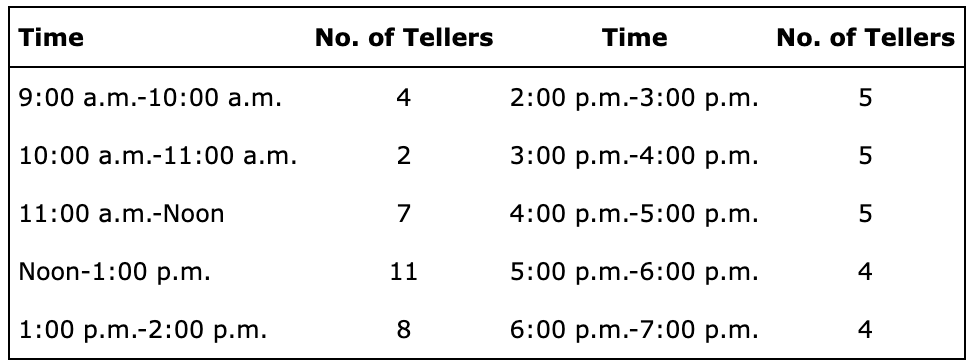
Each full-time employee starts on the hour and works a 4-hour shift, followed by a 1-hour break and then a 3-hour shift. Part-time employees work one 4-hour shift beginning on the hour. Considering salary and fringe benefits, full-time employees cost the bank $15 per hour ($105 a day), and part-time employees cost the bank $8 per hour ($32 per day).
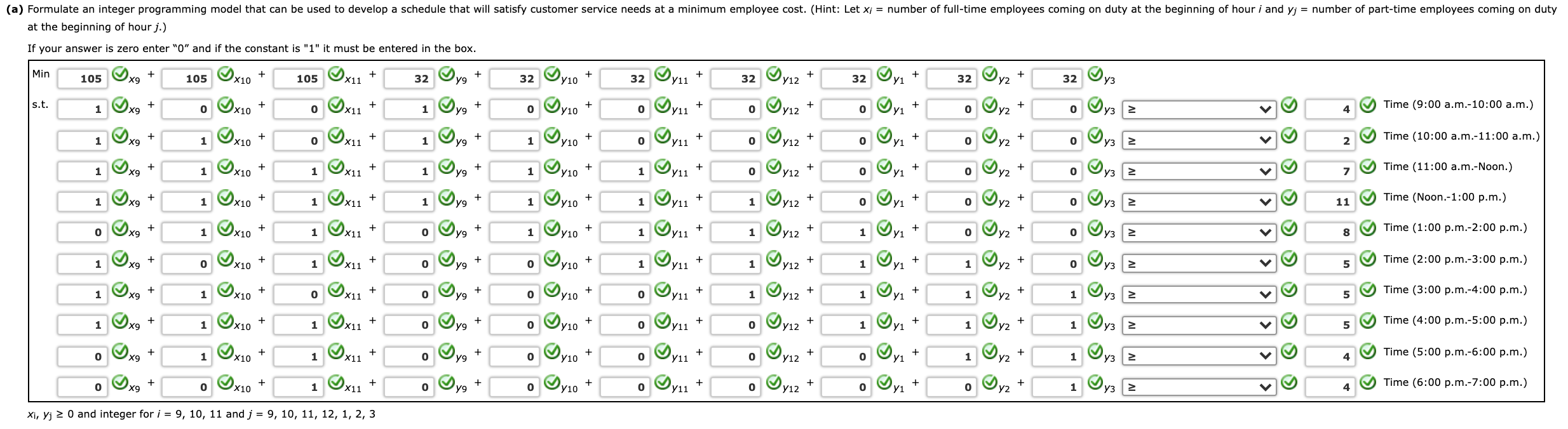
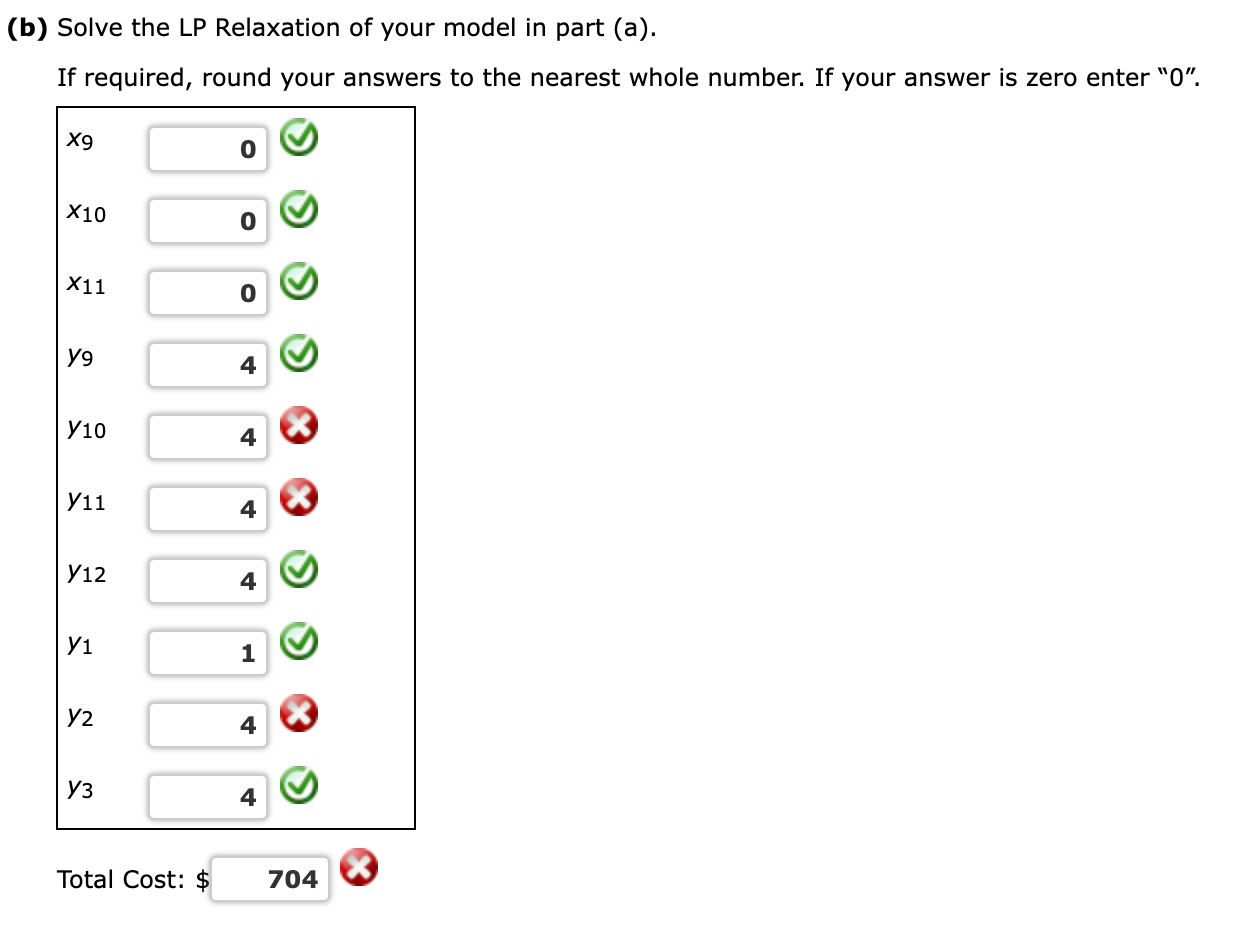
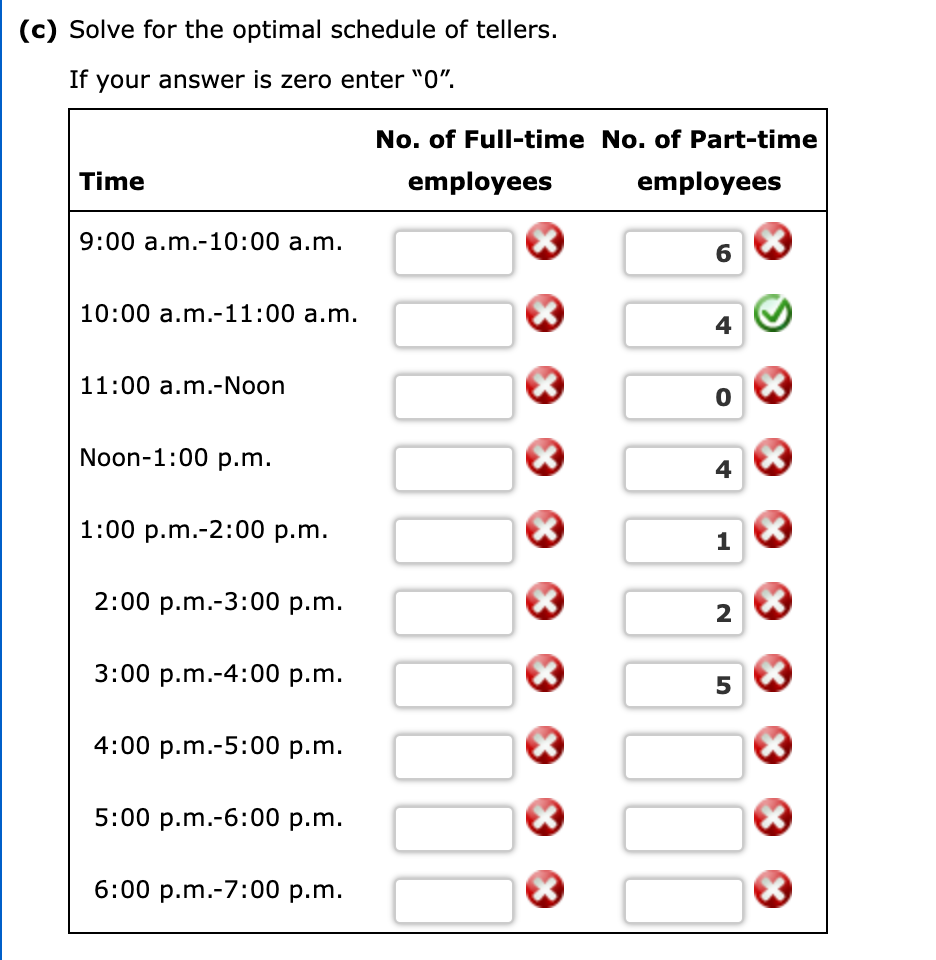
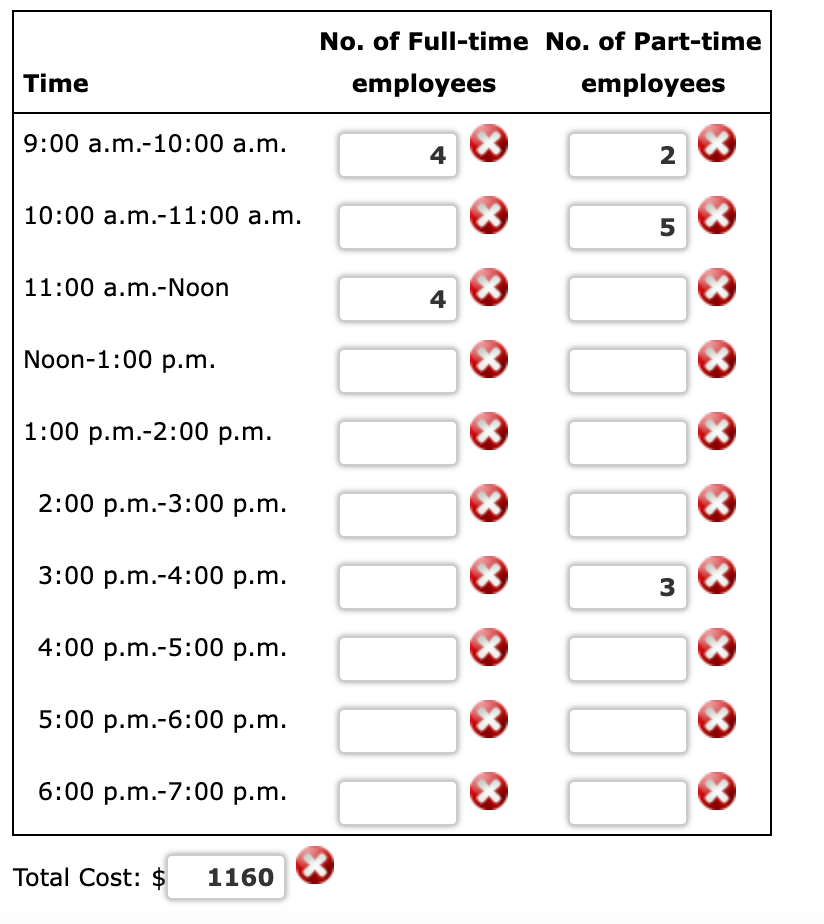
Time No. of Tellers Time No. of Tellers 9:00 a.m.-10:00 a.m. 4 2:00 p.m.-3:00 p.m. 5 10:00 a.m.-11:00 a.m. 2 3:00 p.m.-4:00 p.m. 5 11:00 a.m.-Noon 7 4:00 p.m.-5:00 p.m. 5 Noon-1:00 p.m. 11 5:00 p.m.-6:00 p.m. 4 1:00 p.m.-2:00 p.m. 8 6:00 p.m.-7:00 p.m. 4 + + 105 99 + + + + + 105 g + + + + + + + + y3 2 3x12 3x12 10 + + + Y11 + y10 + + + Oy + + o (a) Formulate an integer programming model that can be used to develop a schedule that will satisfy customer service needs at a minimum employee cost. (Hint: Let xj = number of full-time employees coming on duty at the beginning of hour i and yj = number of part-time employees coming on duty at the beginning of hourj.) If your answer is zero enter "0" and if the constant is "1" it must be entered in the box. Min 105 x10 + 32 y10 32 y12 + 32 Oy 32 32 X11 32 y Y9 yz Y11 Y2 32 s.t. + o 3x10 + 1 yg o y10 o y11 o yaz oyi o Oy2 1 0 y Time (9:00 a.m.-10:00 a.m.) X9 4 0 xg + + + + 1 1 + 1 + 0 1 Time (10:00 a.m.-11:00 a.m.) y9 0 Oys 2 Y10 0 y12 yi 0 y2 0 2 + + 1 1 1 1 Time (11:00 a.m.-Noon.) X11 yu1 1 + y9 1 yg 2 0 Y12 0 0 Y2 7 + 1 y11 1 + 1 + Time (Noon-1:00 p.m.) o Oya Y9 1 0 y2 yz 2 0 11 + 1 y12 1 y11 1 + + 0 0 1 y Time (1:00 p.m.-2:00 p.m.) yg 0 Y2 2 8 + o + y10 + 1 yaz + 1 Time (2:00 p.m.-3:00 p.m.) X9 1 y X10 1 X11 0 Qyz 2 Y9 1 Y11 1 Y2 0 5 + + + + + + 1 ya 2 1 y1 1 1 Time (3:00 p.m.-4:00 p.m.) X9 X10 0 X11 Y9 Y12 5 1 y2 + 1 x11 1 xg + o Oyno + o y12 1 + o 1 yi Time (4:00 p.m.-5:00 p.m.) Y9 1 yz ? y2 1 5 + + + + + 0 Time (5:00 p.m.-6:00 p.m.) X9 1 X10 1 y9 0 Y10 0 0 4 Y1 1 y2 1 2 + + 0 0 Time (6:00 p.m.-7:00 p.m.) X9 X10 1 0 y9 y10 0 Oyu1 0 94 12 + 0 0 0 Y1 y2 1 y3 2 4 10 010 + + + 1 xg + + 712 + 1 Ox11 1 x11 1 Oyno 1 Oyno + 3x10 + + + + + O + + + + + o yao + + + o y11 o Oyu1 1 + Oxio + + + + + > + + + + + + + + g xi, Y; 2 0 and integer for i = 9, 10, 11 and j = 9, 10, 11, 12, 1, 2, 3 (b) Solve the LP Relaxation of your model in part (a). If required, round your answers to the nearest whole number. If your answer is zero enter "0". X9 0 X10 0 X11 0 y9 4 Y10 4 Y11 4 Y12 4 y1 1 Y2 4 Y3 4 Total Cost: $ 704 (c) Solve for the optimal schedule of tellers. If your answer is zero enter "0". . No. of Full-time No. of Part-time Time employees employees 9:00 a.m.-10:00 a.m. -: 6 10:00 a.m.-11:00 a.m. 4 11:00 a.m.-Noon - 0 o Noon-1:00 p.m. 4 1:00 p.m.-2:00 p.m. 1 2:00 p.m.-3:00 p.m. 2 3:00 p.m.-4:00 p.m. 5 4:00 p.m.-5:00 p.m. 5:00 p.m.-6:00 p.m. 6:00 p.m.-7:00 p.m. No. of Full-time No. of Part-time employees employees Time 9:00 a.m.-10:00 a.m. 4 4 2 10:00 a.m.-11:00 a.m. 5 11:00 a.m.-Noon 4 Noon-1:00 p.m. 1:00 p.m.-2:00 p.m. 2:00 p.m.-3:00 p.m. 3:00 p.m.-4:00 p.m. IIIIII 3 3 4:00 p.m.-5:00 p.m. 5:00 p.m.-6:00 p.m. 6:00 p.m.-7:00 p.m. Total Cost: $ 1160









 Study Help