







Question: The basic OFDM model is given in the figure below. Data IFFT Add CP Channel>Remove CPH FFT Decision Design a MATLAB program to simulate the
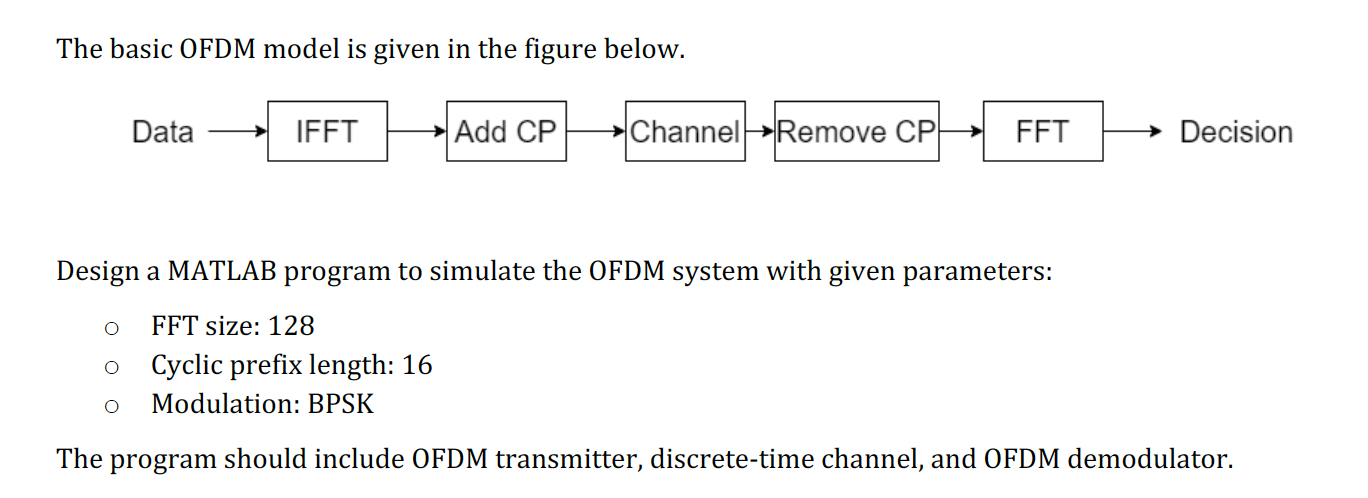
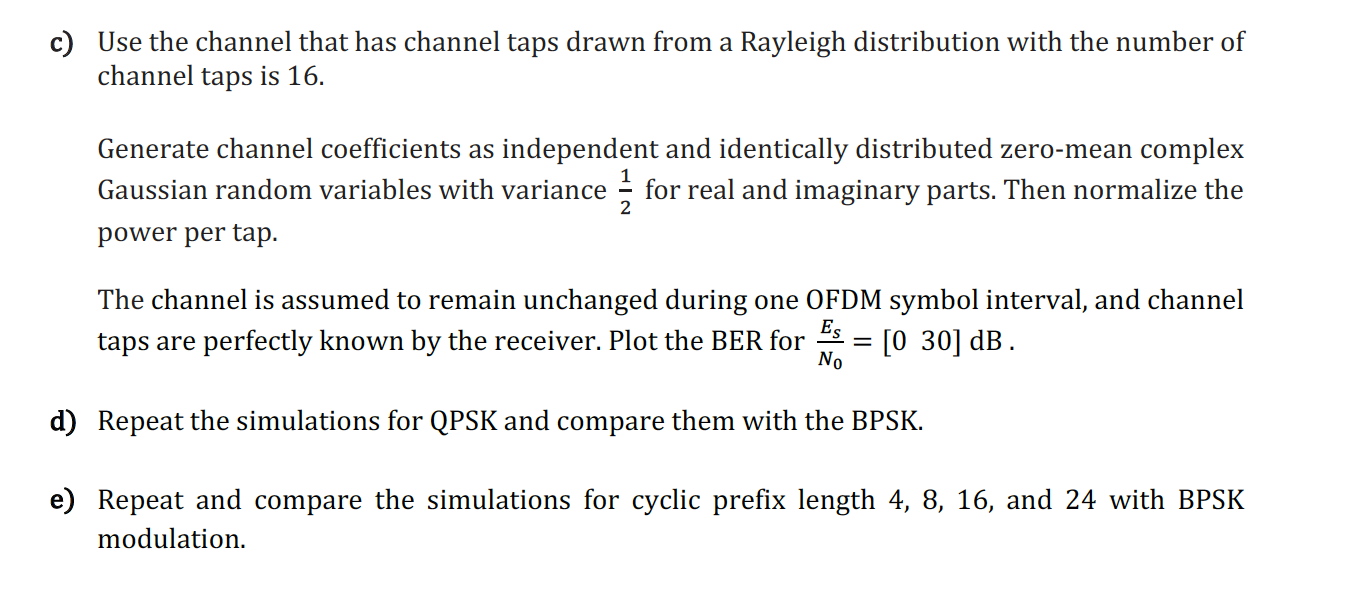
The basic OFDM model is given in the figure below. Data IFFT Add CP Channel>Remove CPH FFT Decision Design a MATLAB program to simulate the OFDM system with given parameters: FFT size: 128 Cyclic prefix length: 16 Modulation: BPSK O The program should include OFDM transmitter, discrete-time channel, and OFDM demodulator. c) Use the channel that has channel taps drawn from a Rayleigh distribution with the number of channel taps is 16. Generate channel coefficients as independent and identically distributed zero-mean complex Gaussian random variables with variance for real and imaginary parts. Then normalize the power per tap. The channel is assumed to remain unchanged during one OFDM symbol interval, and channel ES taps are perfectly known by the receiver. Plot the BER for = [0 30] dB. No = d) Repeat the simulations for QPSK and compare them with the BPSK. e) Repeat and compare the simulations for cyclic prefix length 4, 8, 16, and 24 with BPSK modulation. The basic OFDM model is given in the figure below. Data IFFT Add CP Channel>Remove CPH FFT Decision Design a MATLAB program to simulate the OFDM system with given parameters: FFT size: 128 Cyclic prefix length: 16 Modulation: BPSK O The program should include OFDM transmitter, discrete-time channel, and OFDM demodulator. c) Use the channel that has channel taps drawn from a Rayleigh distribution with the number of channel taps is 16. Generate channel coefficients as independent and identically distributed zero-mean complex Gaussian random variables with variance for real and imaginary parts. Then normalize the power per tap. The channel is assumed to remain unchanged during one OFDM symbol interval, and channel ES taps are perfectly known by the receiver. Plot the BER for = [0 30] dB. No = d) Repeat the simulations for QPSK and compare them with the BPSK. e) Repeat and compare the simulations for cyclic prefix length 4, 8, 16, and 24 with BPSK modulation
Step by Step Solution
There are 3 Steps involved in it

Get step-by-step solutions from verified subject matter experts
 Study Help