







Question: The Basic Principal-Agent Problem with non-linear contracts please read the question in the flowing picture A rm is hiring a worker to do a job
The Basic Principal-Agent Problem with non-linear contracts
please read the question in the flowing picture
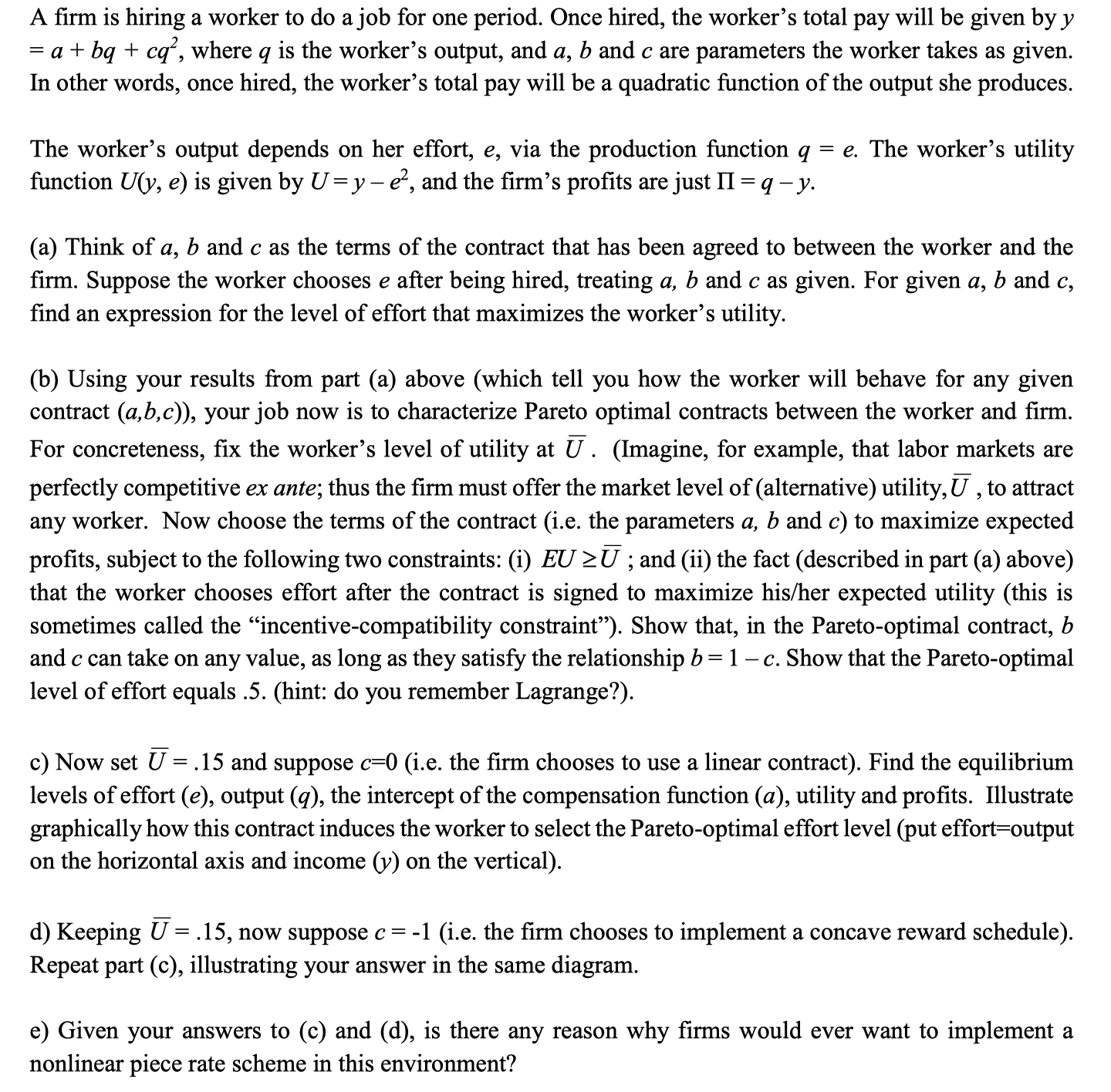
A rm is hiring a worker to do a job for one period. Once hired, the worker's total pay will be given by y = a + bq + of, where q is the worker's output, and a, b and c are parameters the worker takes as given. In other words, once hired, the worker's total pay will be a quadratic mction of the output she produces. The worker's output depends on her effort, 6, via the production function g = e. The worker's utility function U02, e) is given by U=y * 92, and the rm's prots are just H = q 7y. (a) Think of a, b and c as the terms of the contract that has been agreed to between the worker and the rm. Suppose the worker chooses e after being hired, treating a, b and c as given. For given a, b and 0, nd an expression for the level of effort that maximizes the worker's utility. (b) Using your results from part (a) above (which tell you how the worker will behave for any given contract (a,b,c)), your job now is to characterize Pareto optimal contracts between the worker and rm. For concreteness, x the worker's level of utility at [7 . (Imagine, for example, that labor markets are perfectly competitive ex ante; thus the rm must offer the market level of (alternative) utility, (7 , to attract any worker. Now choose the terms of the contract (i.e. the parameters a, b and c) to maximize expected prots, subject to the following two constraints: (1) EU 2 l7 ; and (ii) the fact (described in part (a) above) that the worker chooses effort after the contract is signed to maximize his/her expected utility (this is sometimes called the \"incentivecompatibility constraint\"). Show that, in the Paretooptimal contract, b and c can take on any value, as long as they satisfy the relationship I) = 1 i c. Show that the Paretooptimal level of effort equals .5. (hint: do you remember Lagrange?) c) Now set U = .15 and suppose c=0 (i.e. the rm chooses to use a linear contract). Find the equilibrium levels of effort (e), output (q), the intercept of the compensation function (a), utility and prots. Illustrate graphically how this contract induces the worker to select the Paretooptimal effort level (put effort=output on the horizontal axis and income (y) on the vertical). d) Keeping I7 = .15, now suppose c = 1 (i.e. the rm chooses to implement a concave reward schedule). Repeat part (c), illustrating your answer in the same diagram. e) Given your answers to (c) and (d), is there any reason why rms would ever want to implement a nonlinear piece rate scheme in this environment
Step by Step Solution
There are 3 Steps involved in it

Get step-by-step solutions from verified subject matter experts
 Study Help